
12 Link Building Mistakes That Are Costing SaaS Companies Revenue (Not Just Rankings)

I’ve worked with over 30 SaaS companies on link building. The ones who succeed and the ones who waste their budget almost always come down to the same handful of mistakes. Not complex, mysterious SEO problems. Basic, avoidable errors that burn cash every single month.
The frustrating part? Most of these companies aren’t incompetent. They’ve got solid products, good dev teams, and real marketing budgets. They’re just making decisions based on metrics that don’t mean what they think they mean.
93.8% of link builders say link quality is more important than quantity (Authority Hacker, 2024). That’s great in theory. In practice, most SaaS companies are still chasing numbers on a spreadsheet instead of building the kind of authority that actually moves pipeline.
This is the reality check. Twelve mistakes I see constantly, what they’re actually costing you, and how to fix each one.
Key Takeaways
- 93.8% of link builders prioritise quality over quantity, yet most SaaS companies still buy links based on inflatable DR/DA scores (Authority Hacker, 2024)
- A site’s DR can be inflated from 0 to 60 for under $50, making it a near-useless quality indicator on its own
- SaaS companies that tie link building to bottom-of-funnel pages see 14.6% close rates vs 1.7% for outbound leads (SimpleTiger, 2026)
- Link building is more relevant in the AI era, not less. Companies ranking in AI Overviews also have the strongest backlink profiles
- The best links come from relationships and editorial placements, not databases and marketplaces
Mistake 1: Buying Links Based on DR or DA Alone
This is the single biggest mistake I see in SaaS link building, and I genuinely cannot stress this enough. Domain Rating and Domain Authority are third-party metrics created by Ahrefs and Moz respectively. Google does not use them. They are approximations, and they can be manipulated for almost nothing.
I’m talking about Fiverr gigs. Literally $10-35 to inflate a site’s DR from zero to 50 or 60. One documented case showed a site paying $35 to reach DR 51, which then climbed to DR 60 within months, all while the site had zero organic traffic and ranked for nothing (Xamsor, 2024). Nathan Gotch from Gotch SEO Academy ran a similar experiment, taking a site from DR 0 to 70 using purchased links. The site still didn’t rank.
The metric itself is calculated based on the quantity and strength of backlinks pointing to a domain. That’s it. It doesn’t account for content quality, topical relevance, user engagement, or whether the site has a single real visitor. When you buy a link from a “DR 60 site” that you found in a marketplace, there’s a very real chance that DR was manufactured.
What to do instead: Look at the full picture. Does the site have real organic traffic? Is that traffic from keywords relevant to your niche? Does it have genuine content that humans actually read? Does it look like a real publication or a link farm wearing a suit? I’ll cover exactly how to evaluate this in the next two sections.
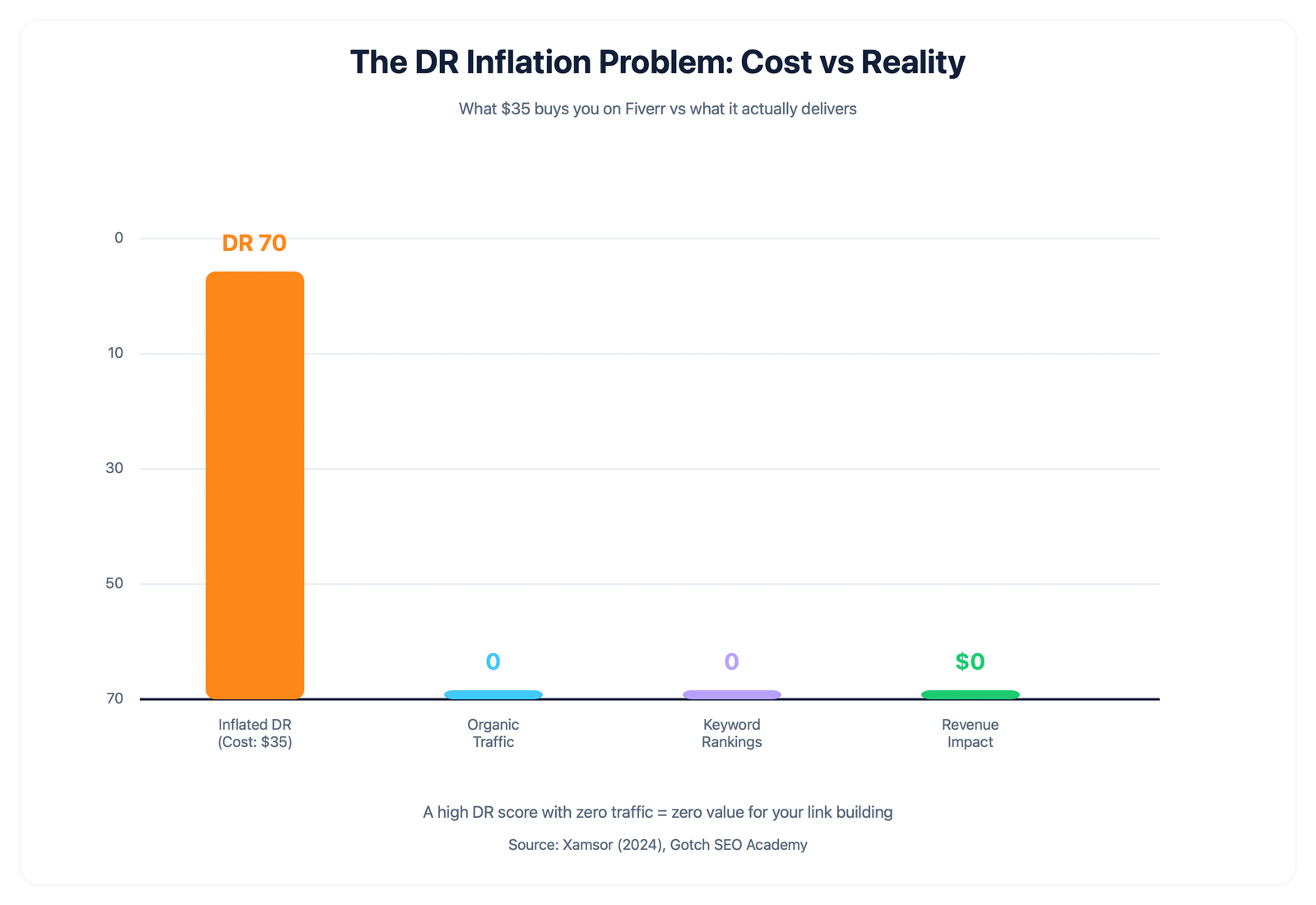
This is also the metric most likely to be waved at you in a sales pitch, which is why it belongs in any conversation about why domain rating is the wrong thing to compare agencies on.
Mistake 2: Evaluating Links on Organic Traffic Without Checking Keywords
So you’ve moved past DR. Good. The next thing most people graduate to is evaluating sites based on organic traffic. And look, that is better. A site with real organic traffic is at least a functioning website that Google trusts enough to send visitors to.
But here’s the problem: it depends enormously on what keywords are driving that traffic.
I see this constantly. A site shows 50,000 monthly organic visits and everyone gets excited. Then you look at what keywords are actually bringing in that traffic, and it’s things like “how to convert MP4 to MP3” or “free PDF editor online.” These are junk traffic keywords. They exist purely to inflate organic traffic numbers so the site can charge more for link placements.
If you’re a CRM company buying a link from a site like this, you need that site to rank for CRM-related keywords. The traffic needs to come from an audience that overlaps with your buyers. A link from a tech blog that ranks for “best CRM for small business” is worth ten times more than a link from a site with five times the traffic but zero topical relevance to your space.
What to do instead: Open Ahrefs or Semrush and look at the actual keywords driving traffic to any site you’re considering. Are those keywords relevant to your industry? Would the people reading that content potentially be your customers? If the answer is no, the link isn’t worth the money regardless of the traffic number.
Mistake 3: Buying Links From Database Marketplaces
This one seems really attractive in theory. You sign up to a link marketplace, browse through thousands of sites, filter by DR and traffic, pick your domains, and pay per link. Clean, simple, scalable.
The reality is different.
First, the pricing is massively inflated. These marketplace companies are adding enormous margins. A placement that might cost $50-100 if you approached the site directly will be listed at $300-500 through the marketplace. You’re paying for the convenience of a UI and a database, not for link quality.
Second, and this is the bigger problem, any link that’s available to you through a marketplace is available to absolutely everyone. Your competitors, their competitors, random affiliate sites, gambling sites, everyone. Google’s SpamBrain system is specifically designed to identify these patterns. When hundreds of unrelated sites all get links from the same set of domains, it’s not exactly subtle.
The links you actually need are the ones that aren’t sitting in a database waiting to be purchased. They’re built through relationships. Editorial contacts. Partnerships with other agencies. Relationships with marketers at SaaS companies. Genuine digital PR. The rule of thumb is simple: the harder a link is to get, the more valuable it will be.
At EMGI, we’ve built links on sites like Monday.com, HubSpot, and BigCommerce over the past year using exactly this approach. Not because those sites were listed in a marketplace, but because we’ve spent years building relationships with editorial teams and content managers in the SaaS space.
What to do instead: Build relationships before you need links. Engage with content managers on LinkedIn. Offer genuine value through data, quotes, or guest contributions. The best link building looks nothing like a transaction and everything like a partnership. If you’d rather skip the vetting, I’ve pulled together a breakdown of the SaaS link building agencies I rate that work this way rather than off a marketplace database.
There is a reason that supply is so cheap, and I have broken down what sits behind the fifty dollar placement alongside what a genuine negotiated link costs.
Mistake 4: Only Building Links to Blog Content
Pages with at least one backlink are 77% more likely to rank in the top 10 than pages with none (LinkBuildingHQ, 2026). But here’s the question nobody asks: which pages are you building those links to?
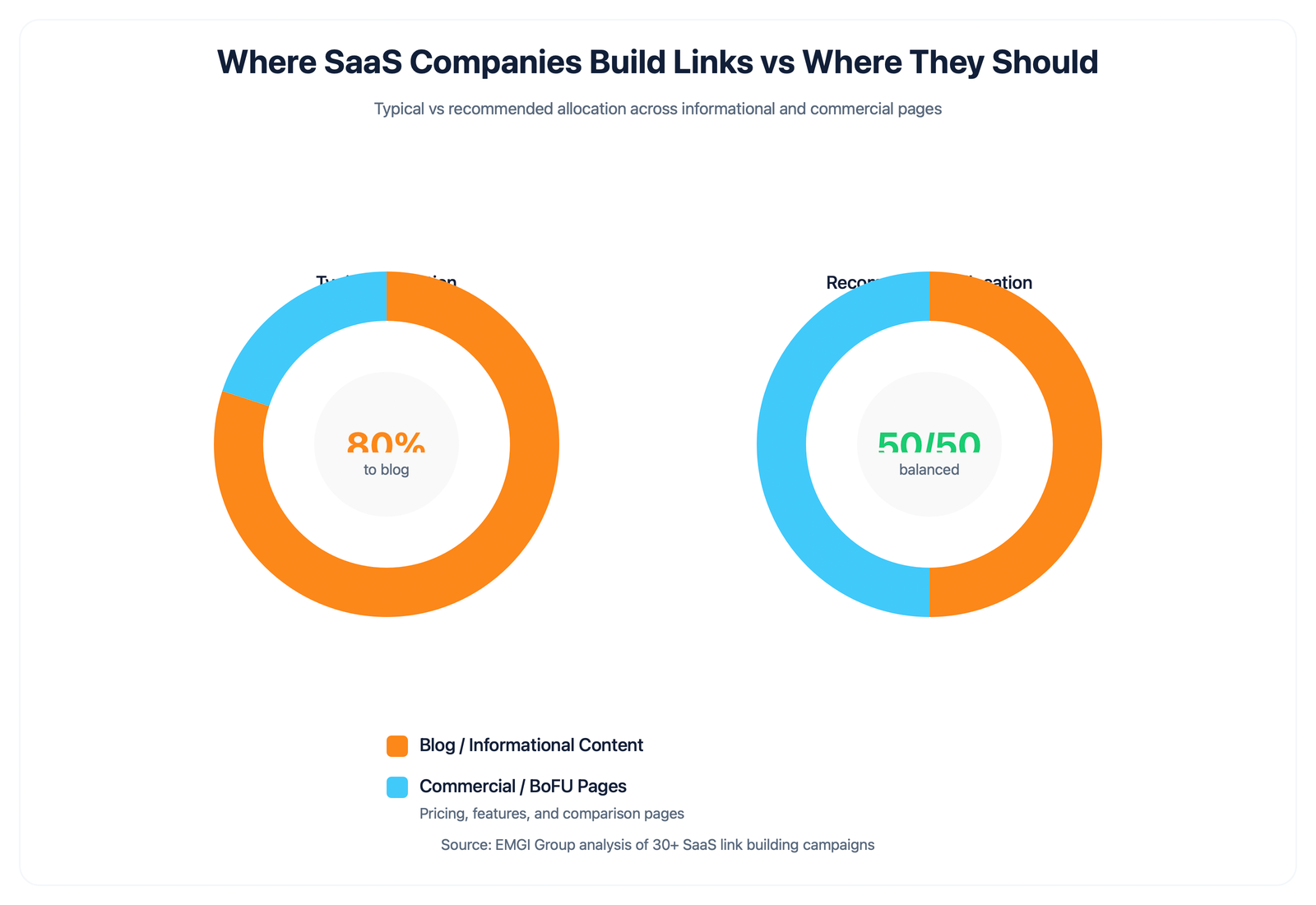
Most SaaS companies default to building links to blog posts. It makes sense on the surface. Blog content is informational, it’s easy to link to naturally, and it’s what most outreach agencies are set up to target. But blog posts don’t convert. They sit at the top of the funnel, catching informational queries from people who aren’t ready to buy.
The pages that actually drive revenue are your comparison pages, feature pages, pricing pages, and use-case landing pages. These are the bottom-of-funnel pages where buyers are making decisions. SEO leads from high-authority rankings have a 14.6% close rate compared to just 1.7% for outbound leads (SimpleTiger, 2026). That’s an 8.6x difference. But it only works if those commercial pages actually rank.
Building links exclusively to blog content is like training for a marathon but never actually running the race. The training helps your overall fitness, sure. Internal links from blog posts can pass some equity to your commercial pages. But nothing beats direct authority to the pages that actually make you money.
What to do instead: Every link building campaign should include a mix of targets. Yes, build links to flagship blog content. But also build links directly to comparison pages, feature pages, and use-case pages where possible. This is harder and requires more creative outreach, but the revenue impact is incomparably better.
Mistake 5: Not Tying Link Building to the Buyer Journey
This follows directly from mistake 4, but it’s a broader strategic problem. Link building should be part of your revenue engine — part of a broader off-page SEO strategy, not a separate SEO project running in isolation.
Every link building strategy, everything we believe in at EMGI, is that it should be tied to the buyer journey. What keywords are your buyers actually searching for when they’re discovering companies like yours? What pages do they land on before they sign up for a demo or start a free trial?
Those are the pages that need authority. Those are the keywords that need to rank. And link building is how you get them there.
Too many SaaS companies treat link building as a vanity metric exercise. “We got 20 links this month.” Great. Did any of them help a page that’s actually in your buyer’s journey? Did they move a commercial keyword? Did pipeline increase? If nobody can answer those questions, the link building programme isn’t tied to revenue. It’s just activity.
This is especially important in SaaS, which is one of the most competitive organic landscapes in the world. You’re not competing against small blogs. You’re competing against companies with $50,000/month content budgets and teams of 20 writers. The only way to win is to be surgical about where you build authority, and that means following the buyer journey.
What to do instead: Map your buyer journey first. Identify the 5-10 pages that directly contribute to conversions. Make those your primary link building targets. Measure success by ranking improvements on those specific pages, not by total links acquired. And before you commit to outreach, make sure the site itself is actually ready to convert the traffic — we run a full SaaS website audit before any campaign goes live.
Mistake 6: Thinking Link Building Is Less Important Because of AI
A useful counterweight: we wrote an honest review of the current AI visibility tool category so you can measure whether the work is landing. Links still matter, measurement closes the loop.
I hear this one more and more. “AI is changing search, so links don’t matter as much anymore. We should focus on brand mentions and being in Reddit threads instead.”
This is categorically wrong.
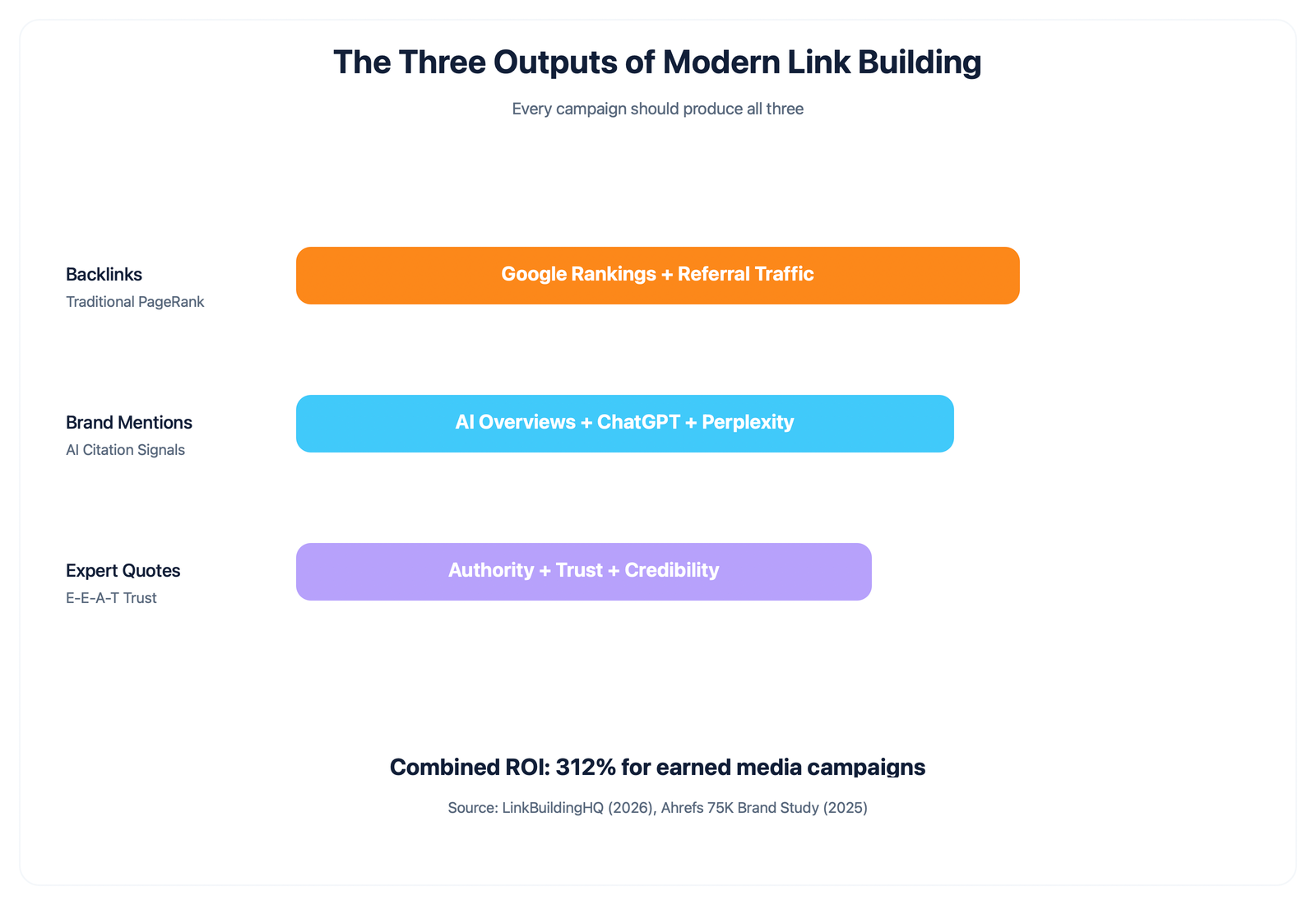
As our LLM SEO for SaaS guide explains, 73.2% of SEO experts believe backlinks directly influence whether a brand appears in AI Search Overviews (Editorial.Link, 2025). And the data backs it up. Research from Ahrefs covering 75,000 brands found that branded web mentions have a correlation of 0.656-0.709 with AI visibility, while backlinks still show a 0.218 correlation (Ahrefs, Dec 2025). Those aren’t competing signals. They’re complementary.
The vast majority of companies that rank well in AI search are also ranking well in Google. They didn’t get there by accident. They got there through massive authority building, including link building.
Here’s what’s actually happening: as AI has made it easier and easier to produce good content at scale, the only real differentiator in organic marketing has become authority. Everyone can write a decent blog post now. Not everyone has DR 70+ links from industry publications. Not everyone has been cited in Search Engine Land or featured on HubSpot’s blog.
This is why companies are going all-in on organic authority across every channel: YouTube, blogs, webinars, podcasts, and then distributing that content everywhere. Links are a core part of that authority stack. They’re not less relevant. They’re more relevant than ever because they’re harder to fake (despite what the DR manipulators might suggest).
What to do instead: Think of link building, brand mentions, and AI visibility as three layers of the same authority strategy. Don’t abandon links for mentions. Build both. Companies that do both are the ones appearing in both Google’s traditional results and AI Overviews.
Mistake 7: Ignoring Topical Relevance Entirely
A DR 40 link from a site in your exact niche will outperform a DR 70 link from a general site nine times out of ten. Topical relevance isn’t a nice-to-have. It’s the primary signal Google uses to evaluate link quality.
Think about it from Google’s perspective. If a well-known CRM review site links to your CRM product, that’s a credible editorial endorsement from a domain that Google already associates with the CRM topic. If a generic lifestyle blog with a random tech category links to you, Google has no topical connection to reinforce.
This is where the DR obsession causes the most damage. SaaS companies will choose a DR 65 general site over a DR 35 industry-specific publication every time because the number is bigger. They’re optimising for the wrong metric.
LLMs are making this even more pronounced. AI systems prioritise contextual relevance and editorial quality when selecting sources to cite (Search Engine Land, Jan 2026). A link from a topically relevant source signals to both Google and AI systems that your content is authoritative in that specific domain.
What to do instead: Build a target list based on topical relevance first, then filter by quality metrics. A link from a niche SaaS review site, an industry newsletter, or a competitor’s resource page is worth more than a link from a high-DR generalist site.
Mistake 8: Worrying About Penalties When You Should Worry About Wasted Money
Here’s something a lot of people get wrong about bad backlinks. The common fear is that buying low-quality links will get your site penalised, that Google will actively punish you and tank your rankings.
The reality in 2026 is different, and in some ways it’s worse. Google’s SpamBrain system is designed to “neutralize the impact of unnatural links” rather than penalise the receiving site (Google Search Central, 2022). What this means in practice is that bad links are simply ignored. They don’t hurt you. They just don’t do anything.
That sounds fine until you realise what it actually means for your budget. You’ve spent $500 on a link that Google has completely neutralised. It wasn’t penalised. It just evaporated. The money is gone, the link exists on paper, and your rankings haven’t moved a millimetre.
This is the modern cost of bad link building. It’s not a dramatic penalty and a frantic disavow process. It’s a slow bleed of budget into links that Google quietly ignores while your competitors invest in links that actually work.
Sites using manipulative tactics now face algorithmic devaluation that can happen in minutes, not months, thanks to SpamBrain’s real-time processing (Blue Tree Digital, 2026). And here’s the kicker: link-based ranking gains are permanently neutralised once Google’s systems identify and discount those links.
What to do instead: Stop worrying about penalties and start worrying about ROI. Track which links actually move rankings. If a link source consistently produces zero movement, stop buying from it regardless of the metrics.
Mistake 9: Treating Link Building as a One-Off Project
78.1% of SEO professionals report a positive ROI from link building (LinkBuildingHQ, 2026). But that ROI comes from consistent, sustained effort, not from a one-month burst of 30 links followed by nothing.
Link building compounds. The authority you build in month one makes month two’s links more effective. A steady cadence of 5-10 quality links per month will dramatically outperform a one-off blast of 50 links, even if the total count is lower over the same period.
I see SaaS companies do this constantly. They’ll run a three-month campaign, see some improvement, declare link building “done,” and move the budget somewhere else. Six months later, their competitors have overtaken them because those competitors never stopped building.
Your competitors aren’t stopping. In the SaaS space, the companies that dominate organic search, the ones ranking for the high-intent commercial keywords, are building links every single month. They’ve been doing it for years. You can’t match that with a quarterly burst.
What to do instead: Commit to a minimum 6-12 month link building programme. Budget for consistency, not volume. Five quality links per month for twelve months will generate more revenue than fifty links in one month followed by silence.
Mistake 10: Using Generic Anchor Text Everywhere
Anchor text tells Google what the linked page is about. If every link pointing to your pricing page says “click here” or “visit website,” you’re wasting the most valuable signal a backlink carries.
On the other end of the spectrum, if every link uses the exact keyword “best CRM software pricing,” that’s an obvious manipulation signal. Google’s algorithms are specifically tuned to detect unnatural anchor text patterns.
The sweet spot is natural variation. A healthy anchor text profile includes branded anchors (“EMGI Group”), partial-match anchors (“SaaS link building services”), generic anchors (“this guide”), URL anchors, and the occasional exact-match anchor. The ratio should look organic, like what would naturally happen if different people linked to you for different reasons.
What to do instead: Aim for roughly 40-50% branded anchors, 20-30% partial-match, 10-15% generic, and no more than 5-10% exact-match. Vary it naturally. If your anchor text profile looks like a spreadsheet formula, it’s wrong.
Mistake 11: Ignoring AI Overviews and Brand Mentions as Link Outcomes
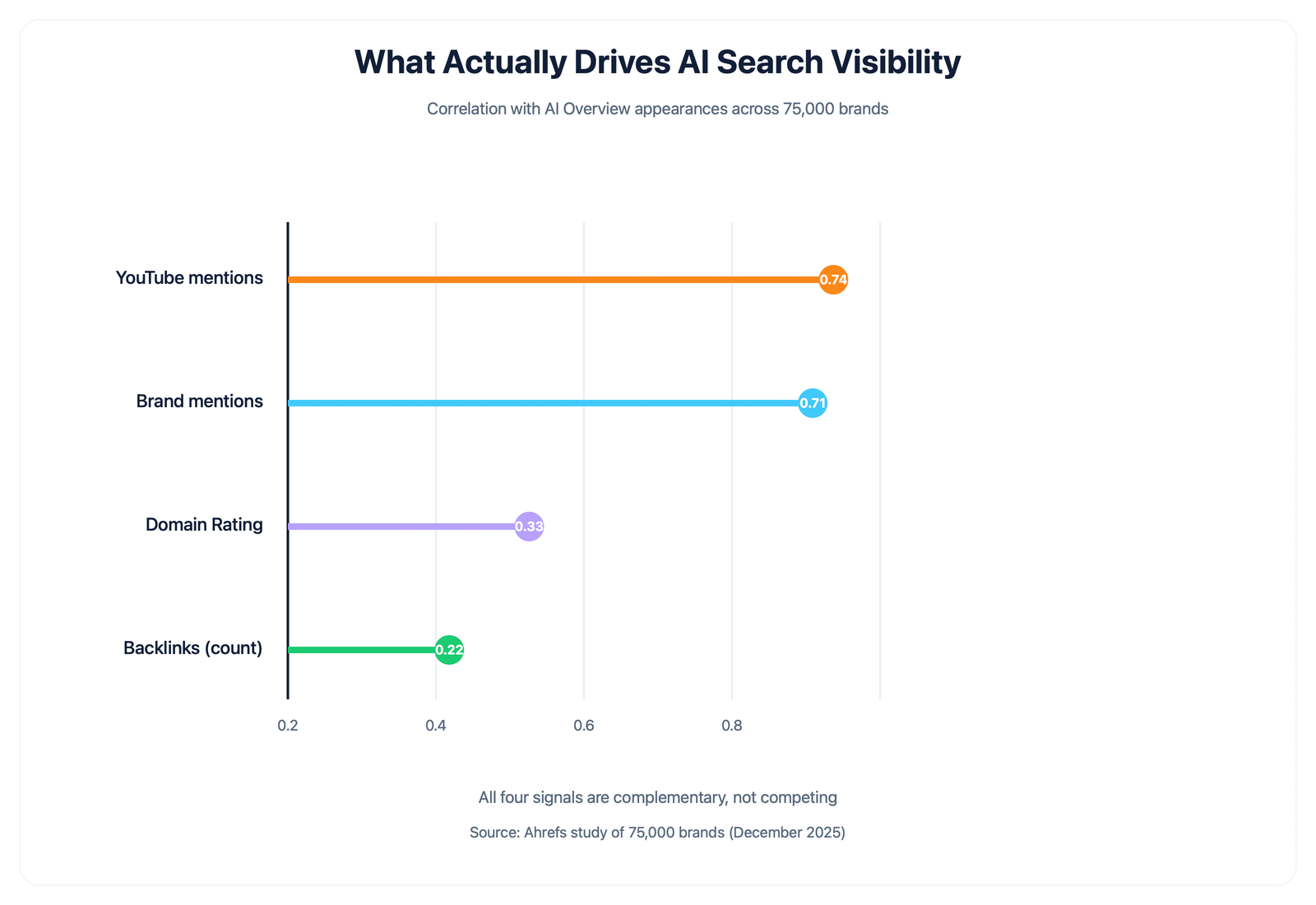
Link building in 2026 isn’t just about PageRank. When your brand gets mentioned in a high-quality article, even without a direct link, that mention feeds into AI systems. Brand mentions have a stronger correlation (0.664) with AI Overview appearances than backlinks alone (0.218) — a signal mapped in our SaaS AI citation gap report (Position.digital, 2026).
This means your link building campaigns should be generating more than just links. They should be generating brand visibility across the publications and platforms that AI systems crawl and cite.
A digital PR campaign that lands you a mention in Search Engine Journal, a quote in a SaaS industry report, and a link from a niche blog has produced three different types of authority signal. The link passes traditional equity. The mentions feed AI citation systems. The quote builds E-E-A-T.
Brands utilising earned media and digital PR strategies report an average ROI of 312% (LinkBuildingHQ, 2026). That’s because they’re capturing value across multiple channels from a single campaign.
What to do instead: Expand your definition of “link building outcomes” to include brand mentions, quotes, and citations. Track these alongside traditional backlink metrics. A mention in a high-authority publication without a link is still valuable for AI visibility.
Mistake 12: Not Measuring Revenue Impact
This is the mistake that ties all the others together. If you can’t draw a line from your link building spend to revenue, you’re flying blind.
SaaS firms see an average 702% ROI from SEO investment, with most breaking even at around 7 months (LinkQuest, 2025). But that’s the average. The companies that track properly and optimise their campaigns see much higher returns. The ones that don’t track properly often see zero return because they don’t know what’s working and what isn’t.
Here’s the measurement framework we use with every EMGI client:
- Baseline rankings for target keywords before the campaign starts
- Weekly rank tracking on the specific pages receiving links
- Monthly organic traffic to those pages (not sitewide, page-level)
- Pipeline attribution from organic search to demo requests or signups
- Revenue per link calculated by dividing total link spend by attributed revenue
If your agency can’t tell you which links moved which keywords, and how that translated into traffic and pipeline, then you’re paying for activity reports, not results.
Most marketers allocate 28-36% of their total SEO budget specifically to link building (LinkBuildingHQ, 2026). That’s a significant chunk of budget. It deserves the same level of measurement rigour as your paid acquisition channels.
What to do instead: Set up conversion tracking that connects organic landing pages to pipeline. Use UTM parameters and CRM attribution to close the loop. If your link building agency can’t show you revenue impact, find one that can.
The Revenue Impact Framework: Scoring Your Link Building Programme
Not sure if you’re making these mistakes? Here’s a quick self-assessment. Score your current link building programme across these dimensions:
| Dimension | Red Flag (0 pts) | Acceptable (1 pt) | Best Practice (2 pts) |
|---|---|---|---|
| ———– | —————— | ——————– | ———————– |
| Link evaluation | DR/DA only | DR + traffic | DR + traffic + keyword relevance + topical fit |
| Link sources | Marketplace only | Mix of marketplace and outreach | Relationship-based editorial placements |
| Target pages | Blog only | Blog + homepage | Blog + commercial pages (pricing, features, comparisons) |
| Buyer journey | No alignment | Partial alignment | Every link targets a buyer journey page |
| AI signals | Links only | Links + some mentions | Links + mentions + quotes + brand visibility |
| Measurement | Link count only | Rankings tracked | Revenue attribution per link |
| Consistency | One-off projects | Quarterly campaigns | Monthly sustained programme |
| Anchor text | All exact-match | Some variation | Natural profile with branded dominance |
Score interpretation:
- 0-5: Your link building is likely burning money. Start with mistakes 1-3.
- 6-10: Solid foundation but significant revenue left on the table. Focus on mistakes 4-6.
- 11-16: You’re in the top tier. Optimise for AI visibility and measurement precision.
FAQs
What Is the Biggest Link Building Mistake SaaS Companies Make?
Buying links based solely on Domain Rating (DR) or Domain Authority (DA). These metrics can be inflated from zero to 60 for under $50, making them unreliable quality indicators. A site with high DR but zero relevant organic traffic provides negligible SEO value. Always evaluate topical relevance, keyword traffic, and editorial quality alongside any metric.
Does Link Building Still Matter for AI Search?
Yes, more than ever. 73.2% of SEO experts believe backlinks influence AI Search Overview appearances (Editorial.Link, 2025). Companies ranking well in AI search consistently have strong backlink profiles. As content creation scales with AI, authority signals like backlinks have become the primary differentiator.
How Much Should SaaS Companies Spend on Link Building?
Most SaaS companies allocate 28-36% of their total SEO budget to link building. More important than the amount is the consistency: 5-10 quality links per month over 12 months will outperform a one-off batch of 50 links. SaaS firms see an average 702% ROI from SEO investment, with link building as a core component.
Should I Disavow Bad Backlinks?
In most cases, no. Google’s SpamBrain now neutralises low-quality links automatically rather than penalising the receiving site. The real cost of bad links isn’t a penalty: it’s wasted budget on links that get quietly ignored. Focus your energy on building better links rather than disavowing old ones.
How Do I Measure Link Building ROI?
Track five metrics: baseline rankings for target keywords, weekly rank movements on linked pages, page-level organic traffic changes, pipeline attribution from organic search, and revenue per link (total spend divided by attributed revenue). If you can’t connect links to pipeline, your measurement needs work.
Matt Emgi is the founder of EMGI Group, a SaaS link building agency based in the UK. He’s built links for 30+ SaaS companies across Europe, North America, Asia, and Australia. He believes every link should drive revenue, not just rankings, and that the best links come from relationships, not marketplaces. Connect on LinkedIn.