
How to Get Your SaaS Cited by ChatGPT, Perplexity and Google AI Overviews
Want more from EMGI in your Google results? Add us as a preferred source.
A SaaS buyer opens ChatGPT on a Tuesday night and asks for the best tool in your category, under their budget, on their stack. The model answers with three or four brands by name. By the time your BDR calls on Friday, the shortlist is locked. If you were not in that answer, you were never in the deal.
This guide is the full playbook for getting cited: how AI systems choose brands, the seven layers that decide whether you appear, and the exact five-step workflow I run inside ChatGPT for paying clients. I have spent the last two years building these campaigns at EMGI alongside traditional link building, and our own research across 150 SaaS companies found that 44% of brands ranking on page one of Google are completely invisible to ChatGPT on their most important commercial queries. The SEO was done. The shortlist still got built without them.
Everything below is the do-it-yourself version of what we run as our LLM SEO service for SaaS. Steal it, run it in-house, or skip to the end if you would rather hand it over.
Key Takeaways
– Brand mentions correlate 0.664 with AI visibility, 3x stronger than backlinks at 0.218 (Ahrefs, Aug 2025)
– 48% of Google queries now trigger AI Overviews, reshaping how SaaS buyers discover tools
– LLM SEO is not a replacement for traditional SEO; it’s a parallel discipline that rewards authority, not keywords
– The playbook: a seven-layer GEO model plus a five-step ChatGPT workflow, built on structured content and off-page authority
– SaaS companies building AI citation strategies now will compound advantages over 12-24 months
What Is LLM SEO (And Why Should SaaS Companies Care)?
LLM SEO is the practice of optimising your brand presence so AI systems cite you in their generated responses. It’s also called GEO (generative engine optimisation) or AI search optimisation. 45% of B2B buyers used AI tools during a recent purchase (Gartner, 2025), and that number climbs every quarter.
If you want to see why memory matters so much, our live experiment on how ChatGPT picks software shows the model answering buying questions without searching at all.
Think of it like this. Traditional SEO gets you into the list. LLM SEO gets you into the answer. It’s the difference between being on the shelf and being the one the shopkeeper recommends by name. When a SaaS buyer asks ChatGPT “what’s the best HRIS for remote teams under 200 employees,” the response doesn’t return ten blue links. It returns a paragraph naming two or three products, with reasons why each fits. That’s an AI citation, and it’s increasingly where purchase decisions start.
The terminology can get confusing. LLM SEO, GEO, generative engine optimisation, AI SEO; they all describe roughly the same discipline. The core idea is consistent: make your brand the one that AI systems reference when your category comes up.
In our experience running these campaigns, I’ve noticed that SaaS companies have a natural advantage here. You already produce structured documentation, comparison pages, and technical content. That content is exactly what LLMs prefer to extract and cite. The challenge isn’t creating content from scratch. It’s restructuring what you already have so AI systems can find and trust it.
Traditional SEO vs LLM SEO: A Quick Comparison
| Factor | Traditional SEO | LLM SEO |
|---|---|---|
| Goal | Rank in search results | Get cited in AI responses |
| Primary signal | Backlinks | Brand mentions + authority |
| Content format | Keyword-optimised pages | Answer-first, citable passages |
| Success metric | Rankings, CTR, traffic | Citation rate, share of voice |
| Timeframe | 3-6 months | 6-12 months |
| Keyword role | Central (density, placement) | Minimal (concepts, entities) |
Why does this matter right now? Because by 2028, Gartner predicts 90% of B2B buying will be AI-agent intermediated (Gartner, Nov 2025). The SaaS companies that build citation authority now won’t just have a head start. They’ll have a moat. And if you’ve read our piece on reputation management and brand authority, you’ll recognise the pattern: the signals that shape how Google sees your brand are the same signals shaping how AI describes it.
LLM SEO, also called GEO or generative engine optimisation, is the practice of optimising brand presence for AI citation rather than search rankings. 45% of B2B buyers now use AI tools during purchases (Gartner, 2025), making AI visibility a direct revenue driver for SaaS companies.
Why Your SaaS is Invisible in ChatGPT
In this video:
- A real buying query typed into ChatGPT live, and which brands appear when your buyer shortlists tools
- Why Google rankings and AI visibility are different games: one time-tracking tool ranks for 6x more keywords yet loses almost every AI search query
- The strongest signal for AI citations: in-context third-party brand mentions, in the articles AI actually reads when it assembles an answer
How Is LLM SEO Different From Traditional SEO?
Traditional SEO optimises for clicks from a list of links. LLM SEO optimises to become the answer within a generated response. AI Overviews now appear in 48% of Google queries (BrightEdge, Feb 2026), which means nearly half of all searches already blend both worlds.
The ranking factors are fundamentally different. LLMs don’t read your meta description. They don’t care about your title tag length. They don’t reward keyword density. What they do reward is authority, recency, structured answers, and entity clarity. If your content clearly establishes what your product does, who it serves, and why it’s credible, LLMs can work with that.
Here’s a sharper breakdown:
| What LLMs Reward | What LLMs Ignore |
|---|---|
| Brand authority and consistency | Keyword density |
| Recent, updated content | Meta tag optimisation |
| Structured, extractable answers | Title tag character count |
| Entity clarity (consistent naming) | Internal anchor text variation |
| Third-party validation (reviews, mentions) | Page speed (directly) |
But here’s what catches people off guard. There’s significant overlap between the two disciplines. Domain authority still matters for both. Backlinks still signal trust. A site with strong traditional SEO has a foundation that LLM SEO builds on. You don’t abandon one for the other. You run them in parallel.
The biggest misconception I see from SaaS marketers is treating LLM SEO as a content formatting exercise. “Just add FAQ schema and you’re done.” That’s maybe 20% of the picture. The other 80% is what happens off your site: who mentions you, where they mention you, and what context surrounds those mentions. If you want the full breakdown of those off-page signals, we’ve got a complete off-page SEO checklist for SaaS that covers both traditional and AI-facing signals.
Traditional SEO drives clicks from search result listings, while LLM SEO drives citations within AI-generated responses. With 48% of Google queries now triggering AI Overviews (BrightEdge, Feb 2026), SaaS companies need both disciplines running simultaneously.
Why are most SaaS brands invisible in AI search?
The 44% invisibility number from our SaaS AI Citation Gap Report surprised me when we first ran it. These are brands ranking on page one of Google for their target commercial terms. The SEO work was done. The authority was there. And yet on a ChatGPT prompt like “best project management tool for remote engineering teams”, they did not appear. At all.
Three structural reasons SaaS is more exposed than other categories.
Long consideration windows
Enterprise SaaS buying cycles commonly run 6 to 18 months. Mid-market is shorter, SMB shorter still, but the enterprise end of the market is the part that sets the shape. Buyers research upstream of the vendor website. If the first-touch question happens inside ChatGPT on a Tuesday night, and you are not cited, you do not enter the evaluation. By the time the buyer hits your homepage weeks later, they arrived because somebody else’s citation pulled them.
Buying committees each use AI differently
In a typical SaaS purchase, you are not selling to a person, you are selling to a committee. The IC runs the first prompts, building a shortlist. The VP checks reputation signals and cross-references with Reddit. The CFO asks the model for risk flags. Finance asks about pricing. Each stakeholder runs different prompts on different surfaces. Winning in one does not cover the others.
Trust-critical categories over-index on AI shortlists
Fintech, healthtech, and developer tools all show heavier AI-first shortlisting in our data. These are categories where a wrong choice hurts, so buyers outsource the first filter to a model that “feels” unbiased. Here is the irony, and it is worth sitting with. People genuinely believe AI is more objective than a Google search. The reality is the opposite. A Google SERP shows you ten results and lets you pick. An LLM hands you three names inside a sentence and presents them as if the model reasoned its way to the answer. It did not. It surfaced whichever sources it has been trained to trust, weighted by citations, and wrapped the output in the tone of a confident human. Buyers who would scroll past an ad on Google now accept the first model output at face value. The perceived objectivity is higher, the actual objectivity is lower. Which brings us to the invisible shortlist problem.
The invisible shortlist. If you are not cited when the IC first prompts ChatGPT on a commercial term, you do not make the evaluation. Your competitors are having a conversation with your buyer that you never see.
The good news: this is solvable. Not overnight, not with one tactic, but systematically. The seven-layer model below is how I structure the work for our retainer clients.
The two levers that actually move AI citation rate
Before the full model, the short version. Across every client engagement we run, two moves sit a full tier above everything else.
If I could only do two things for a SaaS client, these are the two.
- Get brand mentions, particularly semantic mentions, inside the articles you want to appear in. Not links. Mentions, in context, alongside the category claim or the comparison. A hyperlink is a bonus. The named mention is the signal.
- Target the companies already cited as sources for your most important queries. Look at who ChatGPT cites when you run your buyer prompts. That list is your off-page target set. Backlinks and guest posts on those exact sites are hard to earn but move the needle more than anything else I have tested.
Everything in the rest of this article is in service of these two. If you remember nothing else, remember them in that order.
Most AI SEO guides tell you to add FAQ schema, write an llms.txt file, and mention your brand more often in your own content. Those moves are fine. They are also marginal. The two levers above sit a full tier above every other tactic in terms of measurable citation lift. I am stating that flatly because I have watched it play out across ten active client engagements.
We have also shown this mechanic live, ringed screenshots and all, in a buyer-level breakdown of how AI answers get assembled.
Does any of this contradict Danny Sullivan’s “good SEO is good GEO” position? Partly. Authority still wins at the macro level. But the Sullivan line misses the fact that LLMs reward semantic context and specific source citation, not just domain rating. A weaker site with the right named mention in the right comparison article can beat a stronger site with neither. I have receipts. The ten wins further down this article are the receipts.
What Ranking Factors Drive AI Citations for SaaS Companies?
Brand mentions correlate 0.664 with AI visibility, roughly 3x stronger than backlinks at 0.218 (Ahrefs, Aug 2025). That single data point reshapes how SaaS companies should think about their off-page strategy. Links still matter. But mentions matter more for AI. We tested this pattern in our own research: the SaaS AI Citation Gap Report analysed 150 SaaS companies and found 44% of Google’s top-ranking brands are completely invisible to ChatGPT.
The strongest single signal? YouTube mentions, which correlate at 0.737 with AI visibility (Ahrefs, Dec 2025). This makes sense when you consider how LLMs are trained. They ingest text from across the web, including video transcripts, podcast show notes, review platforms, and forum discussions. Every time someone mentions your brand in a YouTube video transcript, that’s a signal the model absorbs.
Review platform presence acts as a citation multiplier. SaaS companies with active profiles on G2, Capterra, and TrustRadius appear 2.6 to 3.5x more often in AI responses than those without. The platforms themselves rank well in traditional search too, so this is a double win.
Content recency also plays a role. LLMs favour recently updated content, especially for technology topics where products evolve quickly. A two-year-old comparison page carries less weight than one updated last quarter.
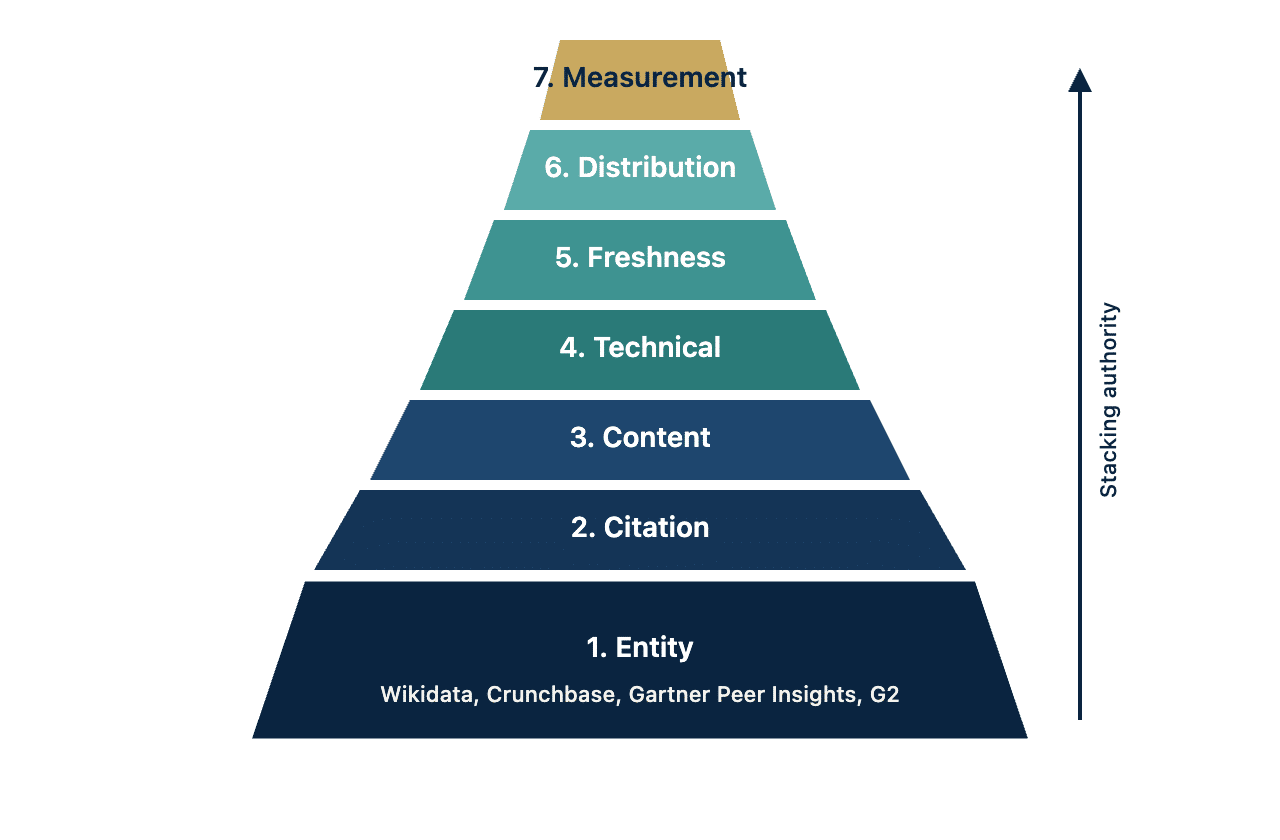
The seven-layer GEO model for SaaS
Most GEO guides in circulation use six layers. I added a seventh (Distribution) after watching one specific pattern play out across EMGI’s client base: original research that lives quietly on a client blog does not get cited. The same research, amplified through podcasts, LinkedIn, guest posts, and expert quotes, gets picked up by LLMs inside weeks. Authority compounds when it is visible. Distribution is how that happens.
The layers, in working order:
- Entity
- Citation
- Content
- Technical
- Freshness and searchability
- Distribution
- Measurement
Layer 1: Entity. Can an LLM tell who you are?
Entity recognition is the foundation. If an LLM cannot resolve your brand into a clear, disambiguated entity with a category, a product, a founding team, and a set of facts, it will not cite you. Wikidata, Crunchbase, LinkedIn Company pages, and Gartner Peer Insights are the canonical sources. The deeper mechanics of how machines resolve brands are in our entity SEO explainer. Our follow-up research on how directory listings and backlinks compound for AI search citations, plus the per-category subreddit map of Reddit visibility in Google AI Overviews, shows the same pattern across 137 SaaS brands.
The entity sources most SaaS companies miss
- Wikidata. Not Wikipedia. Wikidata, the structured knowledge graph Wikipedia runs on. LLMs pull entity facts from it directly. Most SaaS brands do not have a clean Wikidata entry.
- Crunchbase. Funding, founders, product category. Often outdated. Update it.
- Gartner Peer Insights. Expensive to cultivate, disproportionate payoff. Our data shows it lifts ChatGPT citations more than any other single directory.
- G2, Capterra, Software Advice. Volume of reviews matters more than star rating. Apollo.io sits on 19 directories with 24,730 reviews and zero ChatGPT citations on CRM queries, because the category tagging says “sales engagement” and not “CRM”. Get the category right first.
Entity is a one-off sweep you do once and maintain quarterly. It is also where most SaaS teams leave money on the table. Our off-page SEO checklist covers the mechanics.
Layer 2: Citation. Who vouches for you in the sources LLMs trust?
Citation is where most of the SaaS GEO work happens. Semrush’s June 2025 analysis found that Reddit contributes roughly 40% of AI citation share across ChatGPT search answers (Semrush, 2025). That single stat should reshape how SaaS marketing teams think about earned media.
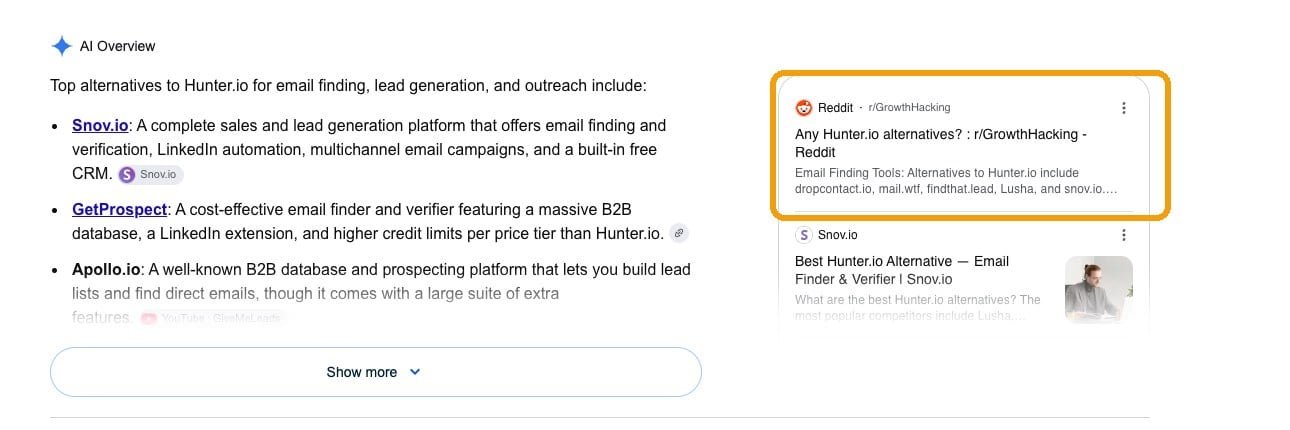
The citation layer is where link builders win by default. If you already have an earned-media practice, you are 80% of the way there. The other 20% is about which sources you target.
The sources LLMs over-cite for SaaS
- Reddit threads in relevant subreddits. r/SaaS, r/sales, r/devops, vertical-specific subs. Not spam, genuine practitioner answers.
- Niche industry publications. Often lower DR than you expect, but topical authority is high.
- High-DR SaaS review sites. G2, Software Reviews, Crozdesk, TrustRadius. Our data shows Software Reviews and Crozdesk punch above their weight.
- Expert podcasts and YouTube. Both are citation surfaces in their own right. ChatGPT and Gemini pull transcripts. A 40-minute podcast mention becomes a durable entity association that a backlink alone cannot match.
- Medium and similar open publication platforms. High domain authority, low editorial friction. LLMs trust them disproportionately given how easy they are to publish on.
- Parasite placements. Forbes, Entrepreneur, trade publications. Charles Floate has been publishing detailed LinkedIn breakdowns on how parasite SEO still works in 2026, despite Google’s repeated attempts to crack down on the tactic. His posts are worth reading end to end. The short version: a well-placed article on a parasite host still outranks and out-cites most owned content, because the model reads host authority, not author motive.
There is a second layer to this most SaaS teams miss. A parasite placement is not just a backlink. It is a brand mention, an entity association, and a perceived-authority signal stacked on top of the link value. An LLM reading Forbes does not just pass link equity back to your domain. It reads “X is the kind of company Forbes writes about”, and that semantic weight sticks. Treat every earned citation as three signals at once: link, entity, authority.
In our web scraping SaaS client engagement, we focused on DR 65+ sites as the anchor quality filter. Long-tail queries started ranking inside AIO after the link work, even though those queries were not the direct targets. That is the whole-site authority distribution effect. It is not a “one link equals one page ranks” story, it is a systemic authority lift that LLMs then read as a signal.
I wrote a full piece on why high-authority backlinks still matter for anyone wanting the deeper argument.
Layer 3: Content. Are your pages shaped for passage extraction?
LLMs cite passages, not pages. Your content has to be structured so that a 40 to 80 word chunk can be lifted cleanly into an answer with the citation pointing back at you. This is a writing craft problem, not a technical problem, and most SaaS teams over-engineer it.
The pattern I use on every piece of priority content:
- Question as the heading (or a direct rephrasing of how a buyer would ask it).
- Direct answer in the opening sentence, 20 words or fewer.
- Evidence in the next sentence, ideally with a named data point and a source.
- One concrete example, short, specific, SaaS-relevant.
If you look at this article, every H2 follows that shape. It is not accidental. It is how the passage-extraction game is played.
Original data is the shortcut for smaller brands
Here is the single most important tactical observation I have made in the last 12 months. LLMs love citing data. Specifically, they love citing data that no other source carries, on topics the model has been asked about. Our SaaS AI Citation Gap Report is the clearest example I have. Minimal distribution. No PR push. A small email list and two LinkedIn posts. It was picked up inside ChatGPT within a week of publishing. We are not Ahrefs. We are not Search Engine Journal. The semantic value landed because the data was original and useful.
The flywheel effect is what makes this valuable long after the first citation. The report has already brought us new backlinks from writers citing our stats inside their own articles. Those backlinks pass authority back to the domain, which lifts every other page, which increases the chance of further AI citations on unrelated prompts. One piece of original research compounds into ongoing authority, ongoing citations, and ongoing pipeline. This is the flywheel in practice. Not theory.
This is the opening for smaller SaaS brands. You cannot outspend HubSpot on authority. You can publish something HubSpot has not published.
Comparison pages are the highest-ROI content format
A disproportionate share of the citation wins we track sit on comparison queries (“X vs Y”, “alternative to X”). Build those pages, seed the anchor corpus on G2, Software Advice, and Slashdot, and you set up a flywheel where the model cites your own comparison page as a source for adjacent comparison queries. Semantic positioning is what makes this work. Linear gets cited as “the PLG-friendly alternative to Jira”. Basecamp gets cited as “the async-first option for distributed teams”. The phrase is not a tagline, it is a semantic handle the model latches onto because it solves the buyer’s query in three words. If your comparison content gives the model that handle, you get cited on adjacent prompts you never explicitly targeted.
Layer 4: Technical. What crawlers can reach you, and what structure do they see?
The technical layer has the smallest single-lift of the seven, but it is a floor you cannot skip. Get this wrong and everything else compounds less. Get it right and the work moves to citation, content, and distribution.
Honest caveat first. I have seen plenty of sites rank perfectly well with mediocre technical SEO. Core Web Vitals are important but rarely decisive. Schema helps but is not a silver bullet. The hygiene list below matters less than content and citations on most engagements. Two exceptions, both non-negotiable.
The technical stack that matters for GEO
- Schema. Organization, Product, FAQ, HowTo, BreadcrumbList. Priority order. The first three are non-negotiable.
- robots.txt posture. Explicitly allow GPTBot, ClaudeBot, PerplexityBot, Google-Extended unless you have a strategic reason to block. Most SaaS teams block by accident.
- JavaScript rendering. This is the one technical bar that actually kills you in AI search. LLM crawlers are meaningfully worse at JS than Googlebot. A lot of the “vibe-coded” websites I see built on modern JS frameworks have not been optimised for rendering at all, and their pricing, features, and comparison copy exist only in the client-side bundle. If a crawler cannot read the passage, it cannot cite the passage. Full stop. Server-render or pre-render the commercially important content or accept that you are invisible to most AI surfaces. I cannot overstate this.
- Internal linking. The other non-negotiable. The same principles that pass link equity pass entity context. LLMs map sites through your internal link graph, and the graph tells the model which pages are important and how they relate. Getting internal linking sorted properly is worth a tonne of good backlinks. I have seen sites with mediocre off-page profiles outrank heavier competitors on the strength of internal linking alone. If you do one technical thing this quarter, audit the link graph.
- llms.txt. Overrated. No hard evidence LLMs respect it meaningfully. We run one on emgigroup.com because it takes an hour and cannot hurt. Position it as covering bases, not as a silver bullet.
I am going to keep pushing back on the llms.txt hype. Every few weeks somebody publishes a post claiming it is the next frontier. I have not seen the data. Until I do, treat it as a hygiene item.
Layer 5: Freshness and searchability. Is your content still indexable and current?
Freshness is massively important, and most SaaS teams underweight it. Here is the test I run before any content engagement. Open the SERP for the target keyword. Look at when the top-ranking pieces were last updated. If the top three are all fresh inside six months, your 2023 cornerstone page is not going to compete, no matter how good the original writing was. LLMs and Google both weight recency heavily on commercial queries, and the gap between a fresh piece and a stale piece is not 10%. It is closer to the page being read versus the page being ignored.
Updating existing content with fresh stats, new screenshots, and actual 2026 examples makes it more extractable. That is the word I want readers to hold onto. Extractable. An LLM pulling a passage wants a statistic with a recent date attached and a source it can cite. Give it that and your odds of citation go up meaningfully.
The conclusion I have reached after running this across dozens of client blogs: it is better to maintain a blog with fewer pages and genuinely fresh content than to keep publishing new pieces while older ones rot. Most SaaS teams have the ratio backwards. They publish four new posts a month and update zero. Flip that. Content updates are just as important as new content, arguably more so, because a refreshed page already has link equity, internal link graph position, and search history working for it.
The working cadence I use with clients:
- Cornerstone pages. Review every 60 to 90 days. Update stats, refresh examples, add new comparisons.
- Listicles and “best of” pages. Touch every 30 days minimum. These rot fastest.
- Product docs. Update on every release. LLMs read doc sites as authoritative source.
- Blog posts with commercial intent. Annual refresh at minimum, ideally 6-monthly.
- “Last updated” stamps. Render them on the page, include them in schema.
The searchability side is simpler than it sounds. Can a crawler reach the passage? Is the heading a question? Is the answer in the first 40 words? Does the passage have a source? If the answer to any of those is no, you have a searchability problem dressed up as a freshness problem.
Layer 6: Distribution. How does your authority become visible?
This is the layer most GEO guides miss, and it is the layer I think is becoming decisive. Authority is not just “what domains link to you”. Authority is what the LLM has seen your brand associated with, across every surface it has crawled. Distribution is the mechanism that makes that association happen.
The distribution surfaces that compound
- Podcasts. Niche industry shows, not top 10 charts. Transcripts get indexed. Expert quotes compound.
- YouTube. Underrated as a GEO surface. ChatGPT and Gemini both cite YouTube transcripts. Long-form interviews, product walkthroughs, debates.
- Substack and Medium. Newsletters with a consistent cadence build entity association fast. LLMs trust them disproportionately.
- LinkedIn. Dense with buying-committee signal. Comment threads get indexed.
- Parasite placements. Forbes, Fast Company, trade publications. Pay-to-play mostly. Still useful.
- Expert quotes in journalists’ articles. Help a B2B Writer, Qwoted, Featured.com, direct outreach to trade journalists. Each quote is a compounding citation.
- Journalist relationships. Long-term, not transactional. Two good relationships outperform 20 pitches.
I run EMGI’s distribution personally because I do not trust it to a junior. The cost of a missed relationship compounds for years. The cost of a good relationship does the same in reverse.
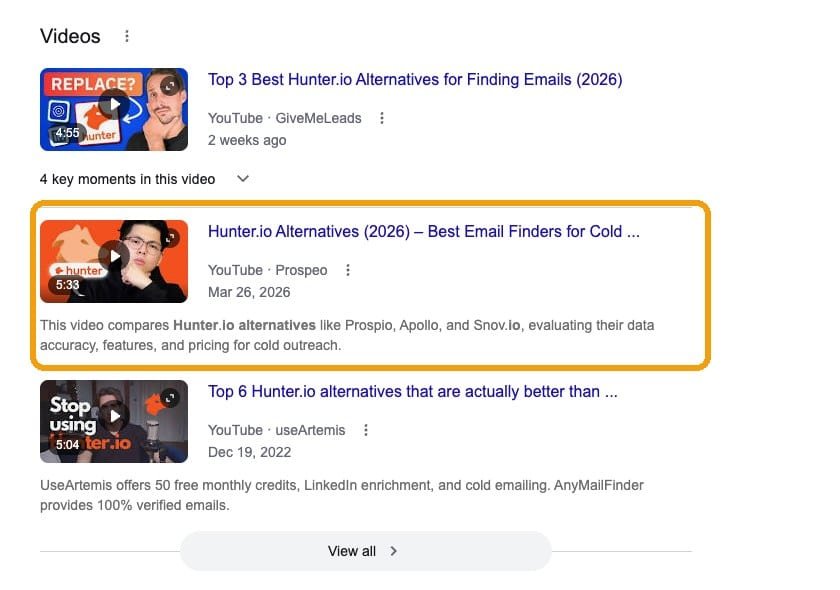
Our Prospeo engagement shows how the layers stack. The work we ran was the authority side: targeted link building into the comparison and head-term pages, which took organic from roughly 1,000 to 17,000 monthly visits, and ChatGPT now names Prospeo on “Hunter.io alternatives” prompts (it is one of the wins in the table further down). The distribution layer, Prospeo run themselves, and you can see it working below: their own YouTube comparison ranks on the very same query.
Layer 7: Measurement. If you cannot see it, you cannot improve it.
Measurement is where most SaaS teams give up or overspend. The AI visibility tools market is loud, expensive, and largely unnecessary if you have an engineer who can spend a weekend with an API. Semrush, Ahrefs, Profound, Peec AI, Otterly, Athena all offer AI visibility tracking. Most of them wrap the OpenAI or Anthropic APIs with a dashboard on top.
What to measure
- Citation frequency. On your priority prompts, how often does your brand appear, as a percentage of runs?
- Share of voice on target keywords. Of all brands cited on a prompt, what share is yours? Track this at the keyword level, not the domain level, because share of voice fluctuates heavily by query. Your brand might hold 40% share on “best X for Y” and 0% share on “X alternatives”, and those two numbers move independently.
- AI-referral traffic. GA4 segment for ChatGPT, Perplexity, Copilot referrers. Still small as a share of total organic, but growing fast and disproportionately high intent. A ChatGPT referral converts at a meaningfully higher rate than a cold organic click, because the buyer has already been pre-qualified by the model’s shortlist.
- Branded query lift. When AI citations rise, branded search typically follows inside 60 to 90 days. This is the second-order evidence that AI visibility is working, even before referral traffic shows up meaningfully in analytics.
Share of voice is the metric I care about most. It collapses citation presence and competitive pressure into one number per keyword. If your share of voice climbs on the 20 buyer prompts you care about, everything else (traffic, pipeline, branded search) follows. If it does not climb, you are running the wrong tactics.
How to measure, without a tool vendor
At EMGI we built our own measurement stack on top of the DataForSEO APIs. I will not go deep on the implementation here, but the short version is: we run the priority prompts on a weekly cadence, log the cited brands, track share of voice by keyword, and flag changes. It gives us the same output as a $1,500 per month SaaS tool for a fraction of the cost. If you have an engineer who can spend a weekend with an API, you do not need a vendor. I cover the tool-building approach step by step in the five-step workflow below, and do a full category review in our AI visibility tools guide.
Under $1M ARR, build, defer, or ask your agency. Over $1M ARR, a tool is fine, but know what you are paying for.
How Do You Optimise Content for AI Citation?
Content with self-contained passages of 50 to 150 words gets cited 2.3x more often by AI systems (Victorino Group, 2025). AI doesn’t cite entire articles. It extracts short, answer-first passages that directly address a question. Every section of your content needs to be independently citable.
The academic research on GEO confirms this at a granular level. Adding statistics to content increases AI visibility by 22%. Including direct quotations from experts boosts it by 37% (GEO arXiv paper, 2025). These aren’t vague “content quality” recommendations. They’re measurable formatting changes you can apply to existing pages in an afternoon.
Phrasing matters too. Definitive statements get cited at 36.2%, compared to 20.2% for vague constructions (Victorino Group, 2025). “Brand mentions are the strongest AI ranking factor” gets cited. “Brand mentions may potentially be among the factors” does not. Be specific. Be direct. It’s the same thing your English teacher told you about thesis statements, except now the reader is a neural network.
Here’s what I focus on when optimising SaaS content for AI:
Answer-first paragraphs. Every H2 opens with a direct answer in 40 to 60 words. This is the passage AI systems are most likely to extract.
Question-based headings. 60 to 70% of H2s framed as questions. This matches how users prompt AI tools.
FAQ sections with schema. LLMs extract FAQ content preferentially. Implement FAQPage schema markup so AI crawlers can parse it cleanly. If you’re not sure where to start, our SaaS website audit checklist walks through the technical setup.
Entity clarity. Use your product name consistently. Don’t alternate between “our platform,” “the tool,” and “the solution.” Name it. Every time.
The Citation Capsule Framework
A citation capsule is a self-contained passage designed to be extracted and quoted by AI systems. Here’s an example:
SaaS companies with active review profiles on G2 and Capterra appear 2.6 to 3.5x more often in AI-generated responses. Building and maintaining review platform presence is one of the highest-ROI activities in an LLM SEO strategy.
That’s 39 words. It contains a specific claim, a data point, and it stands on its own without needing surrounding context. An AI system can quote it directly.
I write citation capsules for every H2 section in our client content now. It adds maybe 20 minutes to the writing process and dramatically increases the odds of AI extraction. The trick is treating each capsule as its own micro-article: claim, evidence, implication, all in under 60 words. Like writing a really good tweet, except it actually serves a purpose.
To build your own citation capsules:
- Write the direct answer to the section’s heading question
- Include one specific statistic with source attribution
- Keep it between 40 and 60 words
- Make sure it reads clearly without any surrounding context
- Place it as the opening paragraph of each H2
AI systems cite self-contained passages of 50 to 150 words 2.3x more often than unstructured content (Victorino Group, 2025). Adding statistics increases citation rates by 22%, and definitive phrasing gets cited at 36.2% versus 20.2% for vague language, according to GEO research.
What Is the Role of Link Building in LLM SEO?
AI Overviews reduce organic CTR by 61% for queries where they appear (Seer Interactive, Sep 2025). That’s the cost of not being cited. And most LLM SEO guides get the solution wrong. They treat AI optimisation as purely on-page: restructure your headings, add FAQ schema, implement llms.txt. That matters, but off-page authority signals are what LLMs actually use to decide who gets cited.
Think about how LLMs build their understanding of your brand. They don’t just read your website. They read everything written about you across the entire web. Blog posts that mention you. Comparison articles that include you. Forum discussions where users recommend you. Podcast transcripts where hosts name you. It’s like a reputation that follows you around. Every piece of third-party content that names your brand is another data point feeding the model’s picture of who you are.
This is not theoretical. At Constant Hire, an e-commerce recruitment client we build links for, AI recommendations have grown into 26% of all leads, and their prospects say so on sales calls. Guillaume Deschamps, their Growth Marketing Manager:
“We have some big names that say, you guys were the first one appearing on AI search, so I chose to work with you. A lot of clients actually have said that. They searched for something, found us, we were the first result, and they just decided to work with us.”

Guillaume Deschamps, Growth Marketing Manager, Constant Hire
Ethical, editorial link building creates exactly these signals. When we place a client on an authoritative SaaS publication with a contextual brand mention, we’re not just building a backlink. We’re shaping how AI systems describe that brand. And the anchor text and surrounding context in those placements directly influence the language AI uses when it talks about your product.
We saw this firsthand with HR Partner. After 25 months of strategic link building, 200+ placements, their feature pages hit #1 and started appearing in AI Overviews. The authority we built for Google simultaneously built authority for AI systems. It wasn’t a separate initiative. The same signals fed both. Read the full case study.
Semantic context is the nuance here. The words surrounding your brand mention influence AI-generated descriptions. If you consistently appear in content about “enterprise security compliance,” AI systems associate your brand with that category. If your mentions are scattered across unrelated topics, the AI’s description of your product gets muddled.
We’ve tracked this across client campaigns. SaaS companies whose editorial placements consistently used category-specific language saw clearer, more accurate AI descriptions within 3 to 6 months. Companies with scattered, off-topic placements saw vague or incorrect AI descriptions persist longer. It’s the same principle behind our link building ROI research, where we found that focused, category-relevant placements deliver outsized returns compared to scattershot approaches.
Why Most AI Citations Come From Off-Site Signals
This is exactly why link building, done right and avoiding the usual link building mistakes, is naturally positioned for LLM SEO. We’ve been building these off-site authority signals for years. The difference now is that the signals feed AI models, not just Google’s algorithm. With Viddyoze, for example, we built 70+ links averaging DR 68, which drove 200% traffic growth in 7 months and ultimately supported their exit. That kind of authority footprint doesn’t just rank pages. It teaches AI systems that the brand is credible and worth citing. See the Viddyoze case study.
Off-page authority drives AI citations more than on-page formatting. LLMs train on the entire web, synthesising brand descriptions from editorial mentions, review platforms, Reddit discussions, and video transcripts. Link building that creates contextual brand mentions directly shapes how AI systems describe and recommend SaaS products.
The five-step workflow I run inside ChatGPT
The seven layers are the model. This is the Monday-morning version: the exact workflow I run for clients, start to finish.
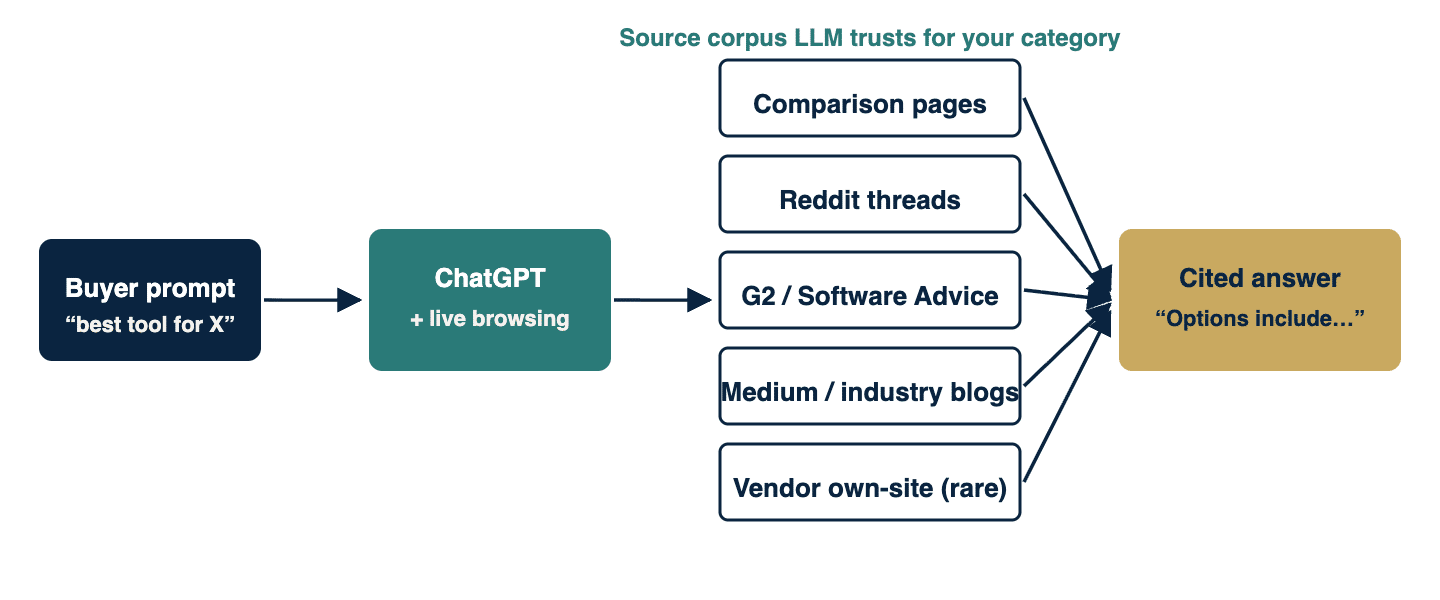
The mechanics matter. ChatGPT’s browsing tool pulls live web results, combines them with training data, and produces a cited answer. That answer draws from a specific source corpus. For B2B SaaS queries, that corpus leans hard on comparison pages, alternatives pages, G2, Software Advice, Slashdot, Reddit threads, and the occasional Medium article. Your own homepage is rarely in the set. The articles that mention you are.
Here is the part most SaaS marketing teams miss. ChatGPT does not cite your best page. It cites the page that already ranks and already contains your brand name in the right semantic context. That means your off-page footprint does the heavy lifting. If you are invisible on the comparison corpus that ChatGPT trusts, your own blog is rarely going to save you.
Step 1: How I Actually Get Started Inside ChatGPT
Open ChatGPT, run the prompts yourself, and watch what happens
I start every engagement the same way. I open ChatGPT, I log out of my account, I enable browsing, and I paste the first buyer prompt in. I watch it stream. I do not automate this step on day one. The eyeball pass is what tells me whether my client is in the conversation at all, and which competitors are eating their lunch.
The reason I do it by hand first is that the scripted version (Step 5) will tell you the binary: cited, yes or no. It will not tell you the tone of the citation. You only feel that by reading the output yourself. Is the model damning your client with faint praise? Is it parroting a dated G2 review? Is a competitor getting a paragraph while you get a bullet? Those textures matter, and they decide the off-page priorities that follow.
Step 2: Audit Your Current ChatGPT Visibility (and My Language for the Audit)
The vocabulary I use when I audit a SaaS inside ChatGPT
You cannot fix what you have not measured. The audit is the cheapest and most diagnostic thing you will do in this whole process, and 80% of the SaaS teams I meet have never run it properly. The way I run this audit has a specific vocabulary, and I want to walk through it because the framing drives the output.
The language I use to frame the audit
I do not call it “AI SEO reporting” or “LLM ranking checks”. I call it the citation set. The citation set is the finite list of brands ChatGPT will name when a buyer asks a given question. My job is to get my client into that set, and then to move them up inside it. Every word in that frame is deliberate.
It also pays to know when citations are even in play: we sat and watched ChatGPT answer buying questions for an hour, and most of the time it never searched at all.
A few more terms I lean on repeatedly:
- Source corpus. The specific domains ChatGPT pulls from when it answers a prompt. Not “backlink profile”. Not “authority”. The corpus. It is finite, query-specific, and knowable.
- Semantic mention. Your brand named alongside a category claim or comparison, in prose, in an article that already sits in the source corpus. The hyperlink is optional. The named binding is the signal.
- Citation position. First named, third named, buried in a footnote, or missing entirely. I grade every prompt on this, not just cited/not cited.
- Shortlist-worthy. The test a buyer applies before they ever click through. If the model presents four vendors, you want to be one of them. Rank three beats rank five. Rank five beats missing.
- Off-page footprint. The sum of comparison pages, directory listings, Reddit threads, and category articles where your brand appears in context. This is the lever. The site you own is rarely the lever.
I force clients to adopt this vocabulary in the first call. Marketing teams trained on Google rankings want to talk about “position” and “visibility score”. I push back. The citation set is not a ranking. It is a shortlist. The measurement model is different, and using the wrong language leads to the wrong remediation.
What to run through ChatGPT
You need three prompt types at minimum:
- Category prompts. “Best [product category] for [buyer type]”. Example: “best CRM for mid-market B2B” or “best practice management software for physiotherapists”. Top of funnel, hardest to win.
- Comparison prompts. “[Competitor A] vs [Competitor B] vs [Competitor C]”. Example: “Cliniko vs Halaxy for small allied health practices”. Middle of funnel, where SaaS brands win fastest.
- Alternatives prompts. “[Dominant competitor] alternatives” or “cheaper [competitor]”. Example: “Hunter.io alternatives cheaper email finder”. High-intent, shortlist-building prompts.
What to record
For each prompt, capture four data points. Are you cited, yes or no? If yes, what position in the answer? What phrasing did ChatGPT use to describe you? And, critically, what domains did ChatGPT cite as sources at the bottom of the response? That last column is the target list for Step 4.
Run 15 to 20 prompts for a first pass. Enable browsing. Use a logged-out session or incognito to avoid personalisation bleed. Most SaaS audits take an hour end to end, and the output tells you exactly where the visibility gap sits.
Step 3: Identify Target Queries and the Source Sites Behind Them
Map the queries that matter, and the sites that feed them
Once you have the audit, you triage. Not every prompt is worth winning. The job here is to pick the 30 to 60 prompts that actually represent buyer intent in your category, then identify the source sites ChatGPT trusts for each one. That source-site list is your off-page plan.
Mine your sales call transcripts. This is the single highest-value source.
If your marketing team is not pulling from Gong, Fathom, or Fireflies every month, you are guessing at buyer language. Sales call transcripts are the only place where the real, unfiltered buyer query lives, in the buyer’s own words, before any marketing team has had a chance to clean it up or reframe it. That raw phrasing is exactly what ChatGPT is trying to mirror when it synthesises an answer.
Here is the integration I push for. Every Monday, the marketing team pulls the previous week’s discovery calls. They search for “have you looked at”, “we compared”, “we’re also evaluating”, “the other tool we liked was”, and “someone recommended”. Every phrase that follows becomes a candidate prompt. The buyer literally hands you the language. You do not need to interpret it. You copy it into the prompt library.
The same transcripts tell you who your competitors are inside the buyer’s head, which is almost never the competitor set your product team thinks it is. I have had clients who believed they competed with three named rivals. The sales transcripts revealed they actually competed with two of those rivals plus four others their PMMs had never mentioned. The prompt library has to reflect the buyer’s real shortlist, not the internal positioning deck.
The other three places to source prompts
- Customer support and onboarding tickets. The migration questions. “Does this do what [competitor] does?”
- Reddit and Quora threads in your category. Search your competitors’ names. Buyer language lives there.
- Google Search Console. Filter for queries with brand plus competitor, or category plus modifier. High-intent commercial queries often carry over to ChatGPT almost unchanged.
Mapping source sites to prompts
For every prompt in your working set, list the domains ChatGPT cited underneath the answer. After 30 prompts you will see clusters. The same ten to fifteen domains appear again and again. That cluster is your target map. Typical pattern for B2B SaaS looks like this:
| Source type | Typical domains | Why ChatGPT trusts it |
|---|---|---|
| Review directories | G2, Software Advice, Capterra, Gartner Peer Insights, Slashdot | Structured, volume, freshness |
| Comparison editorial | Vendor comparison pages, category alternative pages | Named entity density |
| Community | Reddit, Quora, Stack Overflow | Semantic variety, buyer voice |
| Vendor-owned | Competitor blogs with comparison posts | Structured head-to-head language |
| Adjacent media | Category blogs, SaaS review sites | Topical authority and freshness |
The cluster is not identical across categories. CRM looks different from allied health, which looks different from web scraping. The method is identical, but the target list is category-specific. You do the work once, then it drives every off-page decision for the next twelve months.
Step 4: Earn Semantic Brand Mentions on the Source Sites That Matter
Get mentioned, in context, where ChatGPT already looks
This is where the work lives. You have the target prompts from Step 2. You have the source domains from Step 3. This step is the off-page programme that gets your brand named, in the right context, on those exact pages.
What “semantic mention” actually means
A semantic mention is your brand name used alongside a category claim, a comparison, or a use-case description. It does not need to be hyperlinked. ChatGPT parses the text, recognises the entity, and binds your brand to that context. A sentence like “Supabase, the open-source Firebase alternative” is a semantic mention doing more work than ten raw homepage backlinks. Plausible gets the same treatment for “the privacy-friendly Google Analytics alternative”. The category frame is crisp, the brand is named inside it, and the model learns the binding.
This is the whole game, and it is why the context of the surrounding article matters more than anything else. You do not want to be the SaaS begging for a mention. You want to be the SaaS that gets naturally described by its category semantic, because the category frame is so clean that any writer covering the space names you without thinking. Supabase earned that. Plausible earned that. Beeper is earning it right now for “the universal chat inbox”. Your job is to engineer the same clarity of framing for your own category, and then to seed the right contexts where that framing gets reinforced. Prioritise the context of the article above all else. If the surrounding prose is not a natural fit for your category claim, the mention will not stick, no matter how many you buy.
Where to focus the off-page work
- Comparison corpus. G2 alternative pages, Software Advice category pages, Slashdot head-to-heads. These are the single highest-impact surfaces for comparison queries. Profile completeness, feature tagging, screenshots, review volume, use-case tagging. All of it matters.
- Third-party comparison editorial. “Best X for Y” articles on category blogs, SaaS review sites, vertical publications. If the article ranks on Google and has your category in the title, it feeds the ChatGPT corpus.
- Reddit and Quora. Semrush’s 40% citation share figure tracks with what I see in client work. Reddit is the single most undervalued surface in SaaS GEO. Not spammy self-promotion. Actual informed contributions in the subreddits where your buyers live.
- Vendor-owned comparison pages. This is the hardest and highest-impact category. Competitors’ own comparison pages (“Competitor X vs You”) are gold when they exist. When they do not, adjacent vendors’ pages can be targeted. Think niche edits and expert contribution, not link-begging.
A quick note on backlinks. You still want them. A DR 60+ editorial mention on a relevant site does double duty, it feeds Google authority (which bleeds into AI Overviews) and it provides the semantic mention for ChatGPT. Ahrefs’ 2025 data puts niche edits at around $361 and DR 50+ guest posts at around $600. Those numbers are not pocket change, but when you target them against the source-site list from Step 3, the ROI is defensible.
Step 5: Build a Measurement Workflow with Google Apps Script and the OpenAI API
Build the tracker yourself. It takes a weekend.
This is the section I wish more agencies would write honestly. Measuring AI visibility is essential. Paying a tool vendor $500 to $2,000 per month to do it is not. Most of the AI visibility tools on the market today are wrappers around the OpenAI API with a nice dashboard on top. You can wrap the same API for a fraction of the cost with a weekend of engineering.
What we built at EMGI
We use Google Apps Script plugged into the OpenAI API. The setup is embarrassingly simple. A Google Sheet holds the prompt library in column A. A script loops through every row, sends the prompt to ChatGPT via the API with browsing enabled, parses the response for brand mentions and cited domains, and writes the result back to the sheet. We run the top ten prompts weekly and the full library every 30 days. Cost per run, pennies. Cost to build, two evenings.
Here is what the core function looks like, heavily trimmed:
function runPromptLibrary() {
  var sheet = SpreadsheetApp.getActiveSheet();
  var prompts = sheet.getRange("A2:A61").getValues();
  var apiKey = PropertiesService.getScriptProperties().getProperty("OPENAI_KEY");

  prompts.forEach(function(row, i) {
    var prompt = row[0];
    if (!prompt) return;

    var response = UrlFetchApp.fetch("https://api.openai.com/v1/chat/completions", {
      method: "post",
      contentType: "application/json",
      headers: { Authorization: "Bearer " + apiKey },
      payload: JSON.stringify({
        model: "gpt-4o-search-preview",
        messages: [{ role: "user", content: prompt }]
      })
    });

    var data = JSON.parse(response.getContentText());
    var answer = data.choices[0].message.content;
    var cited = answer.toLowerCase().includes("hr partner") ? "YES" : "NO";

    sheet.getRange(i + 2, 2).setValue(new Date());
    sheet.getRange(i + 2, 3).setValue(cited);
    sheet.getRange(i + 2, 4).setValue(answer);
  });
}
That is the whole pattern. Extract the citation list, store the full answer for qualitative review, add a column for position if you want sophistication. You can add a second pass against Claude via the Anthropic API to triangulate. For smaller prompt volumes, non-coders can run the same workflow through the Claude desktop app or ChatGPT’s browsing API via an MCP connector, which does not require any code at all.
The framing that matters
Tool vendors wrap an API. You can wrap the same API. Your agency should be doing this for you as a standard part of the retainer. If you are paying an AI visibility tool subscription and your agency is not integrating that data into reporting, you are paying twice for the same workflow.
Worked example: does HR Partner appear on a query that does not name them?
Prompt: “simplest HR software for small business under 50 employees”
ChatGPT output (captured April 2026):
“For teams under 50 employees looking for a lean HR system without enterprise overhead, HR Partner is consistently named alongside BambooHR and Breathe HR. HR Partner focuses on core HR admin, employee records, and leave tracking, which suits small businesses that want simplicity over payroll depth.”
Sources cited: G2 small-business HR category, Software Advice under-50 employees listing, Slashdot category page, a Capterra roundup.
Citation status: YES, named in the consideration set on a query that does not contain the brand name.
Why this matters: appearing when your own brand is in the prompt proves nothing. The model will parrot a brand you named. Appearing on a non-brand category query is the real test of whether the off-page work has landed. HR Partner is named here because G2, Software Advice, Slashdot and Capterra already carry their brand in the right small-business HR context. The semantic mention did the work.
That output is from the 25-month HR Partner engagement where we grew organic value from roughly $5K to $20K per month. The ChatGPT surface is now an extension of that same off-page programme. Same target sites, same entity work, new output surface. The tracker script tells us week by week whether we are holding the position on the non-brand queries that actually matter.
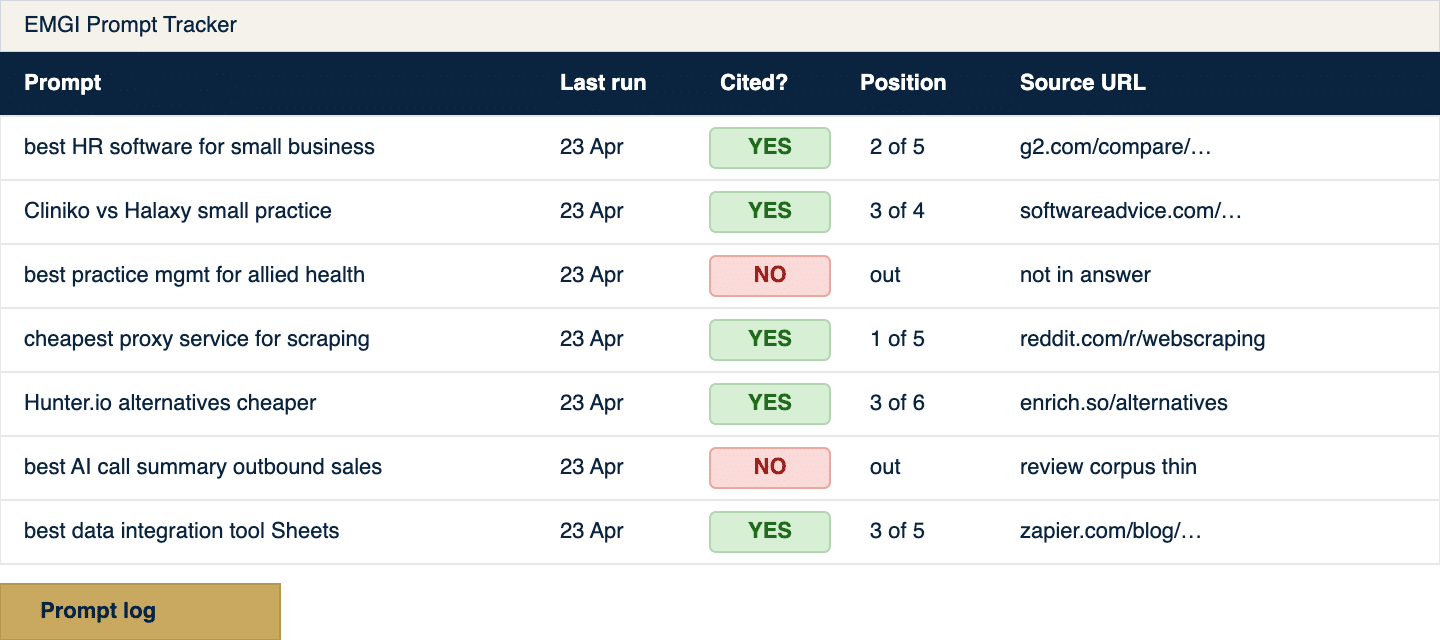
Two Worked Examples: Vertical Clinical SaaS and Horizontal CRM
Every SaaS GEO guide I read trips over the same problem. They give you a generic prompt template and call it a framework. Real buyer prompts are category-specific, and the source corpus looks different in every niche. Here are two worked examples from current and recent client work, one vertical, one horizontal.
Niche A: Vertical SaaS, clinical and allied health
For the clinical SaaS AIO campaign, we run the anchor clusters around appointment reminders, practice management, clinical notes, and AI scribes. Those are the buyer mental models. The prompt library for this niche looks like this:
Sample prompt library, vertical allied health
Middle-of-funnel (category) prompts:
- “best practice management software for allied health professionals”
- “cloud-based clinic management software for small allied health practices”
- “automated SMS appointment reminders for clinics”
- “AI note takers for therapists”
Bottom-of-funnel (comparison) prompts:
- “Cliniko vs Halaxy for small allied health practices”
- “Cliniko alternatives for Australian physio clinics”
- “patient reminder software comparison”
Observed source corpus: Capterra allied health category, Software Advice physiotherapy section, vertical publications, a handful of practice management comparison blogs, Reddit r/physicaltherapy threads.
Status: the client appears inside the shortlist on the Cliniko vs Halaxy comparison prompt without needing their own brand name in the query, which is the win that actually matters. Work in progress on the category-level “best practice management software for allied health professionals” prompt, which is a heavier lift because the source corpus is more fragmented.
Niche B: Horizontal B2B SaaS, CRM and sales engagement
Horizontal SaaS has a denser source corpus and much higher competition, which means comparison queries dominate and category queries are close to unwinnable for newer brands. Here is the prompt library shape for a CRM or sales-engagement client:
Sample prompt library, horizontal CRM and sales engagement
Middle-of-funnel (category) prompts:
- “best CRM for mid-market B2B”
- “best AI call summary tool for sales teams”
- “best sales engagement platform for 50 to 200 rep teams”
Bottom-of-funnel (comparison) prompts:
- “best AI call summary tool for outbound sales teams”
- “Apollo.io vs Outreach vs Salesloft”
- “HubSpot alternatives for mid-market”
Observed source corpus: G2 dominates. Gartner Peer Insights is punching above its weight. Software Advice, Capterra. Substantial Reddit contribution from r/sales and r/salesops. Client-hosted comparison posts are now being cited back as source on adjacent queries, which is the GEO flywheel working.
Status: the AI call summary client holds a shortlist position on non-brand category queries, and their own content is cited by ChatGPT as an authoritative source on adjacent comparison questions. That is the source-citation loop, the single clearest signal that your GEO programme has compounded into genuine authority.
The CRM niche also sets up the single biggest piece of original data we have found this year, which deserves its own section further down.
Ten Citation Wins: The Pattern Across Categories
Patterns matter more than anecdotes. Here is a summary of ten current client wins in ChatGPT, captured through the DataForSEO scraper in April 2026, with client names removed and category descriptors in their place. This is the pattern-match evidence. It is also the reason I am confident the two levers at the top of this article are ranked in the right order.
| Category | Query | Position |
|---|---|---|
| Data integration (no-code ETL) | best data integration tool for Google Sheets 2026 | Rank 3 |
| Email finder tooling | Hunter.io alternatives cheaper email finder | Rank 3, “cheapest solid options” |
| Web scraping API | best web scraping API for developers | Table-featured, summary pick |
| Localisation platform (open source) | open-source React localisation tool | Rank 1, open-source option |
| AI call summary (sales) | best AI call summary tool for outbound sales teams | Rank 1, own content cited as source |
| B2B email finding (bulk) | most accurate bulk email finder | Rank 1 |
| Small-business HR | simplest HR software for under 50 employees | Featured positioning |
| Web scraping proxy | best proxy for web scraping 2026 | Rank 3, “best value” |
| SaaS financial planning | best FP&A software for SaaS finance teams | Rank 1 |
| Allied health practice management | Cliniko vs Halaxy for small allied health practices | Featured in shortlist |
Four patterns worth calling out
- Comparison-query dominance. Eight of ten wins are on “X vs Y” or “alternative” or shortlist-style queries. Top-funnel “best X” wins are rarer. This is the clearest possible evidence that middle and bottom-of-funnel is where smaller SaaS brands win in ChatGPT first.
- The source-citation loop. In the AI call summary category, the client’s own hosted content is cited as a source by ChatGPT when it answers adjacent comparison queries. That is the flywheel working at full speed. Publish comparison content, earn the right mentions, get cited for adjacent comparisons, which feeds further citation of your own content.
- Reddit is a first-class citation surface. The web-scraping-proxy client’s top-three position on “best proxy for web scraping 2026” is sustained partly by a Reddit quote ChatGPT pulls into the answer (“99.86% success rate, fastest I’ve seen”). This tracks cleanly with the Semrush 40% citation-share figure covered in Layer 2.
- The comparison corpus decides the game. The small-business HR and open-source localisation wins land because G2, Software Advice and Slashdot already carry structured head-to-head pages naming those brands. The agency job is to get on those corpuses. That is not a content marketing job. It is an off-page entity-seeding job.
What our directory research adds
We measured 137 SaaS brands across 23 directories and 120 buying queries to see how directory presence and topical authority combine into ChatGPT citations. Four findings are worth carrying into your own plan:
- AI Overview and ChatGPT citations correlate at 0.94. The two surfaces are drawing from the same authority pool. Optimising for one lifts the other.
- Review count correlates with AI citations at 0.86. Review rating correlates much lower. LLMs reward scale, not stars. A CRM with 10,000 three-star reviews beats a CRM with 1,000 five-star reviews on citation frequency.
- Gartner Peer Insights is the single strongest directory predictor of LLM visibility. Software Reviews and Crozdesk also lift ChatGPT citations materially. G2 rating, contrary to industry gospel, is overrated as a citation signal. Presence matters. The star count does not.
- Category positioning overrides raw review volume. The Apollo.io example from Layer 1 is the proof: huge directory footprint, zero CRM citations, because the tagging says sales engagement. Topical relevance beats directory inclusion every time.
How Do You Build AI Visibility Across Different Platforms?
The seven-layer model and the workflow above are the system. This section is the surface-by-surface view, and for the Google side specifically, our AI Overview optimisation walkthrough goes deeper.
Each AI platform trusts different sources and weights different signals. Only 13.7% of citations overlap between AI Overviews and AI Mode (Ahrefs, Dec 2025), which means a platform-specific strategy isn’t optional. What works for Google AI Overviews won’t automatically work for ChatGPT or Perplexity.
Google AI Overviews
B2B technology queries trigger AI Overviews 82% of the time (BrightEdge, Feb 2026). If you’re selling SaaS to other businesses, your category is almost certainly covered.
The good news: being cited in an AI Overview gives you 35% more organic clicks than appearing in traditional results alone (Seer Interactive, Sep 2025). So this isn’t a zero-sum game. Citation actually boosts your click-through rate.
What Google AI Overviews reward:
- Schema markup. BlogPosting, FAQPage, and HowTo schemas make your content machine-readable
- Topical authority. Deep content clusters around your core topics
- FAQ sections. Structured Q&A content gets extracted frequently
- Domain authority. Google’s existing trust signals still apply here
The strategy for AI Overviews closely mirrors good traditional SEO. If you already have strong topical authority and clean technical SEO, you’re well positioned. Think of it as the same exam with a few bonus questions at the end. The thesis sits in the topical authority thesis.
ChatGPT
ChatGPT has 1 billion monthly active users (OpenAI, Jan 2026) and drives 87.4% of all AI referral traffic (Datos/Similarweb, 2025). It’s the dominant platform, and it has its own citation quirks.
Recency matters heavily. ChatGPT favours content updated within a 30-day freshness window for dynamic topics. Old content drops from responses quickly.
There’s also a Bing index correlation. ChatGPT’s web search features pull from Bing, not Google. If your content isn’t indexed in Bing, ChatGPT may not find it during web-enabled queries. Check your Bing Webmaster Tools. Sounds obvious, but I’d estimate half the SaaS companies I talk to haven’t even set up a Bing profile.
Brand authority and consistency drive ChatGPT citations for non-search queries. The model’s training data reflects the volume and sentiment of your brand mentions across the web. More high-quality mentions equals stronger brand recognition in responses.
Perplexity
Perplexity serves 30 million monthly active users with 780 million queries per month (Perplexity, May 2025). It’s smaller than ChatGPT but uniquely valuable because it shows its citation sources explicitly.
This transparency means users can see which brands Perplexity trusts. For SaaS companies, appearing as a cited source builds credibility with the researcher reading that response.
What feeds Perplexity citations:
- Citation diversity in your own content. Perplexity favours content that itself cites credible sources
- Reddit presence. Perplexity indexes Reddit heavily, and our study of 1,486 SaaS buying queries shows which subreddits drive the citations by category and funnel stage. Genuine user discussions mentioning your brand feed directly into Perplexity’s responses
- Freshness. Like ChatGPT, Perplexity rewards recent content
- Structured answers. Clear, extractable passages with specific claims
AI platforms cite different sources with only 13.7% overlap between them (Ahrefs, Dec 2025). Google AI Overviews trigger on 82% of B2B tech queries, ChatGPT drives 87.4% of AI referral traffic, and Perplexity shows explicit citation sources. Each platform requires a distinct optimisation approach.
Proof: how we make SaaS brands visible in AI answers
Theory is cheap. This section is the evidence I point clients at before they sign. First Page Sage reported 702% ROI on B2B SaaS SEO investments with a 7-month average breakeven in 2026 (First Page Sage, 2026). GEO sits inside that envelope. Here is what the work looks like in practice.
The web scraping SaaS case, DR 65+ and the authority distribution effect
Our primary SaaS case study is a web scraping SaaS client I took on when their head of marketing called me frustrated that their AIO presence was zero. They ranked well on Google for the head term but did not appear in the AI overview. Classic invisibility problem.
We focused on DR 65+ sites as the anchor quality filter. Over the engagement, the earned citations compounded in a specific way: long-tail queries started ranking inside AIO after the link work, even though those long-tail queries were never direct targets. The authority passed through the site internally and distributed across the whole URL set. This is the whole-site authority distribution effect. It is the clearest live evidence I have that GEO rewards systemic authority, not page-by-page tactics.
Final result: rank 1 inside Google AIO on the target head term, with related long-tail queries picking up AIO presence as a second-order effect. The full case study has the numbers.
The UK e-commerce experiment, 0 to 7,000 impressions in two months
This is an unpublished EMGI experiment I want to describe carefully because the client is in a UK e-commerce niche I cannot disclose. We launched a brand-new website on an exact-match domain, with no pre-existing authority. Semantic-depth content combined with targeted link building on the keywords that started to perform.
The detail worth sitting with: we were not targeting soft category-level prompts. The experiment was run on direct commercial-intent keywords with 1,000+ monthly search volume each. These are the terms where the buyer is already in purchase mode, not the informational end of the funnel. Inside two months the site moved from 0 to 7,000 monthly impressions and kept growing. It appeared inside Google AI Overviews and was cited inside ChatGPT on category-level prompts adjacent to the commercial targets. We were the only company under DR 70 to appear on those AI surfaces at all. Every other cited brand was significantly larger, more established, and sitting on years of accumulated authority.
This is the proof point that kills the “you need DR 80 to get AI citations” line. You do not. You need the right semantic signal plus the right targeted authority work on the exact keywords you want to win.
The SaaS AI Citation Gap Report, self-proof
I have referenced this report throughout, but it is worth separating out. Our research across 150 SaaS brands was picked up by LLMs within seven days. It became a cited source on multiple commercial AI prompts inside a month. The report lives on emgigroup.com, a specialist agency site, not a tier-one publication.
This matters because it closes the loop on the “GEO is just SEO” argument. If GEO were purely an authority play, the report would not have been cited. Ahrefs or Semrush would have been cited instead, for the same topic, by default. The semantic value of the data was what the model rewarded. For more on this, see what topical authority actually means for SaaS.
What Does a Practical LLM SEO Strategy Look Like for SaaS?
GEO techniques can boost AI visibility by up to 40% when applied systematically (GEO academic paper, 2025). But “systematically” is the key word. Sporadic optimisation doesn’t compound. You need a structured roadmap that runs alongside your existing SEO and content programmes.
Here’s the framework I use with our clients. It’s built to run in parallel with traditional link building, not replace it. The first three months are heavy on audit and optimisation. Months three through six shift to off-page authority building. Months six through twelve are about compounding and measurement. It mirrors our 90-day structured approach of Diagnose, Plan, Execute, Report, which we use across all client engagements.
The 90-Day LLM SEO Roadmap
For SaaS companies starting from zero, here’s the weekly breakdown:
Week 1: AI reputation audit (use our 12-point AI visibility audit framework as the methodology). Search 20 to 30 queries across ChatGPT, Perplexity, and Google AI Overviews. Document every mention, every competitor citation, and every gap. This is your baseline.
Week 2: Competitor citation mapping. For each query where a competitor appears and you don’t, identify the likely source. Is it a review profile? An editorial mention? A comparison article? This tells you where to focus.
Weeks 3 to 4: On-site optimisation. Add citation capsules to your top 10 pages. Implement FAQ schema on relevant content. Add an llms.txt if you have a spare hour (covering bases, nothing more). Restructure key pages with answer-first formatting.
Weeks 5 to 12: Off-site authority campaign. This is where link building meets LLM SEO. Secure editorial placements with contextual brand mentions. Build review platform presence. Pursue podcast and YouTube opportunities. Create content partnerships that generate the off-page signals AI systems trust. If you’re wondering what this costs in practice, we’ve broken that down separately.
If you would rather see who actually does this well before committing budget, I scored ten AI SEO agencies against the same criteria, our own entry included and openly disclosed.
And if the term itself still feels like vendor fog, start with our plain-English explainer on what AI SEO really means.
I’ve found that weeks 3 and 4 are where most SaaS companies stall. The on-site changes feel small compared to writing new content. But reformatting a high-authority page with citation capsules takes an hour and can shift its AI visibility within weeks. Don’t skip it. It’s like stretching before a run. Nobody wants to do it, but the people who skip it end up injured.
A structured LLM SEO strategy can boost AI visibility by 40% (GEO academic paper, 2025). The roadmap runs in three phases: audit and optimise existing content (months 1-3), build off-page brand authority (months 3-6), then compound and measure results (months 6-12).
What Tools Should You Use to Track AI Visibility?
Before you buy anything, read our honest review of the best AI visibility tools for SaaS. Most of the category is OpenAI and Anthropic APIs with a dashboard on top, and knowing which ones are worth paying for saves real money.
AI platforms now drive 1.08% of all web traffic, and ChatGPT referrals alone grew over 200% in 2025 (Datos/Similarweb, 2025). But there’s no Google Analytics equivalent for LLM SEO yet. Measurement is emerging, imperfect, and essential.
Start with manual tracking. It’s tedious but accurate. Search 10 to 20 of your core queries on ChatGPT, Perplexity, and Google each month. Log which brands get cited, including your own. Track changes over time. This is your ground truth. Not glamorous, but it works.
For referral traffic, GA4 already captures the data. Filter by source to see traffic from chatgpt.com, perplexity.ai, claude.ai, and copilot.microsoft.com. You’ll likely be surprised by the volume, especially from ChatGPT.
Beyond manual methods, a growing set of tools is worth evaluating:
| Tool | What It Does | Best For |
|---|---|---|
| DataForSEO AI Mentions API | Tracks brand mentions across LLM responses programmatically | Enterprise SaaS with developer resources |
| Otterly.ai | AI visibility monitoring and citation tracking | Mid-market SaaS wanting automated tracking |
| LLMrefs | Generative AI search analytics | Understanding citation patterns across models |
| Troof.ai | AI reputation monitoring | Monitoring how AI describes your brand |
| Google Search Console | AI Overview click data and impressions | Tracking Google AI Overview performance |
| GA4 (referral filter) | AI platform referral traffic | Measuring actual visits from AI platforms |
None of these tools are perfect yet. The space is young. But combining manual audits with GA4 referral tracking gives you an 80% accurate picture of your AI visibility without spending a penny on new tools.
No GA equivalent exists for LLM SEO measurement yet, but AI platforms drive 1.08% of all web traffic with ChatGPT referrals growing over 200% in 2025 (Datos/Similarweb, 2025). SaaS companies should combine manual query tracking, GA4 referral filtering, and emerging tools like Otterly.ai and DataForSEO for visibility monitoring.
How Long Does LLM SEO Take to Show Results?
Gartner predicts traditional search volume will drop 25% by 2026 (Gartner, Feb 2024). The window to build AI visibility is narrowing. But LLM SEO compounds slower than traditional SEO, so patience is non-negotiable.
Here’s the realistic timeline I share with clients:
Months 1 to 3: Baseline. Initial content optimisation and audit. You’re laying groundwork, not expecting citations yet. Some quick wins in Google AI Overviews are possible if your domain authority is already strong.
Months 3 to 6: First citations. Perplexity and Google AI Overviews start citing you. These platforms have lower authority thresholds and faster content indexing. You’ll see your brand appear in responses for long-tail queries first.
Months 6 to 9: ChatGPT citations begin. ChatGPT has a higher authority bar. It takes consistent brand mentions across multiple sources before ChatGPT includes you reliably. This is where the off-page work pays off. Original data is the exception: our own gap report was cited inside a week, but that is a data-novelty shortcut, not the default curve.
Months 9 to 12: Measurable traffic. AI referral traffic becomes visible in GA4. You can start attributing leads and pipeline to AI sources. This is when the ROI conversation gets concrete.
Why the lag? LLM training data sits 3 to 12 months behind real-time. Even with web search features, the base model’s understanding of your brand is shaped by older data. Content you publish today may not influence ChatGPT’s core model for months. It’s like planting a tree. You’re not doing it for shade today.
But here’s the upside. Once cited, you tend to stay cited. Unlike PPC, where traffic stops the moment spend stops, AI citations persist. The compounding effect is real. Early movers build a self-reinforcing cycle: more citations lead to more mentions, which lead to more citations. Authority compounds like a brand moat.
58.5% of US searches already end without a click (SparkToro/Datos, 2025). That number is climbing. The brands investing in AI visibility now won’t just survive this shift. They’ll benefit from it.
LLM SEO takes 3 to 6 months for initial citations and 9 to 12 months for measurable AI referral traffic. The compounding effect makes early investment valuable, since once cited, brands tend to stay cited. Gartner predicts traditional search volume will decline 25% by 2026 (Gartner, Feb 2024).
“GEO is just good SEO”. Let me push back properly.
Danny Sullivan, Google’s search liaison, has repeatedly said that “good SEO is good GEO”. The line gets quoted a lot, usually by old-guard SEOs who find it reassuring. I want to push back on it carefully, because the line is half right and the other half is doing real damage.
Where the “GEO equals SEO” argument is correct
Authority still wins at the macro level. There is a huge correlation between what ranks well in Google and what gets cited in AI answers. As our directory research above showed, AIO and ChatGPT citations correlate at 0.94 across the category. That is enormous. The two systems draw from the same underlying authority pool. If your SEO is genuinely strong, you will pick up a meaningful share of GEO visibility for free.
Fundamentals still print. E-E-A-T, technical hygiene, entity salience, fast sites, good schema, earned links. None of that has changed. Anyone telling you to throw out the old playbook is either selling a new tool or has not been practising long enough to remember that fundamentals always win.
Where the argument fails
LLMs were not in common use two or three years ago. Claiming “nothing is different” in 2026 is naive. Three specific ways LLMs diverge from classic search:
- LLMs love citing data. Original statistics, survey results, experiment outcomes get cited disproportionately, even from lower-authority sites. This is the opening for smaller brands.
- LLMs read long-form content with semantic depth. A 3,000-word guide that covers topical relationships comprehensively can get cited above a thinner, better-linked page.
- LLMs pull context from articles that observe relationships between entities. Comparison pages, head-to-head reviews, “alternatives to X” content are semantic gold for the model.
Quick aside. You can spot an AI-written article that has been published without human oversight because it almost always drifts onto LLMs and AI search as the example topic. It is the tell. Ironic that LLMs love talking about how important LLM search is. Ha ha. Honest version for this piece: I am writing about AI search because I run an agency that works on AI search, not because the model steered me there.
I think a lot of the “GEO is just SEO” rhetoric is the old guard resisting change because the change threatens their existing expertise. If GEO is genuinely different, then the person who has spent 15 years building link-driven authority plays has to learn something new. That is uncomfortable. Saying “it is all just SEO” is easier than saying “the game has added a new surface with new rules on top of the old ones”.
The proof I keep coming back to
I keep returning to the Citation Gap Report because it is the cleanest counter-example: a small specialist agency, minimal distribution, no tier-one PR, cited inside a week. The data was original and the semantic framing was clean. The model decided it was useful.
That would not have happened in 2023. Link graph weight would have pushed the citation to Ahrefs, Semrush, or HubSpot regardless of who had the better data. The model changed. “GEO is just SEO” misses that change.
Net position. Optimise for both. Authority still wins at the macro level. Original data and semantic depth open the door at the query level. The SaaS brands that take both seriously will eat the brands that pick one.
Frequently Asked Questions
What is the difference between LLM SEO and GEO?
They’re effectively the same discipline with different names. LLM SEO focuses specifically on Large Language Model optimisation, targeting platforms like ChatGPT and Claude. GEO, or generative engine optimisation, is the broader term covering all AI search interfaces including Google AI Overviews. In practice, the strategies overlap almost entirely. Use whichever term your team prefers.
Does LLM SEO replace traditional SEO?
No. They’re parallel disciplines that reinforce each other. Traditional SEO drives clicks from search results. LLM SEO drives citations in AI responses. Both require domain authority and quality content. The SaaS companies performing best in AI search are the ones with strong traditional SEO foundations already in place. We cover the full traditional foundation in our off-page SEO checklist.
Can a small SaaS company compete in AI search?
Yes, and sometimes more effectively than larger competitors. AI visibility isn’t purely determined by domain authority. Niche expertise, unique data, consistent brand mentions in your specific category, and strong review platform presence can outperform bigger brands with scattered authority. A vertical SaaS product with deep category content often outranks horizontal platforms in AI responses.
Should I block AI crawlers like GPTBot?
Generally, no. Blocking GPTBot, ClaudeBot, or PerplexityBot in your robots.txt removes your content from AI responses entirely. Unless you have specific licensing concerns, you want these crawlers indexing your site. Allow them access.
Do I need an llms.txt file?
Our honest view: llms.txt is overrated. There is no hard evidence that LLMs respect it meaningfully, and we measured llms.txt across 3,254 SaaS companies to check: adoption runs at five times the web rate with zero effect on ChatGPT citations. Adding one takes an hour and cannot hurt, so we run one on emgigroup.com. Treat it as covering bases, not a silver bullet.
How do brand mentions differ from backlinks for AI visibility?
Brand mentions are text references to your brand without a hyperlink. For traditional SEO, unlinked mentions carry less value than backlinks. For LLM SEO, the relationship inverts. Brand mentions correlate 0.664 with AI visibility versus 0.218 for backlinks (Ahrefs, Aug 2025). LLMs read text, not links. A mention in an article body carries more AI weight than a hyperlink in a sidebar.
How many prompts should I track in a prompt library?
Aim for 30 to 60 buyer-intent prompts split across category, comparison, alternative, and problem phrasing. Five is too few to see signal. A hundred is overhead with diminishing returns. Run the top ten weekly, the full set monthly.
Does Reddit really matter for AI citations?
Yes. Semrush reported in June 2025 that Reddit accounts for roughly 40% of AI citation share, and I see the same pattern across client wins. A web-scraping-proxy client of ours holds a top-three position on “best proxy for web scraping 2026” partly because ChatGPT pulls a Reddit quote into the answer set.
What budget should a SaaS company spend on this?
First Page Sage reported 702% ROI on B2B SaaS SEO with a 7-month breakeven in 2026, and this work sits inside that envelope. Under $1M ARR, focus spend on content, entity cleanup, and a small citation programme. Over $1M ARR, a full agency retainer in the $3K to $15K per month range is sensible. See our link building cost breakdown for category benchmarks.
Build AI visibility now or lose ground later
The shortest version of this entire guide. Your buyers are already asking ChatGPT, Perplexity and Google’s AI for shortlists, and the answers are assembled from a knowable set of sources. Two levers move your citation rate more than everything else combined: get your brand mentioned, in context, inside the articles the models already cite, and target the exact sites that feed your buyer prompts. The seven layers tell you where your gaps are. The five-step workflow tells you what to do on Monday.
Authority compounds. Once cited, brands tend to stay cited, and every new mention makes the next one more likely. The SaaS companies doing this work now will own their category descriptions in AI answers for years. The ones who wait will spend that time trying to break into a shortlist that has already hardened.
If you would rather have this run for you, that is exactly what EMGI’s LLM SEO retainer covers: the audit, the prompt library, the off-page programme and the measurement, with link building underneath it. Or start smaller: book a free AI visibility audit and I will run your most important buyer prompts live, show you where you appear, where you do not, and what it takes to close the gap.
From our research series: the eight searches ChatGPT secretly runs per buying prompt, captured live across ChatGPT, Gemini, Claude and Perplexity.

Written by Matt Emgi
Founder of EMGI Group, a SaaS link building and GEO agency helping B2B SaaS companies doing $1M to $30M ARR become the company buyers find, trust and shortlist: on Google, in ChatGPT, and everywhere in between.
Matt runs strategy on every account personally. There is no account manager layer, and every engagement carries a 90-day firing clause, because the work should earn the retainer. EMGI builds editorial links and brand mentions to the pages that drive revenue, with placements across sites like HubSpot, Zoom, Monday.com and BigCommerce at an average of DR 60+, and tracks AI visibility and share of voice for every client over time. Client retention runs above 90% past the first cycle.
He also publishes EMGI’s original research on how AI search picks brands, including a 137-company, 1,486-query study of AI citations, and his work has been published on VentureBeat. When he is not building links he is usually filming, training Muay Thai, or surfing badly.
Watch Matt on YouTube, follow him on LinkedIn, or read more about Matt and EMGI.