Case Study

Allied Health Practice Management SaaS: How 90+ Vertical-Specific Backlinks Won AI Overview Citations Across 200,000+ Monthly Clinical Searches

Results at a Glance Rank 1 Google AI Overview citations on the two biggest clinical documentation queries in the category: “soap note” and “soap notes” (33,100 monthly searches each) 100+ AI Overview citations across the client’s content, covering 208,560+ monthly searches on clinical, practice management, and therapist-specific queries (sampled, true count higher) Rank 1 AI...

What this case study shows
  • The starting point and category challenge
  • What changed in visibility and trust
  • Why the outcome mattered commercially

Results at a Glance

  • Rank 1 Google AI Overview citations on the two biggest clinical documentation queries in the category: “soap note” and “soap notes” (33,100 monthly searches each)
  • 100+ AI Overview citations across the client’s content, covering 208,560+ monthly searches on clinical, practice management, and therapist-specific queries (sampled, true count higher)
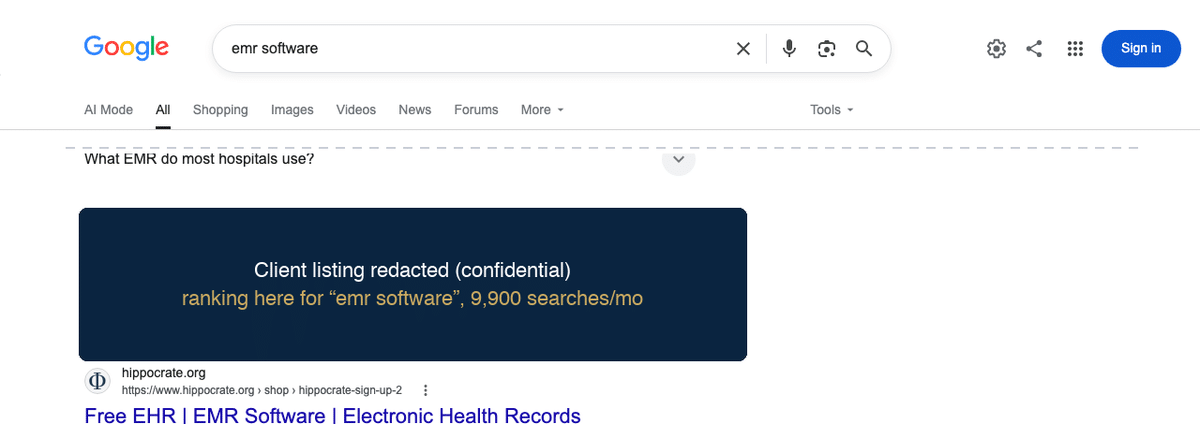
  • Rank 1 AI Overview citation on “EMR software” (9,900 vol) and “EMR system definition” (8,100 vol), both core commercial-intent queries in the health tech category
  • 90+ contextual backlinks built across healthcare, clinical AI, and allied health publications. Zero generic SaaS filler placements.
  • Lead-magnet amplification: the client’s flagship allied health practice management ebook received 10+ dedicated placements, driving sign-ups from the SEO channel
  • AI scribe product launch support: the client’s AI medical scribe product page received 12+ focused placements inside articles specifically about AI in healthcare and clinical documentation automation
  • Active engagement with EMGI embedded as a strategic partner across product launch SEO, profession-specific landing pages, and clinical content roadmap

Engagement Overview: Vertical SaaS Needs Vertical Link Building

This engagement started like most of ours do. The client wanted consistent, relevance-first authority building into a competitive vertical SaaS category. Over time, it evolved into a strategic SEO partnership.

EMGI is a link building agency. That is still the core of what we do. But with this client the engagement extends into regular conversations about the things that actually move the needle for a vertical health tech SaaS. Which profession-specific landing page should get priority authority support in the next sprint. How to seed authority into a new product category page ahead of launch. Which lead magnets deserve dedicated link amplification rather than generic homepage placements. How to position against well-funded competitors whose marketing budgets are multiples larger.

We are part of the project team. The client’s head of SEO and marketing knows exactly what we are building each month, which pages are receiving authority, and what the next three months of roadmap look like.


Context: The Allied Health Practice Management Category

The client is a global practice management SaaS built for allied health, mental health, and other clinical professions. The category is dense with established players: Cliniko, Halaxy, Coreplus, Jane App, SimplePractice, Power Diary, TherapyNotes, WebPT. Each with their own content engine, each competing for the same high-intent queries a clinic owner types when evaluating software.

On top of that, the health tech category has seen a shift since 2024. AI medical scribes have emerged as a separate product wave. Clinical documentation has become one of the most heavily cited topics in AI Overviews for the healthcare vertical. Appointment reminders have become a commodity feature that every practice management platform now ships, which means ranking is no longer about being first, it is about being the cited source.

For a client in that environment, the question is how to build authority that survives Google updates, defends against competitors with bigger budgets, and earns AI citations on the queries that actually bring in qualified leads from clinic owners and solo practitioners.


Strategy: Healthcare-Only Placements, Multi-Surface Link Targets

Three strategic choices we made early:

Choice 1: Healthcare publishers only. Every single placement came from a publisher writing about clinical practice management, AI in healthcare, medical tech, allied health business, patient engagement, or adjacent health vertical topics. No general SaaS round-ups. No lifestyle filler.

Choice 2: Spread links across every commercial surface, not just the homepage. The client has a multi-surface product map: feature pages for appointment reminders, AI medical scribe, client management, and clinical notes software. Category pages for clinic management. Profession-specific landing pages for therapists and other allied health disciplines. A lead magnet ebook on allied health practice management. Each surface needs its own authority layer.

Choice 3: Anchor text that reads like a real clinical writer. “Appointment reminders”, “SMS reminders”, “patient reminder software”, “therapy practice management software”, “AI scribe”, “allied health practice management book”, “clinical notes software”. Natural category language, not forced keywords. Same principle we apply in our anchor text strategy guide.


The Topics We Covered

If you strip out the URLs and just look at what the articles were about, a clear topic map emerges:

Clinical documentation and SOAP notes. The citation-magnet topic. Articles covering note-taking, progress notes, SOAP templates, and EMR workflows. This cluster directly feeds the client’s rank 1 AI Overview citations.

AI in healthcare and clinical documentation automation. A fast-growing cluster. Articles on AI scribes, clinical documentation AI, reducing administrative burden, AI chatbots in clinical workflows. Every placement reinforced the client’s authority on the emerging AI scribe product category.

Appointment reminders and patient communication. The biggest anchor-text cluster in the portfolio. Articles on reducing no-shows, automated SMS reminders, patient engagement workflows, and healthcare communication tools.

Allied health practice management and business operations. Articles on running a private practice, starting a clinic, managing an allied health business. Supports the lead magnet ebook and profession-specific landing pages.

Therapy practice management. Articles specifically about the therapist market, mental health practice operations, and therapy-specific software.

Clinic CRM and patient management. Articles on patient relationship management, healthcare CRM, and practice operations.

Topic clusters of referring articles
Chart 3: Every placement came from an article specifically about a clinical, AI-healthcare, or allied health topic.

Target Page Strategy: A Multi-Surface Link Portfolio

Not everything pointed at the homepage. A common link building mistake we avoid.

Link portfolio target page distribution
Chart 4: Link weight spread deliberately across commercial features, profession landing pages, product launch, and a lead magnet.

Appointment reminders feature page (around 28%). The single heaviest cluster. This page captures huge volume on “appointment reminder software” and “SMS reminder” searches, and converts for clinics with no-show problems. Natural anchor profile: “appointment reminder”, “automated appointment reminders”, “SMS reminders”, “patient reminder software”.

Therapist practice management profession page (around 20%). Vertical-specific landing targeting the therapist market. Because therapists have different software needs than general allied health, this page ranks and converts separately from the main practice management pages.

AI medical scribe product page (around 14%). The client launched an AI scribe product and we layered focused authority support into that launch. Placements inside articles about AI in healthcare, AI scribes for clinicians, medical documentation automation.

Allied health practice management ebook (around 11%). A lead magnet strategy most agencies ignore. Building links to a gated ebook shifts the conversion path from traffic to email sign-up from an authoritative context. The ebook received 10+ placements with anchors like “allied health practice management book” and “health practice management book”. These convert differently because the reader has opted into the topic.

Clinic management category page (around 5%). Top-of-category commercial surface.

Client management and clinical notes feature pages (around 8% combined). Product-specific commercial surfaces supported by articles about patient CRM, clinical documentation, and health tech.

Other (around 14%). Homepage, blog content, and ancillary pages.


The Google AI Overview Payoff

The client’s clinical content is now cited by Google’s AI Overview across the highest-intent queries in the category.

Top 5 Google AI Overview citations by query volume
Chart 1: SOAP note and SOAP notes both earn rank 1 AI Overview citations from a single pillar page.

“SOAP note” (33,100 monthly searches, rank 1). The Overview cites the client’s SOAP note template guide as its primary source. One pillar page, two major rank 1 citations (singular and plural variants).

“Therapist trust issues” (14,800, rank 1). The client’s doorknob disclosure article is cited as the authoritative source on a nuanced clinical topic.

“EMR software” (9,900, rank 1) and “EMR system definition” (8,100, rank 1). Two commercial health tech queries, both cited from the EMR explainer. Bottom-of-funnel citations, the kind that bring decision-stage buyers directly into the brand.

Aggregate reach across sampled citations: 208,560+ monthly searches captured.


What the AI Overview Footprint Means in Practical Terms

A number like 208,560 monthly searches is hard to picture on its own. Here is a conservative way to frame what it actually translates into for a vertical SaaS.

Public studies of AI Overview click behaviour suggest effective pass-through click rates of roughly 1 to 2 percent when a brand is cited as a source on a commercial-intent query. That is significantly lower than traditional organic rank 1 click rates, because the AI Overview answers the question directly in many cases and only some users click through to verify or read deeper.

Applied conservatively to the client’s current footprint:

  • 208,560 monthly searches cited at a 1 to 2 percent effective click-through yields roughly 2,000 to 4,200 additional monthly visits influenced by the AI Overview layer
  • At a realistic SaaS demo-request conversion rate of 1 to 2 percent on those visits, that works out to roughly 20 to 80 demo requests per month attributable to the AI-cited content
  • At a demo-to-customer conversion in the 15 to 25 percent range, that is approximately 3 to 20 new customers per month where the AI Overview citation was part of the discovery path

The ranges are deliberately wide because the underlying assumptions vary from month to month and across clinician segments. The point is not to pin down a precise number, it is that the AI Overview footprint is not a vanity metric. Even at the bottom of the range, a steady stream of new customers per month from an SEO channel that is essentially defended by content authority is the kind of compounding acquisition flywheel that makes vertical SaaS investable.

The compounding effect also matters. Every AI citation makes the next one easier to earn, because the models treat the client’s clinical content as a trusted source. That is what turns an SEO engagement into a long-term authority asset.


Cross-Platform: The Client Is Also Cited by ChatGPT

The authority signal is not confined to Google AI Overviews. When we tested live ChatGPT queries in the client’s commercial category, the client appears directly in ChatGPT’s recommended list on competitor-alternative queries.

On the query “alternatives to the category-leading practice management platform”, ChatGPT’s answer includes the client by name, with positioning around strong scheduling capability and suitability for multi-location clinics. That is a bottom-of-funnel commercial citation. The person typing that query is already evaluating the category leader and shopping for a different fit. Being named in the response, with specific strengths called out, means the client is in the buyer’s shortlist before a sales conversation has started.

The citation is powered by the same topical authority foundation that earned the Google AI Overview wins. ChatGPT’s training pulls from the same web that Google indexes, and the editorial coverage we seeded across healthcare, AI-healthcare, and allied health publications compounded into cross-platform recognition. You do not get ChatGPT citations on commercial alternatives queries without the underlying authority graph in place.


Traditional Organic Ranking: The Defensive Footprint

A domain with no organic authority does not get cited by AI Overviews. The underlying ranking pyramid is what makes everything above possible:

Current Google ranking distribution
Chart 2: The underlying ranking pyramid that makes the AI Overview citations possible.

2,874 total ranked keywords on Google (US), with 36 in position 1, 82 in positions 2 to 3, and 381 in positions 4 to 10. A top-10 footprint approaching 500 keywords in a category with well-funded competitors is the authority base.


Anchor Text: Healthcare Voice, Penguin-Safe Distribution

Across the 90+ placements, the anchor profile reads the way a natural one should in the healthcare vertical:

  • Appointment reminder cluster: “appointment reminder”, “automated appointment reminders”, “SMS reminders”, “patient reminder software”
  • Therapy practice management cluster: “therapy management software”, “therapy practice management software”, “AI note takers for therapists”
  • AI scribe cluster: “AI scribe”, “AI Medical Scribe for All Clinicians”, “Clinical Notes AI App for Healthcare Professionals”
  • Allied health business cluster: “allied health practice management book”, “allied health business guide”
  • Clinical documentation cluster: “clinical notes software”, “progress note software”
  • Patient CRM cluster: “CRM for clinics”, “patient management software”
  • Branded and exact-match commercial: kept deliberately balanced across the portfolio

Natural voice for the vertical. Every anchor is a phrase a real clinician or healthcare journalist would type.


How the Link Portfolio Mapped to the Wins

Three patterns explain the citation footprint:

Pattern 1: topical density on clinical content lifted the AI Overview source selection. The SOAP notes pillar did not receive the majority of direct links. It received a modest share plus a much larger share of topical support from adjacent placements on AI in healthcare, clinical documentation automation, and practice management articles. The AI Overview treated the client’s entire clinical content corpus as one authoritative source.

Pattern 2: product launch got early authority ahead of category consolidation. The AI scribe product page received focused link support inside articles about AI in healthcare, timed around the product’s launch. These early placements are paying off as the “AI scribe” query cluster matures and the AI systems pick category winners.

Pattern 3: lead magnet became a conversion surface, not just a traffic page. The allied health practice management ebook received 10+ targeted placements with natural anchors. Because the page captures email, every visitor from those placements enters the nurture funnel. SEO value shifts from traffic to qualified pipeline.


The GEO and SEO Playbook That Came Out of This Engagement

Five principles that apply across every vertical SaaS authority campaign. Same thinking as our web scraping SaaS case study, Prospeo case study, and our HR Partner campaign:

  1. Pillar pages are the AI citation unit. Not domains. Individual deep-coverage pillar articles on specific query clusters.
  2. Vertical relevance beats DR. A DR 50 healthcare publisher writing about clinical AI is worth more than a DR 80 general business blog.
  3. Multi-surface link distribution matters. Feature pages, profession-specific landings, product launches, lead magnets, and category pages each need their own authority layer.
  4. Anchor text should read like a real writer in the vertical. Clinical voice for clinical content. Natural variation.
  5. Lead magnets are a conversion-first link target. Gated assets shift the SEO channel from traffic to pipeline.

Tied to the broader AI search shift in our SaaS AI Citation Gap Report, the vertical SaaS brands winning AI citations in 2026 are the ones whose topical authority is legible to the AI systems reading the web.


What We Are Working On Next

The engagement is live. Current priorities:

  • Deepening AI scribe category authority as the market matures and AI surfaces start picking tools for “best AI medical scribe” queries.
  • Expanding vertical landing support beyond therapists into other allied health professions.
  • Defending clinical documentation rank 1 citations as competitor content catches up.
  • Mapping the ChatGPT and Perplexity citation picture in detail for the healthcare vertical.

Closing

This is what a mature vertical SaaS engagement looks like. Relevance-first link building as the foundation. Topical authority across the clinical content graph as the output. AI Overview citations on the queries that matter to clinic owners as the downstream signal. A strategy partnership that extends well beyond a monthly link retainer.

If you operate a SaaS in a vertical category where your buyers are increasingly asking AI instead of Google, the conversation we want to have is what your topical authority graph looks like today and what it needs to look like in twelve months.


Want to discuss what a SEO and GEO partnership would look like for your vertical SaaS? Book a free authority audit.