

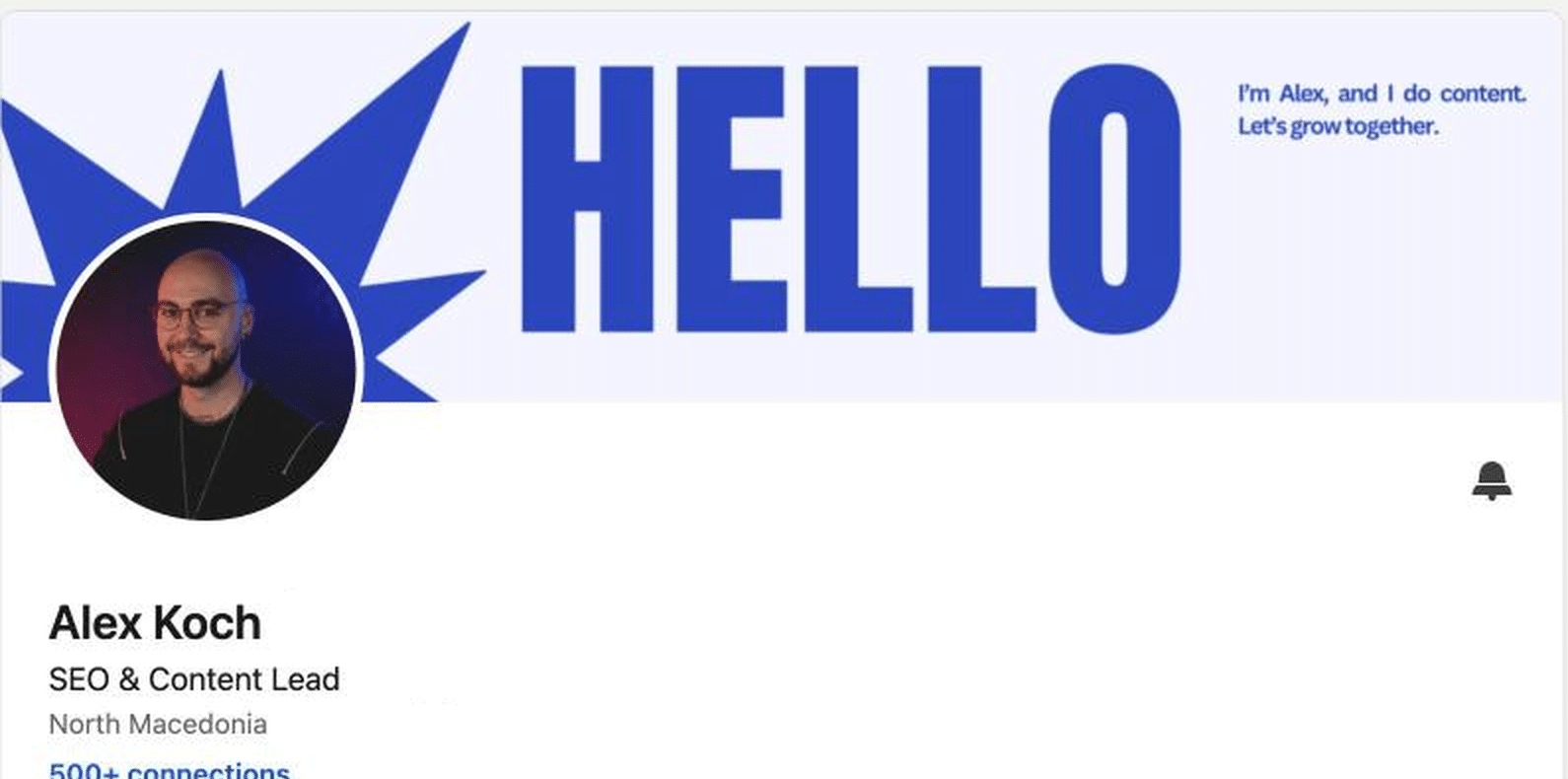
This post answers one question: what is AI SEO, and is the version being sold to you real? To get there properly, I interviewed Alex Koch on my YouTube channel. Alex has spent seven years in SEO, came up through affiliate (the corner of this industry where you either rank or you don’t eat), and now runs SEO and content in-house for a SaaS company. If you’d rather watch than read, the full interview is here:
For the readers, let’s begin where the interview begins: with the story that explains the whole subject.
Alex once ran a tech review site that did a couple of hundred thousand clicks a month. He scaled it into the millions. Then Google’s Helpful Content Update arrived and the site went into what he calls a slow nose dive.
Here’s the strange part. Google never penalised the site. Never de-indexed it. What actually happened, as Alex worked out afterwards, is that one corner of the site (an entertainment section) got popular enough that Google quietly reclassified what it believed the whole site was. The tech reviews didn’t get worse. The competition didn’t get better. Google simply changed its mind about what kind of thing it was looking at, and the rankings followed.
Keep that story in your head. The tech reviews didn’t fail; the entity did. Every pound you will ever spend on AI SEO is, one way or another, an attempt to control how the machines classify you.
Key takeaways
- AI SEO is the work of making your brand known and trusted by the systems that answer buyers’ questions. It is not a new discipline: it is the entity-led SEO that Google’s 2022 Helpful Content Update made mandatory, now with ChatGPT and AI Overviews reading the same signals.
- Buyers are right to be suspicious. The top-voted Reddit answer on the topic calls it “a way for the alphabet salespeople to make more money by not calling it SEO”, and Google surfaces that skepticism on page 1.
- We ran the test live: ChatGPT’s confident “best AI SEO agencies” recommendation, prices included, was assembled almost entirely from four listicle sites most people have never heard of. Whoever is in those lists wins the answer.
- In our research across 137 SaaS companies, 44% of brands ranking in Google’s top 10 were invisible to ChatGPT. The gap is real. The acronym is the sales wrapper.
What is AI SEO?
AI SEO means optimising your brand and content so that AI-driven systems (Google’s AI Overviews, ChatGPT, Perplexity, Claude) discover you, trust you, and cite or recommend you in their answers. Classic SEO aims to rank a page among ten blue links. AI SEO aims to get your brand into the answer itself. Same raw materials, different scoreboard.
Don’t take my word for the definition. Ask Google the question and its own AI answers it before any human result gets a look in:
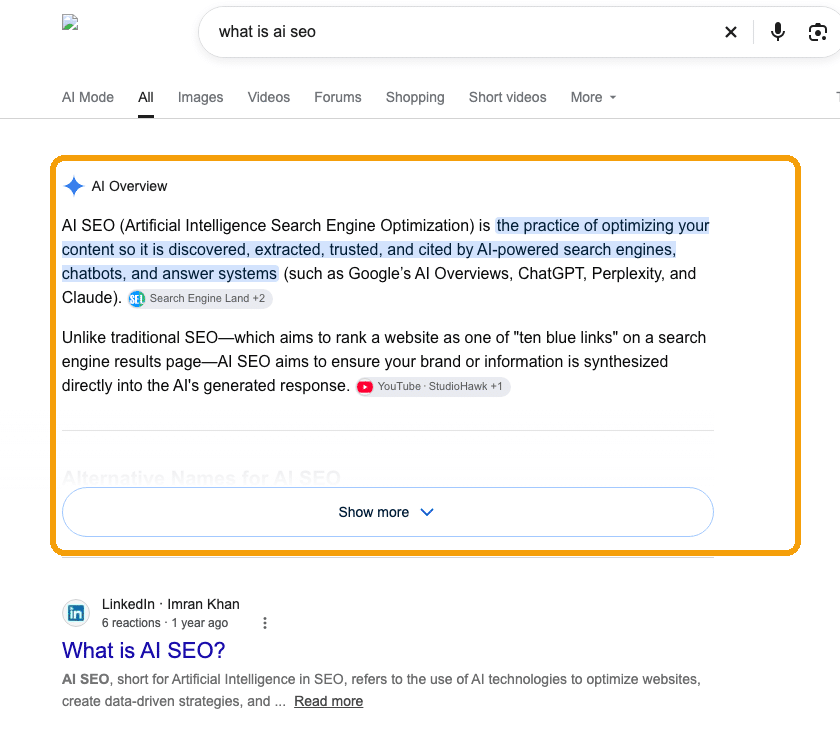
Here’s the part the sales emails leave out, and the core of what Alex and I discussed. None of this started with ChatGPT. It started with the Helpful Content Update in 2022, when Google stopped evaluating pages in isolation and started evaluating the things behind them: brands, people, products, and whether the wider web vouches for their place in a category. Alex puts it bluntly:
“Google moved away from what I call keyword SEO to entity SEO. Whatever you’re searching for, Google needs to understand what that is in order to give you the best results. If your brand is unknown to Google, you are much less likely to rank, even if your content is right. You can do everything right and still not rank, because Google just doesn’t know you as an entity.”
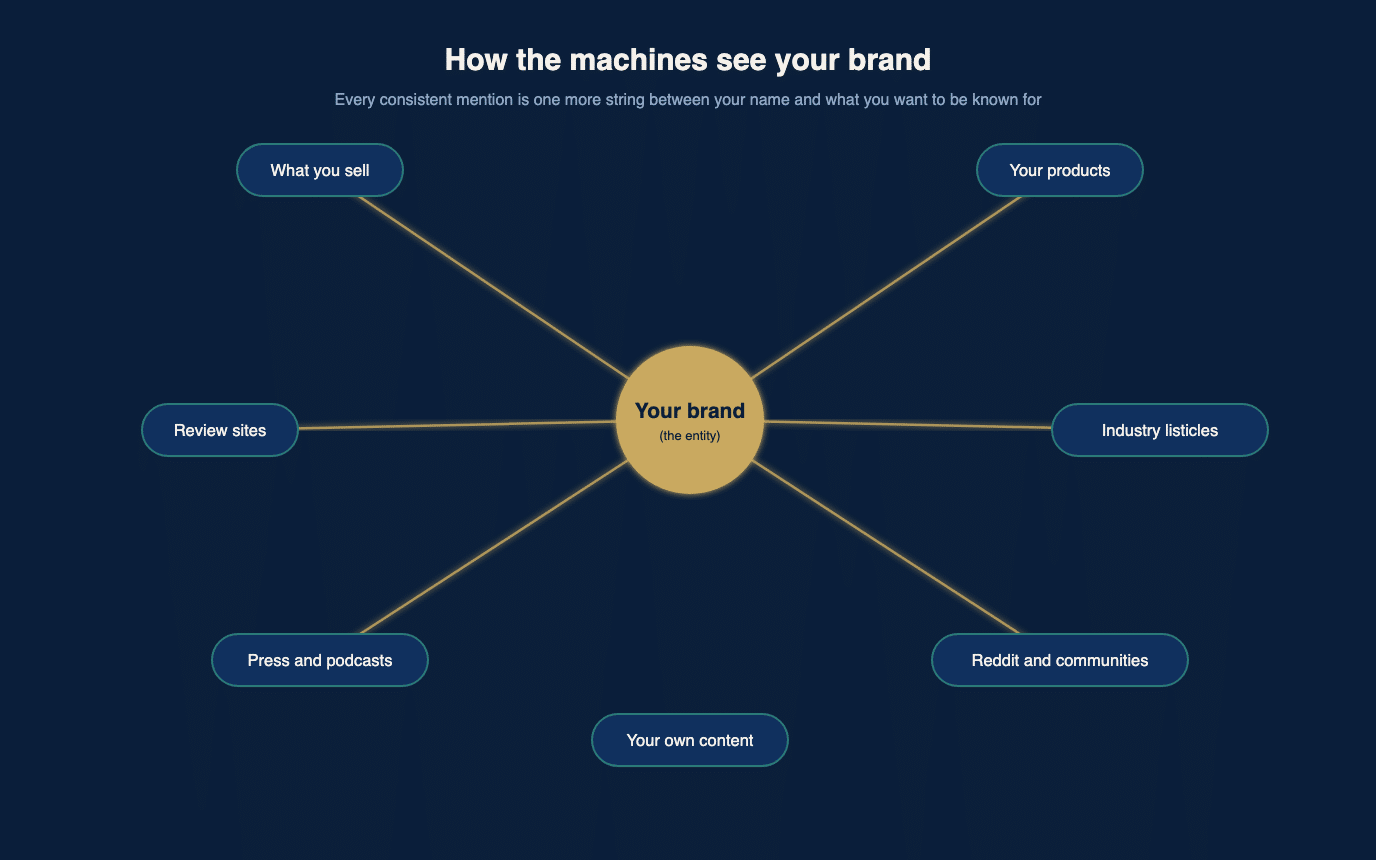
That’s what destroyed his tech site. Google didn’t judge the pages; it re-judged the entity. And it’s why I keep telling people that everything currently sold as AI SEO (brand mentions, Reddit presence, directories, reviews, being talked about consistently across the web) isn’t a new discipline at all. It has been the core of ordinary SEO for four years. The AI answer engines just raised the price of ignoring it, because they read the same web and compress it into a single recommendation.
A picture helps. Think of a detective’s corkboard: your brand in the middle, and every consistent mention, review, listicle slot and community thread as a string connecting you to the thing you want to be known for. The machines decide what you are by the strings:
If you want the deeper version of how the acronyms relate, we’ve pulled GEO, AEO and the rest of the alphabet apart separately. This post stays practical: what the work is, and how to buy it without getting burned.
Why smart buyers don’t trust the term (and why they’re half right)
Search the definitional question and look at what Google surfaces alongside the guides. Real people, asking exactly what you’re probably thinking:
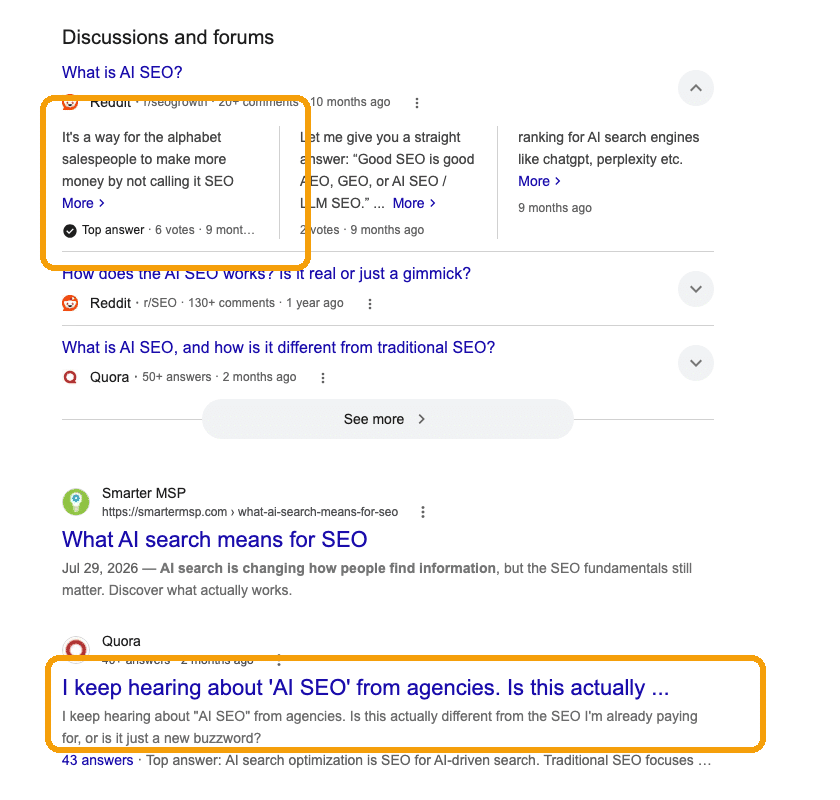
“A way for the alphabet salespeople to make more money by not calling it SEO.” That’s the top answer, and honestly? As a diagnosis of the sales culture, it’s fair. A lot of what’s pitched under this label is ordinary SEO with a new invoice, or worse, checkbox tactics (an llms.txt file here, some FAQ schema there) that nobody has shown to move an AI answer on their own. We checked llms.txt adoption across 3,254 SaaS sites, so this isn’t a guess.
But notice what the skeptics and the sellers both agree on when you strip the attitude away: buying decisions now start inside the answers, and the answers are built from what the web says about you. The disagreement is only about whether that deserves a new name and a new line item. It doesn’t. It deserves the old name, done properly, and judged on whether you show up when a buyer asks.
Walkthrough: watch a five-figure decision get assembled
Rather than argue in the abstract, I ran the experiment the way a real buyer would. I asked ChatGPT, with web search on, to recommend the best AI SEO agencies. Under the hood it does what we described in our query fan-out research: splinters your question into searches, reads what comes back, and compresses it into advice. It came back confident and specific: a numbered list, a one-line verdict per agency, and price ranges from about $3,000 a month to $50,000 and up.
Then I did the thing almost nobody does. I checked the citations. Nearly every source behind that confident answer was one of four aggregator listicle sites. Not the agencies’ clients, not independent reviews, not industry press. Four rankings pages. Here’s one of them:
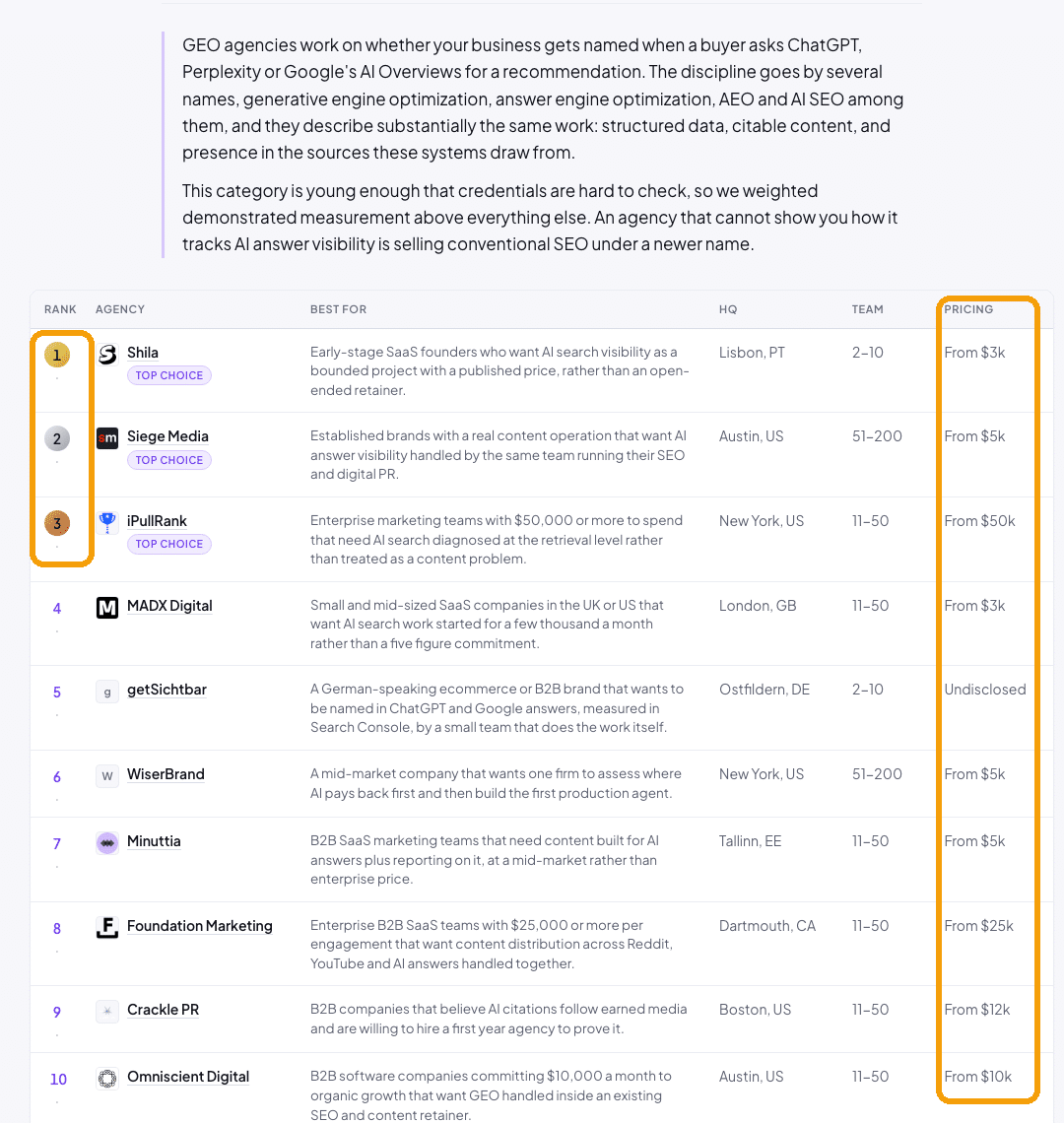
Think about that for a second. A company about to spend five figures a month asks an AI for a shortlist, and the shortlist is retrieval, not judgement: whoever is present and well-described in a handful of source pages gets recommended, with the prices repeated back from the table. The AI didn’t know who was best. It knew who was listed.
This is the single most useful thing a buyer can understand about AI SEO, and it’s the same mechanic our citation gap research across 137 SaaS companies kept finding: 44% of brands ranking in Google’s top 10 were invisible to ChatGPT. Ranking and being known are different achievements, and the second one is built in other people’s pages, in aggregators, directories and lists, which is why directories compound with backlinks in AI search in a way that surprises people.
And it’s not an AI SEO quirk. Try it in any SaaS category
I ran the same test in Alex’s own world. His day job is leading SEO and content at Pabau, which makes practice management software for med spas and clinics. So I asked ChatGPT: what’s the best med spa software?
The shortlist opened with Pabau. The reason ChatGPT gave? A tech listicle had just named it top of the category with an editorial score of 8.6 out of 10, and the rest of the answer was padded out from G2, Software Advice and a few industry sites. Eight sources, give or take, deciding a purchase worth thousands a year. The man spends his days building exactly the mention layer we’ve been talking about, and there’s his employer, first name out of the machine’s mouth. Run the same test for your category: whoever sits in those few pages owns your shortlist. We’ve broken down how to get your SaaS cited by ChatGPT step by step if you want to go deeper.
Want this run on your brand? This exact exercise, your category’s questions through the AI engines, sources mapped, gaps named, is the first thing we do with every client. We’ve published the 12-point framework, and we’ll run it for you free on a thirty-minute AI visibility audit call. No deck, no warm-up quarter, just where your buyers’ answers come from and whether your name comes up.
The market where every answer is a seller
Now the commercial version of the same search. This is page 1 for “AI SEO services”:
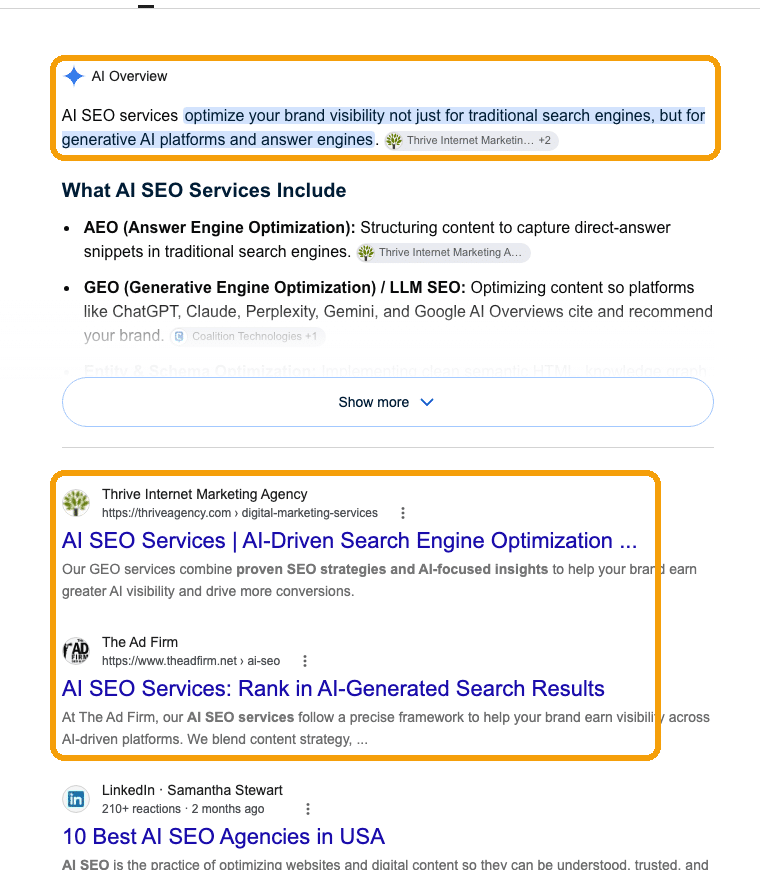
Every single result on that page is either an agency or an agency ranking other agencies. There is no neutral ground, which is partly why I wrote this post the way I did. And ringed at the top you can see the loop closing: the agency that ranks first is also feeding the AI Overview that defines the term. When the sellers write the dictionary, “do your own research” stops being simple advice.
One more specimen, because it shows how the game is actually played by people who are good at it:
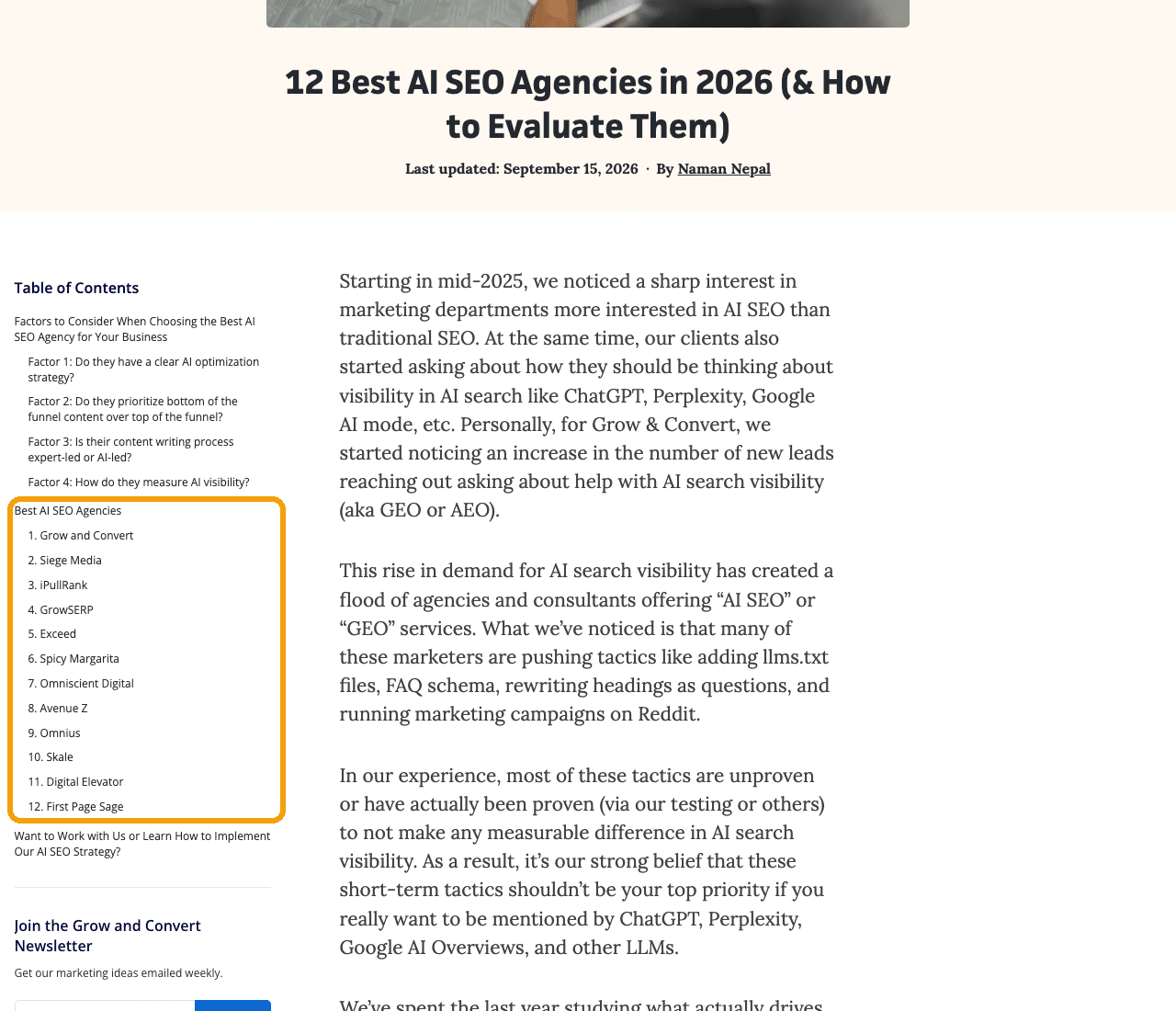
An agency publishes the comparison, puts itself first, and lists eleven competitors underneath. Before you scoff: their article is genuinely useful, it’s honest about snake-oil tactics, and listing your rivals is precisely what makes the page rank and get cited. They understand that these lists are the raw material of recommendations. Alex’s version of the same insight is the scrappiest tactic in the whole episode:
“You still want those brand mentions in listicles, and you can always negotiate. If you’re small and you want to get mentioned in a larger competitor’s listicle, trade: tell them you get two listicle mentions on our site, we get one on yours. That’s massive value for you, and relatively low risk for them, because you’re a small competitor.”
Two mentions for one sounds like a losing trade until you remember whose list carries the weight. As Alex put it, getting your brand into those lists, despite them being run by your competitors, is a high-ROI activity, because they’re the exact sources the AI systems use to decide who to recommend in a category. (Trading visibility has its own craft and its own risks; we’ve covered how link and mention trading actually works separately.) This is the layer most companies can’t build in-house, and it’s the legitimate heart of what authority and reputation work actually sells.
What the real work looks like
So if the acronym is wrapping paper, what’s inside the box when someone’s actually doing the job? In our client work it comes down to five jobs, and you’ve now seen the evidence for each one.
1. Find out what the machines already believe. Before anyone optimises anything, run the questions your buyers ask through ChatGPT, Perplexity and Google’s AI features. The category shortlist. The “is this brand legit” check. You against your main rival. Record whether you appear, how you’re described, and which pages get cited. Those citations are the work list; everything above came from doing exactly this. An agency that quotes a price before doing it is selling a package, not a plan.
2. Make your own site say clearly what you are. The cheap, boring wins: one consistent brand name everywhere, structured data, an about page with real humans on it, product names linking to product pages so every string on the corkboard has somewhere to attach. Most companies have never once audited their site for this, and it’s the part you can fix without anyone’s permission.
3. Publish pages that deserve to be the citation. One page per real buyer question, written from experience that can’t be scraped from anywhere else, building topical authority without publishing 200 posts. This hasn’t changed since 2022; what’s changed is the payoff, because these are the pages AI answers quote. We’ve documented how SaaS brands actually get cited by LLMs if you want the long version.
4. Get into the pages the answers are assembled from. The listicles, comparison pages, review platforms and press that you just watched ChatGPT lean on. Links and mentions with better aim, prioritised by which sources the answers in your category actually cite, not by domain rating trophies. Even unlinked brand mentions count here, because the machines read names, not just hyperlinks. If budget is tight, start with Alex’s trade.
5. Go where your buyers actually talk, and only there. Reddit was, by Alex’s reckoning, ChatGPT’s most-cited source until this spring, and in our own study Reddit showed up in 81.6% of the AI-enhanced Google results we checked. So yes, communities matter, and we’ve mapped which subreddits actually get cited. But Alex’s caveat matters more. Remember who Pabau sells to. As Alex put it, the buyer is “a nurse in California who’s opened a med spa to do Botox injections. She does not go on Reddit.” If your niche is discussed there, show up as a real participant. If it isn’t, that budget belongs in the rooms, podcasts and publications where your buyers actually are. Anyone selling you a Reddit package without asking who your buyer is has answered the question for you.
Then you re-run the job-one questions every month. Not rankings alone: the answers themselves. Whether you appear, how the description shifts, which sources carry you. If a provider can’t show you that tracking, you’re buying the 2019 product with a 2026 label. (We run this loop on our own name, and we’ve published a warts-and-all experiment of the whole system so you can see what the discipline looks like in practice.)
The part nobody puts in the pitch
One more story, this time mine, because it reframes the whole buying decision. I have a partner who runs a web design agency, and their client, an accounting firm in the UK, went from five to fifteen inbound enquiries a week to five to fifteen a day. Not from links, not from AI tricks. From sorting out the messaging and positioning, so that both humans and machines could finally tell what the company actually was.
And that’s the bit that stings. The machines compress what the web says about you into an answer. If what the web says is vague, no tactic fixes the vagueness. The companies winning AI answers right now mostly earned it with years of unglamorous clarity: knowing exactly what they are, and saying it consistently in every place that counts. You’re not too late to start. You’re exactly as late as every competitor your size.
Five questions that expose a weak pitch
I’ve sat on both sides of these calls, and I keep a longer list for vetting any SEO agency. For AI SEO specifically, five questions do most of the damage:
1“What did your audit of our brand find in the AI answers?”
If the pitch landed before anyone looked at how the machines describe you, you’re buying a template with your logo swapped in. You watched me run this audit above in an afternoon. There’s no excuse.
2“Which pages, which placements, and why those?”
Good operators talk in URLs, like the ringed ones through this post. Weak ones talk in acronyms. If the plan can’t name where your mentions will live, there is no plan.
3“Where do the AI answers in our category source from today?”
You’ve seen my category’s version of that table. Ask for yours. If they’ve never pulled it, they’re selling you a map of a country they’ve never visited.
4“Is this separate from our SEO, or the same work?”
The right answer is the same work with a second way of keeping score. Separate line items for SEO and AI SEO usually means paying twice for one job.
5“Can you guarantee citations?”
Anyone who says yes has just failed the interview. The machines decide; the work stacks the odds. That’s the truth, and the good firms say it out loud.
And the red flag that outranks all five: manufactured urgency. Panic is the acronym-seller’s best friend and the buyer’s worst adviser.
Frequently asked questions
Is AI SEO different from traditional SEO?
No. It’s the entity-led, authority-led SEO that Google has rewarded since the 2022 Helpful Content Update, with AI assistants now reading the same signals. The tactics overlap almost completely. What’s genuinely new is what you measure: presence in answers, not just positions on a results page.
Will SEO be replaced by AI?
The ten blue links are shrinking, but the inputs AI answers depend on are the outputs of SEO and brand-building: crawlable content, trusted mentions, clear entities. SEO isn’t being replaced; its results are being read aloud by a new interface. We’ve argued the version of SEO that actually died elsewhere; the brands that fed the old system well are mostly the ones the new one recommends.
Is AI SEO worth paying for?
The work is worth paying for; the label is not. In our 137-company research, 44% of brands ranking top-10 in Google were invisible to ChatGPT, and closing that gap means mention-layer work most teams can’t do in-house. Judge any provider against the five jobs above, not the acronym on the invoice.
How much do AI SEO services cost?
The market runs from roughly $3,000 a month to $50,000 and up, as the pricing table above shows, and the acronym tells you nothing about which end you’re getting. Anchor on scope: an answer audit, named placement targets, content with specific pages behind it, and monthly answer tracking. Price the deliverables, not the discipline; we’ve published the real-numbers pricing breakdown for the link-building half of this work.
Do backlinks still matter for AI visibility?
Yes, arguably more than before, because links and brand mentions are how these systems decide which sources exist and deserve trust. The shift is in targeting: the placements that matter most are the ones AI answers in your category actually cite, not whatever carries the biggest domain rating.
Where this leaves you
If the next AI SEO email in your inbox were honest, it would say: the systems answering your buyers’ questions learn from what the web says about you, your own site is only half of that conversation, and someone has to build the other half deliberately. That’s the product. Everything else is wrapping.
We sell that work, mostly to B2B SaaS companies, and job one is always the audit you watched me run above. If you want it run on your name, that’s exactly what our free AI visibility audit is: thirty minutes on where the answers in your category come from and where you stand in them. And if you’re shortlisting providers, our breakdown of the AI SEO agency market applies the five questions for you.
Thanks to Alex Koch for the conversation that runs through this piece. Seven years in SEO, scar tissue from the affiliate wars, and the clearest explanation of the entity shift I’ve heard. Follow him on LinkedIn; he’s worth it.