

A tech review site is doing a couple of hundred thousand clicks a month. The reviews are solid, the rankings healthy. Then one corner of the site, an entertainment section, gets popular. Nothing about the tech reviews changes, but Google quietly revises its opinion of what the site is. The rankings bleed out over months. No penalty, no notice. The pages didn’t fail; the entity did.
That’s a true story from Alex Koch, who lived it, and it’s the cleanest introduction to entity SEO I know, because it shows the discipline’s central claim in action: machines no longer rank pages in isolation. They rank their understanding of the things behind the pages. This guide explains how that understanding gets built, and how to build yours on purpose.
Key takeaways
- Entity SEO is the practice of making search engines and AI systems correctly understand what your brand is, what it does, and what it should be trusted for, as a thing, not a set of pages.
- It stopped being optional in 2022, when the Helpful Content Update shifted Google from keyword matching to entity understanding. You can do everything right on-page and still not rank if the machine doesn’t know you.
- Entities are built from consistency: one name, one description, repeated across your site, structured data, and every credible third-party page that mentions you.
- The same entity record now feeds AI answers. In our research, 44% of brands ranking in Google’s top 10 were invisible to ChatGPT, almost always an entity problem, not a content problem.
What is entity SEO?
Entity SEO means optimising how machines understand your brand as an entity: a distinct thing with a name, a category, products, people and relationships, rather than a collection of keyword-matched pages. The work spans your own site (consistent naming, structured data, clear identity pages) and the wider web (mentions, listicles, reviews and communities that confirm what you are). Get it right and you rank more easily, appear in knowledge panels, and get named in AI answers. Get it wrong and your content competes with one hand tied behind its back.
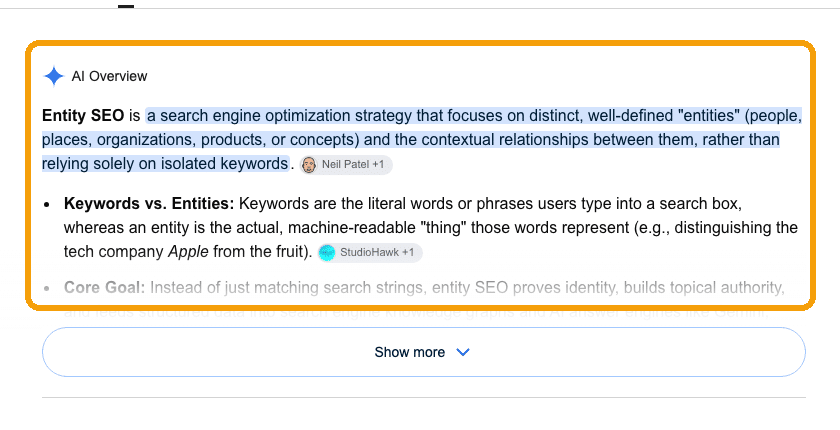
Google’s own AI now explains the discipline this way, which tells you how mainstream the shift has become:
Alex puts the stakes plainly from the practitioner’s side:
“Whatever you’re searching for, Google needs to understand what that is in order to give you the best results. If your brand is unknown to Google, you are much less likely to rank, even if your content is right. You can do everything right and still not rank, because Google just doesn’t know you as an entity.”
None of this is new, by the way. Google announced the shift itself in May 2012, when it launched the Knowledge Graph under a slogan that is still the best three-word summary of entity SEO ever written: “things, not strings”. Hummingbird carried it further in 2013. What changed in 2022 with the Helpful Content Update is that the entity layer got teeth: before it, you could still rank by matching keywords better than the next page; after it, Google increasingly asked a different question first. Who is this, and are they a credible thing in this category? The part of the algorithm that used to lean on links alone now also reads brand mentions anywhere it finds them. That’s the shift that killed Alex’s tech site, and it’s the shift most content strategies still haven’t caught up with.
How machines build their picture of you
Think of a detective’s corkboard: your brand in the middle, and every consistent mention, review, listicle slot, podcast credit and community thread a string connecting you to the concepts you want to be known for. The machines decide what you are by the strings, not by what you say about yourself. And when enough strings agree, the machine writes them down. You have seen the result a thousand times:
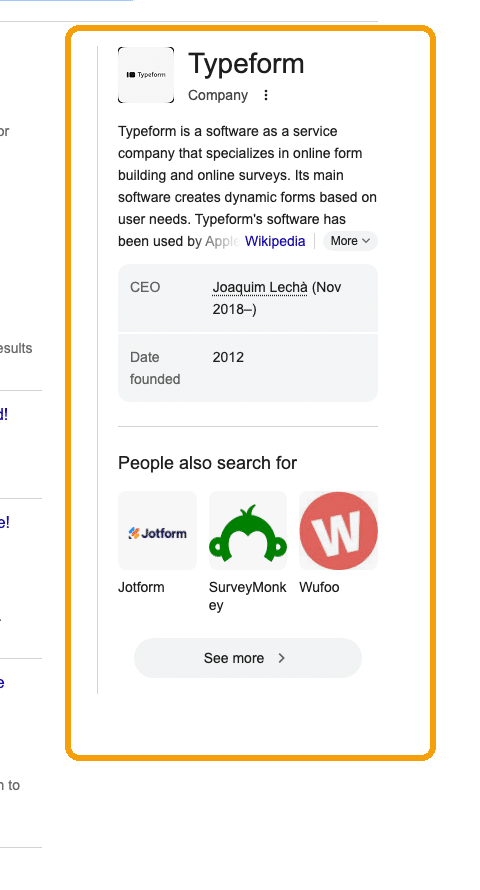
Three things about that corkboard matter more than anything else:
Consistency beats volume. Ten pages that describe you the same way build a stronger entity than a hundred that describe you differently. A brand that is “a form builder” on its homepage, “a survey platform” on G2 and “a data collection suite” in its press releases is three weak entities, not one strong one.
Third-party strings outweigh your own. Your site asserts; the web confirms. This is why unlinked brand mentions carry real weight now: the machine reads names, not just hyperlinks, and a mention on a credible page is a vote about what you are.
Associations are learned, and they compound. Every listicle you appear in alongside your category’s big names teaches the machine you belong in that set. We ran a live experiment on this, watching ChatGPT choose software for an hour, and most of its answers came from exactly this accumulated memory, with no web search at all.
The on-site half: make your identity machine-readable
This is the cheap half, fixable without anyone’s permission, and most companies have never audited it.
One name, everywhere. Pick the canonical form of your brand name and use it without variation: site, social bios, directories, bylines. Every variant splits your entity.
Structured data that states what you are. Organization schema with sameAs links to your profiles, Product schema on product pages, Person schema for your founders. This is you filling in the machine’s form in its own format.
Identity pages that answer identity questions. A real about page with named humans. Product names that link to product pages. Founder names that link to their profiles. Every important noun on your site should have a home, and every mention of it should point there.
Topical coherence. A site that publishes about everything is an entity about nothing; that’s the reclassification trap Alex’s tech site fell into. Build depth where you want to be known, which is the same argument as topical authority seen from the entity side.
The off-site half: get the web to agree with you
The harder half, and the one that moves AI answers. The machine’s picture of you is mostly built from pages you don’t control: category listicles, review platforms, comparison pages, press, podcasts, Reddit and the rest. The work is getting your name into those places, consistently described, next to the category terms you want to own. Directories compound with backlinks here in a way that surprises people, and in our own study Reddit appeared in 81.6% of the AI-enhanced Google results we checked.
We call the deliberate version of this semantic brand positioning: engineering which category, competitors and claims your brand co-occurs with, across every surface the machines learn from. It is the difference between hoping the corkboard assembles itself and stringing it yourself.
And it pays twice. The same third-party pages that strengthen your entity for Google’s rankings are the sources AI assistants retrieve and the memory they train on. One body of work, three scoreboards: rankings, AI Overviews, and chat answers.
How to check your entity today
Ask the machines directly. Prompt ChatGPT and Perplexity: “What is [your brand]?” and “Is [your brand] legit?” Wrong category, stale description or a blank stare means entity work, not content work.
Search your own name. No knowledge panel, or a wrong one, is the on-site half failing. Google “[brand] + [category]” and see whether third parties or only you make the connection.
Audit the descriptions. Collect how you’re described across your top 20 mentions. If they disagree, that’s your work list, in priority order.
In our 137-company research, 44% of brands ranking in Google’s top 10 were invisible to ChatGPT. Almost every time, the gap was this: pages that ranked, attached to an entity the machines had never properly learned.
Frequently asked questions
What is entity SEO in simple terms?
Making sure machines know what your brand is. Classic SEO optimises pages for queries; entity SEO optimises the machine’s understanding of the thing behind the pages, through consistent naming, structured data and third-party confirmation.
Is entity SEO different from keyword SEO?
They’re layers, not rivals. Keywords get a page into consideration; the entity decides how much the machine trusts anything on your domain. Since the 2022 Helpful Content Update, the entity layer increasingly decides first.
Does entity SEO matter for ChatGPT and AI answers?
More than anywhere else. AI assistants compress the web’s view of your brand into a sentence, and brands with weak entities get omitted or described wrongly. The 44% visibility gap we measured between Google rankings and ChatGPT presence is mostly an entity gap.
How long does entity SEO take?
On-site fixes land in weeks. The off-site record compounds over months, because it is built from other people’s pages and, for AI memory, from training runs. Which is the strongest argument for starting before your competitors do.
Where to go from here
Fix the on-site half this month; it’s a checklist, not a campaign. Then build the off-site record deliberately, because that’s the half the machines trust and the half your rivals can’t copy quickly. If you want the entity audit run for you, brand, category and competitors across every engine, that’s the first thing we do inside our LLM SEO service, and the full conversation with Alex that this guide grew from is on the EMGI video channel.