

Everyone in SEO is automating right now. Almost everyone is producing slop. This month I audited a 15-year-old brand that published roughly 3,400 AI-generated posts in 60 days, peaking at 290 posts in a single day. The return: a thin trickle of traffic, and a brand actively diluting its own authority and credibility across thousands of near-identical pages.
We automated nearly everything too. Keyword research, content strategy, writing, publishing, even parts of the link planning. The difference is the result: a brand-new domain, started from zero this January, now on a 1,400-clicks-a-month pace, with buying-intent rankings that a retail client credits with more than doubling their sales of a specific product.
Same technology. Opposite outcomes. The variable is not the model you use. It is the pipeline you put around it, and this post is that pipeline, end to end.
One rule before we start: I am not going to name the site. It is a live commercial asset in a UK consumer category, and naming it would get it cloned inside a week. You get real numbers from Google Search Console, the real system, and redacted specifics. That trade is the whole reason I can publish this at all.
Key takeaways
- A new domain went from 0 to a 1,401-clicks-a-month pace in eight months, with around 100 pages and 84 deliberately low-authority links (Google Search Console, through 20 September 2026).
- Automation was aimed at judgment, not volume: every automated step reproduces what a good strategist does, and every gate a human would apply still exists.
- The traffic is buying-intent: top queries sit at positions 2 to 6 with 4 to 6% CTR, and the retailer those pages recommend saw sales of one specific product more than double.
- The anti-pattern is real: a site we audited publishing 250+ AI posts a day earns a thin trickle of traffic while spreading its authority across thousands of near-identical pages.
This SEO automation case study in numbers (Google Search Console, January to September 2026):
- 0 to a 1,401 clicks-a-month pace in 8 months on a brand-new domain
- 3,540 lifetime clicks, 184,000 impressions, average position 10.3
- Around 100 pages published; the top 10 pages earn 74% of all clicks
- 84 guest-post links in monthly batches of 10 to 14; the growth inflection lagged link velocity by 3 to 4 months
- 46,400 impressions inside Google’s generative AI features since May
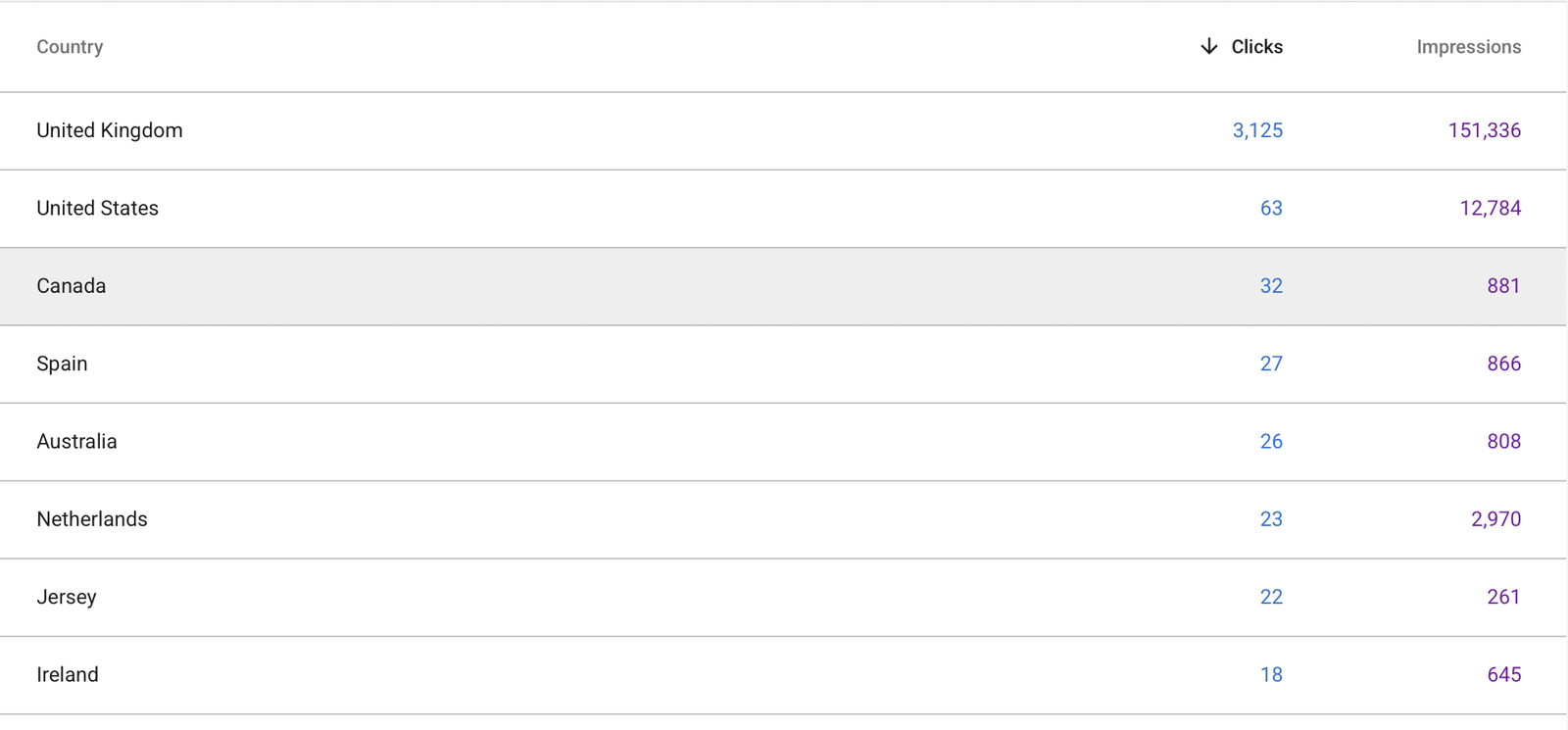
- 88% of clicks from the UK, matching a deliberately UK-weighted link profile
Cite any of these numbers freely; a link back to this page is appreciated.
What does SEO automation actually mean in 2026?
SEO automation in 2026 means using AI and scripts to run the repeatable layers of search marketing: keyword and SERP research, content clustering, drafting, internal linking and publishing, while humans keep the decisions that compound: niche selection, quality gates and link strategy. In our experiment, that split took a new site from 0 to a 1,400-clicks-a-month pace in eight months.
Here is the honest map of what we automate fully and what we refuse to:
- Fully automated: keyword universe pulls, live SERP retrieval and analysis, SERP-overlap clustering, content briefs, first drafts, internal link insertion, image generation, publishing via the CMS API.
- Human, always: choosing the battlefield, the kill-list decisions on which keywords not to chase, the final read on every page, and every single link placement.
Notice what is missing from the automated column: nothing there decides anything. The machine executes; the judgment stays with a person. That distinction sounds philosophical. It is actually the entire difference between the two GSC curves in this post.
The experiment: an SEO automation case study, start to finish
The setup was deliberately hostile. A brand-new domain registered with no history, no audience, no social profiles, no brand searches, and no connection to our agency. A UK consumer category with real buying demand. A content budget that would embarrass most in-house teams.
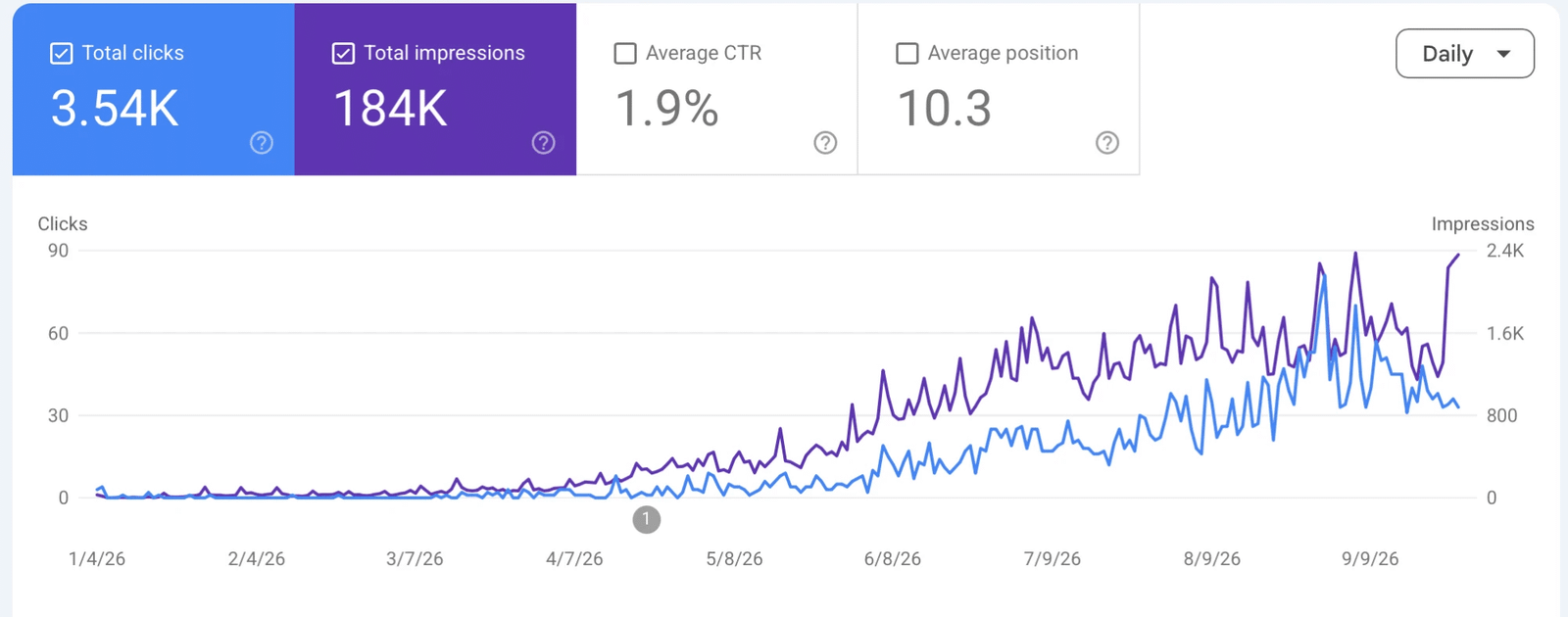
The result, straight from Search Console:
The same curve, redrawn month by month for readability:
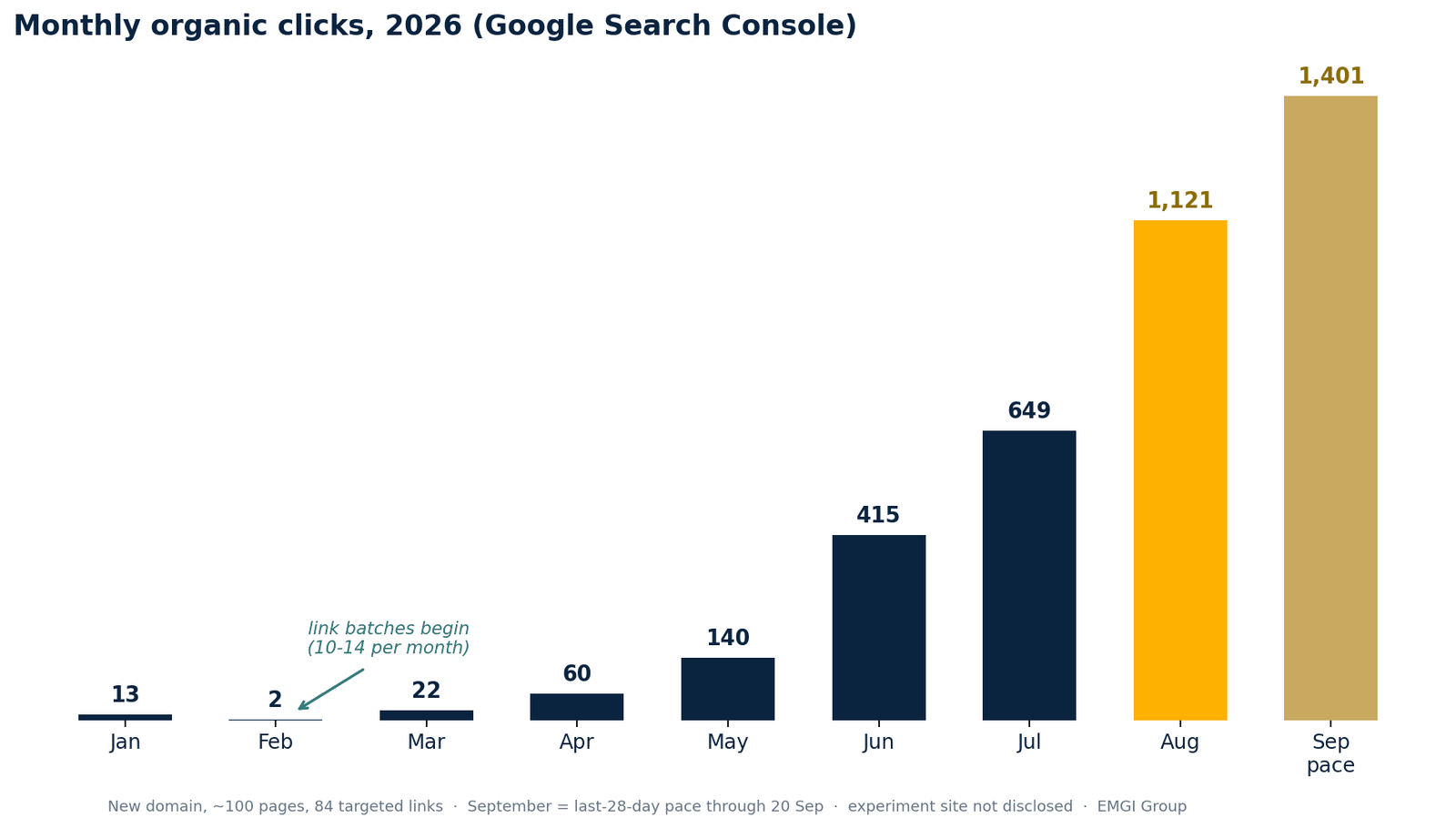
Read the left side of that chart honestly, because it is the part everyone hides. The first three months produced 37 clicks in total. Not 37 a day. Thirty-seven, across ninety days, while impressions quietly climbed from a few hundred to over two thousand a month. Impressions led clicks by roughly 60 days the whole way up, which makes them the leading indicator most people ignore while they panic and rewrite everything.
Step 1: Keyword research that starts from the SERP, not a tool export
Most keyword research is a spreadsheet of wishes. A tool exports 2,000 keywords, someone sorts by volume, and the content calendar fills up with terms the site will never rank for. Our pipeline inverts that: volume is nearly the last thing we look at.
The automated sequence runs like this:
- Seed the entity. One narrow subject the site will cover completely. Not a topic area. An entity.
- Pull the universe. Every query family around that entity, with volume, difficulty and CPC attached.
- Pull the SERP for every candidate. This is the step almost nobody automates and it changes everything. The question is never “what is the difficulty score?” It is “who is actually on page 1?”
- Apply the kill filters. Difficulty above our ceiling: dead. Informational query with no path to a buyer: dead. Page 1 full of dedicated specialist sites: dead. Page 1 full of retailers, generalists and forum threads: alive, because a focused page beats an incidental one.
- Cluster by SERP overlap. If two keywords share five or more of the same top-10 results, they are one page. Never two. This single rule prevents the self-cannibalisation that kills most scaled content, and it is the exact rule the slop factories break hundreds of times a week.
Roughly 90% of the keyword universe dies in those filters. What survives is a short list where every entry has a reason to exist, and that is the difference between a content plan and a keyword wishlist.
Worth being concrete about how this runs day to day, because “automated” hides the interesting part. My input is one line: the seed entity, the market, and the quality bar. The pipeline, Claude orchestrating DataForSEO’s keyword and SERP data, does the pulling, the SERP checks and the clustering, and hands back a machine-readable cluster plan: every cluster typed by intent (transactional, commercial, informational), every post assigned a template, a target and its internal links, before a word exists. Content strategy becomes a review step, not a brainstorm. I approve, veto or reorder clusters; I never assemble them. Each sprint of posts is drafted, checked and published from that plan, and the next sprint starts from fresh rankings data, so the calendar is steered by what actually moved.
Step 2: Content strategy planned as an architecture, not a list
Before a single word was drafted, every surviving query cluster was assigned a page, and every page was assigned a job: convert, build trust, or feed authority to a page that converts. The internal links between them were mapped at the same time, with varied anchors, so the site launched as a structure rather than accumulating as a pile.
The format hierarchy that won, ranked by what the rankings data actually shows:
- The association page. One page answering a question that a much bigger, household-name company creates demand for but never answers properly. This is the site’s biggest traffic driver and it ranks for eight or more query variants on its own. Think of the SaaS equivalent: “which CRM does that famous accelerator hand to every startup”, asked thousands of times, answered by nobody.
- The review and verdict hub. Catches the review, reviews, problems and complaints variants in one place.
- Range reviews. One page per product range catches every model-number long-tail inside it. One page, dozens of queries. Pound for pound the hardest-working format on the site.
- Vs comparisons. Head-to-heads against adjacent premium names. Each reached page 1 within months.
- Buyer-situation guides and trust posts. Low volume, highest CTR on the site, and they feed everything above them.
Here is what that mix looks like in the account, with the URLs redacted and the formats labelled:
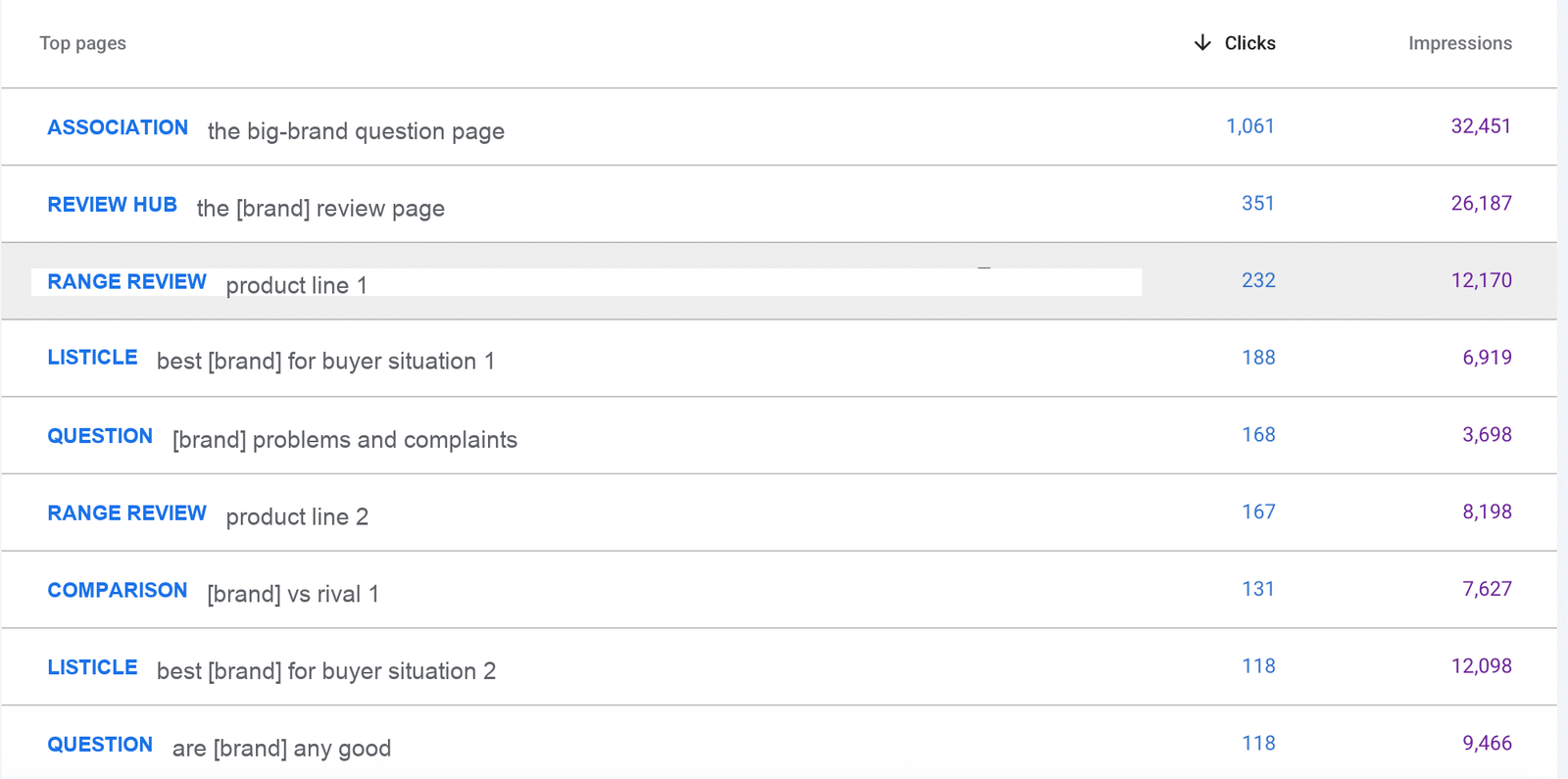
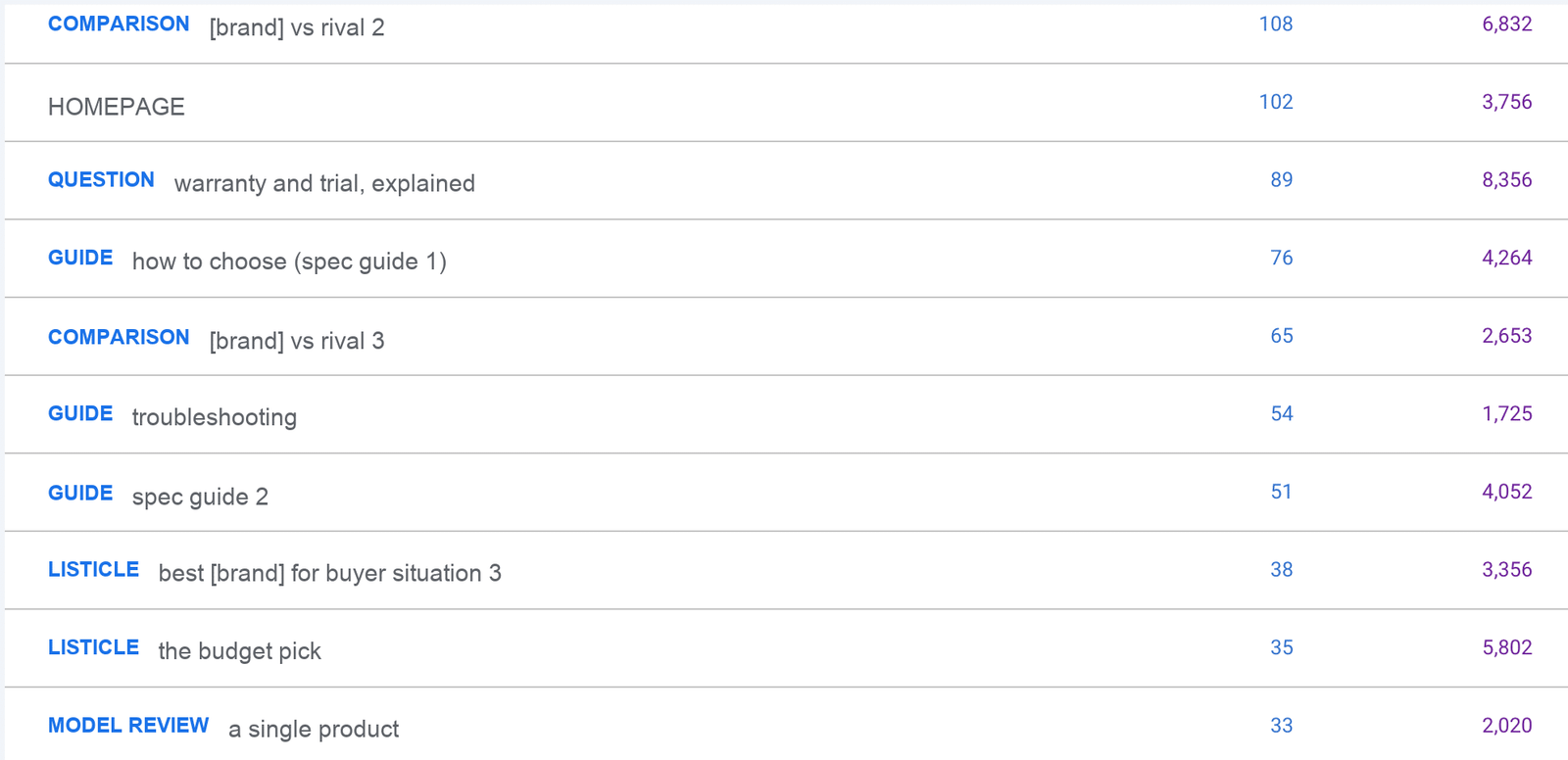
The pattern behind the pattern: formats follow the buyer’s diligence sequence, not the keyword tool’s export order. People check the association, then the verdict, then the specific model, then the comparison, then the objections. The site is that sequence, page by page. That is also what topical authority actually is: complete coverage of a narrow entity, in the order buyers think.
And this is where the firehose sites get the theory exactly backwards. Topical authority comes from comprehensive coverage of a subject, so they publish every keyword variation as its own page and call it coverage. It is not coverage, it is dilution: authority and crawl attention spread across hundreds of near-duplicates, none of them strong enough to earn anything. Successful brands do the opposite. They build a small number of content assets that each own a real question completely, and let every page make the others stronger.
Step 3: Automated writing that does not read automated
This is the section everyone asks about, so let me be precise about what “automated” means for the words themselves. Drafts are machine-written. Pages are not machine-published. Between those two states sits a set of gates, and the gates are the product:
- Research-grounded drafting. Every draft starts from the live SERP analysis and real product data, never from a bare prompt. The model is summarising evidence we hand it, not inventing an article.
- One page per intent. The anti-permutation rule. The audited firehose site I mentioned runs ten near-identical pages per query family; we measured under 5% literal overlap between two of its sibling pages and 100% overlap of intent. Ten pages, one query, all competing with each other.
- Experience injected. Real observations, real numbers, actual opinions with reasons. The things a model cannot invent are exactly the things Google’s quality systems and AI answers select for.
- A style gate. A banned-vocabulary list that strips the tell-tale AI phrasing, enforced British English, and a rule against hedge-everything prose. The firehose site’s pages read like disclaimers. Disclaimers do not get cited.
- A human reads every page before it goes live. Not skims. Reads. The machine drafts; it does not decide.
Automation multiplies whatever process you feed it. Slop in, slop at scale. Judgment in, judgment at scale. The technology in both curves on this page is the same; the process is not.
Step 4: The boring plumbing, automated end to end
Publishing runs through the CMS API from templated builds: consistent markup, schema, image generation, compression, internal links inserted with anchor variation rules enforced in code rather than by memory. None of this is glamorous. All of it compounds, because consistency across 100 pages is itself a quality signal, and hand-published sites drift.
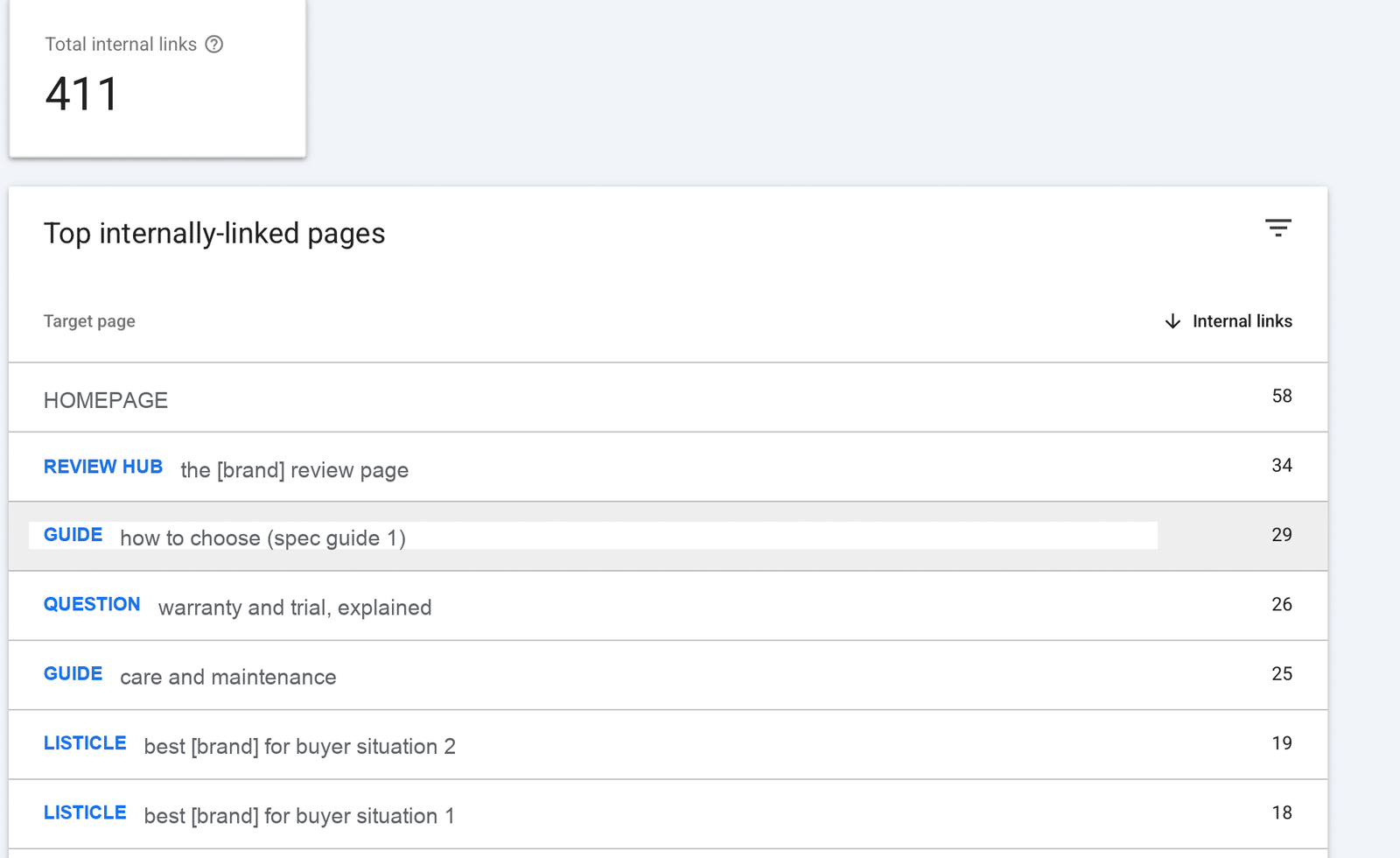
The internal linking is the visible part of that discipline. 411 internal links across roughly 100 pages, weighted deliberately: the homepage, the review hub and the trust guides carry the most, because they are the pages every other page should lift:
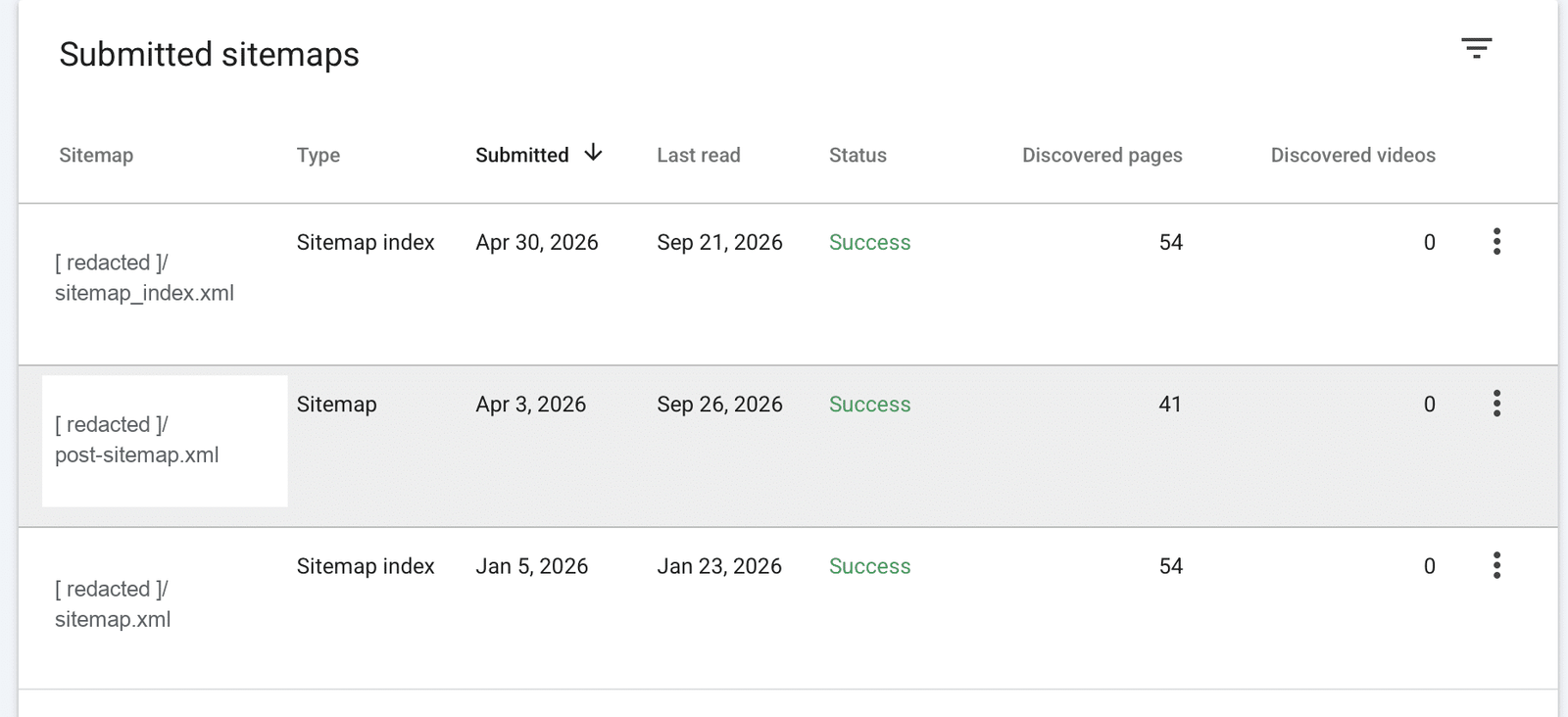
The site currently holds around 100 pages, and here is the concentration stat that matters: the top 10 pages earn 74% of all clicks. We did not need 4,000 pages. We needed the right 100, with the right 10 carrying the weight, which is a good moment to talk about links.
Step 5: The link programme, calibrated to the niche rather than to a vanity bar
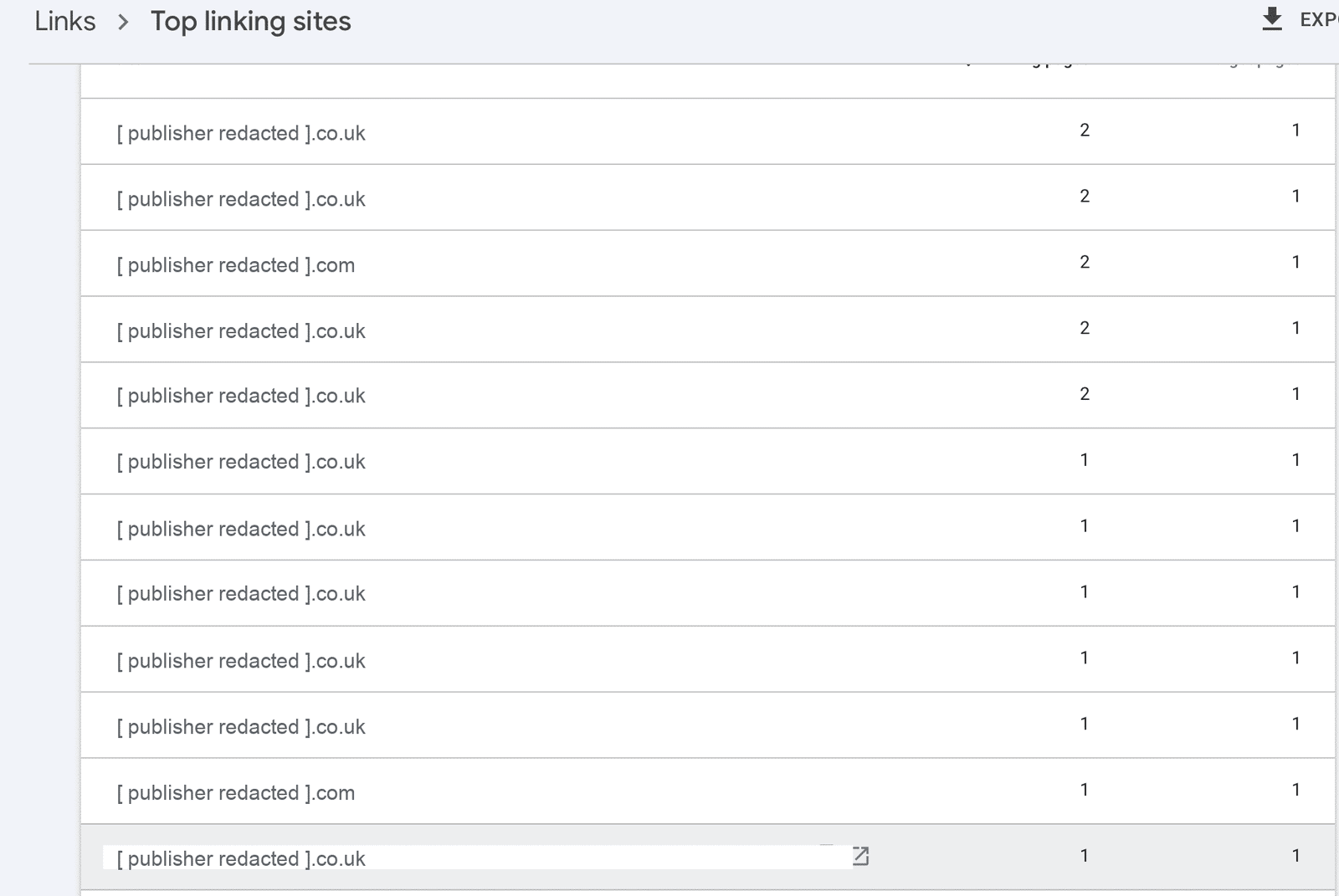
84 links, built in monthly batches of 10 to 14 from February onwards. Every one a guest post on a small but real publication, each with a unique article written around the target page’s topic, so anchors and context vary naturally. No link exchanges, no sitewide footers, no networks.
Two deliberate choices made this programme unusual:
- We went low-authority on purpose. Page 1 in this niche is retailers and generalist magazines, not link-hoarding specialists. We judged that modest, relevant links would clear the bar, and they did. To be clear: these are not the links we build for SaaS clients, where the competitive bar is entirely different. The transferable principle is calibration. Match your link quality to what page 1 actually holds, not to a difficulty score or a DR target that makes a report look good.
- We concentrated. 24 pages received links, but 58% of the entire programme went to the top five commercial pages. The winners got 8 to 13 links each; the long tail got one or two. Anchor discipline did the rest.
Two honest notes on quality, because this is where most link write-ups go quiet. First, the selection bar was semantic relevance above all: every placement is an article genuinely about the target page’s subject, on a site that publishes around that subject’s world. Second, the guest-post mechanic itself caps the ceiling: the strongest publications rarely accept guest posts at all, so a guest-post-led programme is structurally a mid-tier programme. These are not bad sites; they are real, relevant, mostly UK publications. For this niche, at this competition level, that trade was the right one, and the results say it worked. In a harder market the same logic points to a higher bar, not a different principle.
The timeline is worth staring at. Link velocity started in month two. The growth inflection arrived in months five and six, a lag of three to four months, and compounded from there. Anyone who tells you links pay off next month is selling you something. Anyone who tells you they do nothing is reading the wrong chart.
Want this run for your company? The same pipeline, pointed at queries worth far more per click. Book a free AI visibility audit and I’ll show you where your gaps are.
The part nobody else has: rank quality, and where the demand actually goes
Traffic curves are common. Here is what makes this one worth writing about: the site does not monetise attention. It routes demand.
Look at what the rankings are, not just how many. The top queries in Search Console are buying queries: “where can I buy” questions at position 5, “sale” queries at position 6, specific model names at positions 4 to 5, all with click-through rates between 4 and 6%. This is a person with a card in their hand, and every one of those pages recommends a specific retailer at exactly that moment.
That retailer is a client of ours, and this is where the experiment stops being a traffic story. Since the programme began, their sales of one specific high-ticket product our pages recommend have more than doubled. These are products priced between one and three thousand pounds, so you can do the arithmetic on what doubling looks like: our honest estimate, and I label it as an estimate because attribution at this distance is never clean, is a revenue influence in six figures a year. The corroboration I trust more than any analytics dashboard: the client saw their own sales numbers and approved continuing the investment. Budgets renew on results, not on reports.
Then there is the layer that did not exist two years ago, and Search Console now measures part of it. The Generative AI features report shows 46,400 impressions inside Google’s AI experiences since May, running at roughly 500 a day:
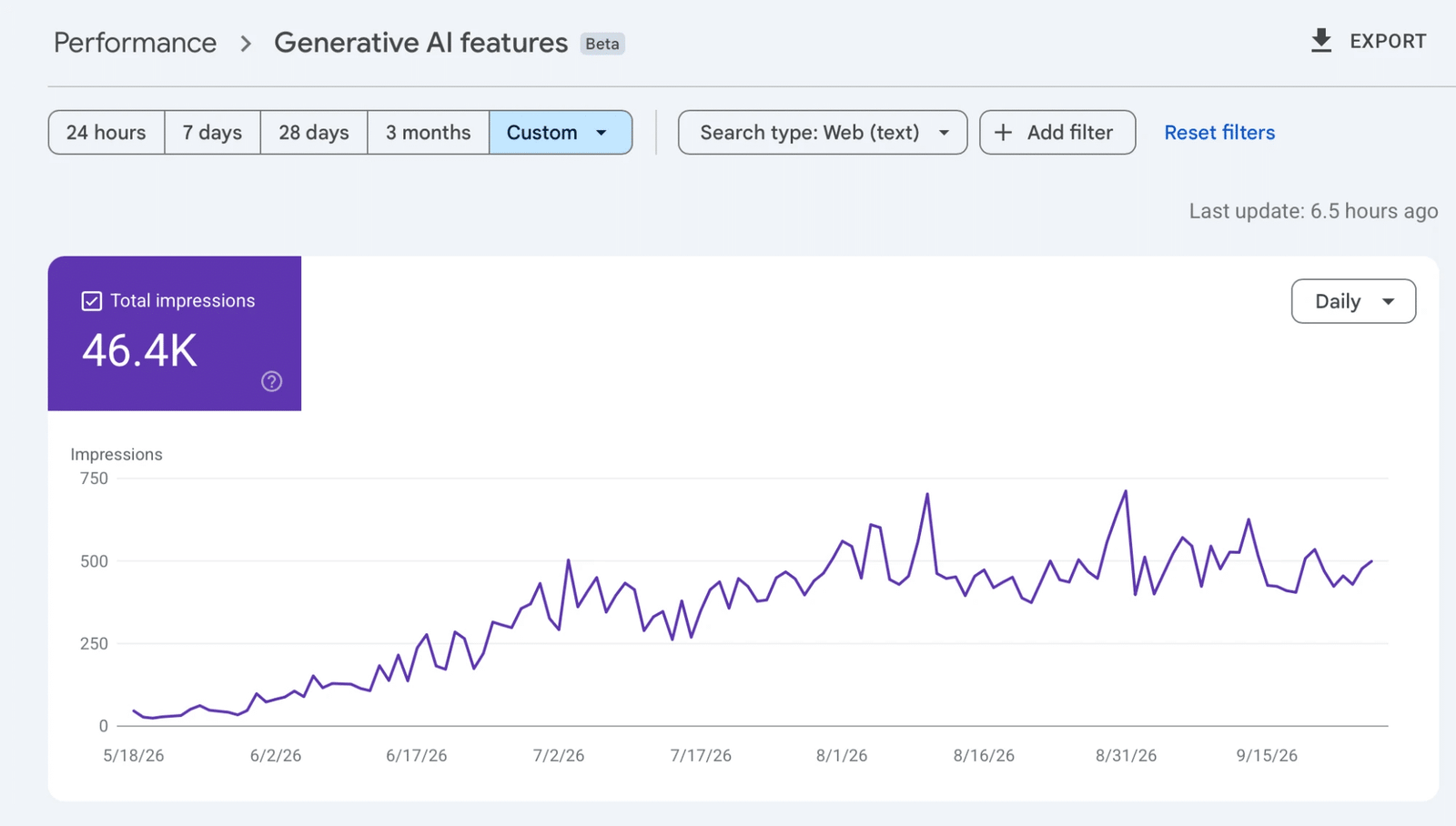
Clicks undercount this influence badly. A buyer who reads the answer, sees the recommendation and goes straight to the retailer never touches our site, and still converts because of it. That is why the retailer’s sales, not our traffic, is the honest scoreboard. It is the same mechanic our AI citation gap research documents in B2B: the answers are assembled from the pages around a brand, and whoever builds those pages holds the pen. We also asked a leading AI assistant where to buy in this category. The answer cited our site as a source and named our client as a recommended retailer, in the same breath. The satellite content has become the evidence the machines quote when they make a recommendation. If you have read our work on owning the recommendation layer, this is that thesis running in production: the sites around a brand decide what the answers say about it, and whoever builds those sites holds the pen.
The results, honestly read, including what we cannot prove
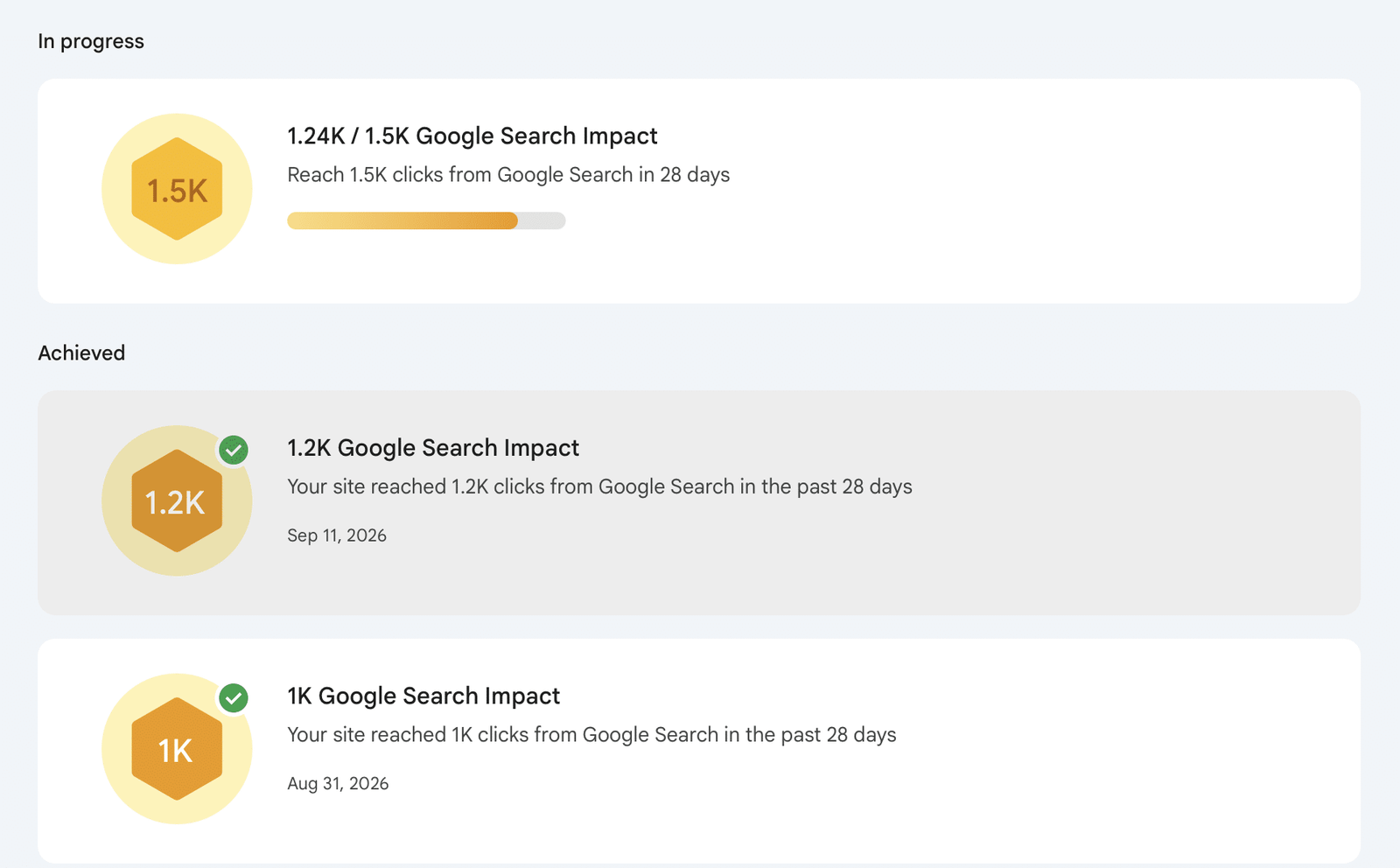
Here is everything a less comfortable version of this post would leave out.
- We cannot cleanly separate content from links. Both ramped together and there is no control group. What the data supports: the content-only months produced impressions but almost no clicks, the inflection followed link velocity by three to four months, and neither half looks sufficient on its own.
- The first quarter looked like failure. 37 clicks in 90 days. If we had judged the system on a 90-day window, we would have killed a site now pacing 1,400 clicks a month.
- Not every page worked. A long tail of pages earns almost nothing individually. In this architecture that is by design, they exist to feed the ten that matter, but nobody should pretend every published URL is a winner.
- The revenue number is an estimate. Doubled sales of the product is client-reported fact. The six-figure influence is our arithmetic on top of it, and I would rather show you the maths than sell you the certainty.
Why write it this way? Because the slop economy runs on certainty, and certainty is exactly what the data never gives you. The strongest claim this experiment supports is also the most useful one: a disciplined, automated pipeline with human judgment at the gates reliably beats both the manual grind and the firehose.
What this means if you run a SaaS content operation
You are probably not selling high-ticket consumer products. The mechanics transfer anyway, because the SaaS version of every move here is a move we already run for clients: the association page becomes your alternatives and comparison layer, the range review becomes your use-case hub, the demand routing becomes the third-party layer that decides whether AI answers shortlist you, and the calibrated links become links that clear a much higher bar. We analysed 150 real SaaS strategies this year, and the winners were running exactly this shape: concentrated pages, aimed authority, judgment over volume.
The uncomfortable question for most SaaS content operations is not “should we automate?” You already are, or you will be within a year. The question is what your pipeline multiplies. If the answer is a keyword wishlist and a publish button, you are building the 4,000-page site with under two visits per post. The machines are neutral. The process is the strategy, and the results, in search and AI answers alike, follow the process.
And if you want to watch the judgment layer of this system applied by hand, in public, we ran a full live audit on Cal.com using exactly the same thinking:
Frequently asked questions
What SEO tasks can actually be automated in 2026?
Keyword and SERP research, overlap clustering, drafting, internal linking, image generation and publishing can all run automated. Niche selection, quality gates, final review and link decisions should stay human. Our experiment automated the first list end to end and reached a 1,400-clicks-a-month pace in eight months.
Does Google penalise AI content?
Google penalises scaled low-value content, whatever wrote it. The distinction is visible in data: a site we audited publishing 250+ AI posts a day earns a thin trickle of traffic spread across thousands of near-identical pages, while our gated site concentrates roughly 100 pages into a 1,400-clicks-a-month pace. The gates, not the generator, decide the outcome.
Can AI-written content rank on Google?
Yes, when every draft starts from live SERP research, targets one intent per page, carries real experience and passes a human read before publishing. Our machine-drafted pages hold positions 2 to 6 on buying-intent queries with 4 to 6% CTR, on a domain that did not exist a year ago.
Do you still need backlinks if your content is automated?
On this evidence, yes. We built 84 targeted guest-post links, 58% of them aimed at just five commercial pages, and the growth inflection followed link velocity by three to four months. Content alone produced impressions; the combination produced clicks.
How long does automated SEO take to show results?
Expect a dead-looking first quarter. Our site earned 37 clicks in its first 90 days, then 415 a month by month six and 1,121 by month eight. Impressions led clicks by roughly 60 days throughout, making them the metric to judge early progress on.
The pipeline is the product
Strip this post to one sentence: automation did not make our SEO cheaper, it made our judgment scale. The same tooling that produces 4,000 invisible pages for one company produced 100 pages, a 1,400-click pace and a doubled product line for another, and the only difference is what sat in the pipeline.
We run this system for our clients, mostly B2B and SaaS companies, where a click is worth a great deal more than it is in consumer retail. If you want to see what it finds on your site, book a free AI visibility audit or start with our SaaS link building service. I will show you your version of this chart, including the part that looks like failure.
This is still a live experiment and we are testing more as it runs. But it is already a great result, and we are genuinely happy with how far SEO can be automated when the judgment stays in the pipeline.