
Best GEO Agencies 2026: 10 Generative Engine Optimisation Specialists, Grouped by the Mechanism They Move

By Matt Emgi · Updated July 2026
72% of B2B software buyers now use ChatGPT to evaluate vendors, and 51% of tech brands have zero AI citations to show for it (MarketScale, on Averi’s analysis of 680 million citations, 2026). That gap between where buyers ask and where brands appear is the entire generative engine optimisation industry, and it has spawned dozens of agencies in about eighteen months. Some are genuine specialists. Some are SEO retainers wearing a new badge. Some are software dashboards being sold as strategy.
I run one of the agencies on this list, so the same rules as every list I publish: EMGI is placed where I believe we honestly belong, with our weaknesses stated, and everyone else gets a fair, sourced write-up with the caveat their sales page leaves out. One thing you should know about this category before reading any “best GEO agencies” article, including this one: almost every list ranking GEO agencies is published by a GEO agency that ranks itself first. I have cross-checked every entry against at least two independently authored sources, and where an agency’s main evidence is its own listicle, I say so.
Scoping note: this is the specialist list, for buyers whose brief is specifically “get us into the AI answers”. If what you actually need is a full search partner for the AI era, Google rankings included, start with my companion list of the best AI SEO agencies; only two names appear on both lists, deliberately.
Updated October 2026. Every agency’s pricing re-verified from its own site, homepage screenshots added, and a live test added showing how the AI engines actually pick GEO winners.
TLDR: the quick answer
- Best for B2B SaaS wanting both mechanisms moved at once: EMGI Group (from $4,000/mo, no long lock-in).
- Citation outreach at scale: Skale. Regulated enterprise: First Page Sage ($6,000-12,000/mo, month-to-month). Pipeline-tied content: Omniscient Digital.
- GEO-native boutique: Discovered Labs. Bottom-funnel queries: Breaking B2B. Low-commitment start: Optimist. EU SaaS: Omnius. Enterprise technical: iPullRank and Go Fish Digital.
- Before you trust any list, ours included: our live ChatGPT test found the “best GEO agency” answer assembled from a press release the winner wrote itself. The receipts are below.
What is GEO, and how does it actually work?
Generative engine optimisation (spelled generative engine optimization in the US; GEO either way) is the work of making your brand the one AI engines retrieve, cite and recommend: in ChatGPT answers, Google AI Overviews, Perplexity, Claude and Gemini. The mechanics matter because they dictate what the work is. When an AI engine answers a buying question, it either recalls brands from training data or runs live searches and merges what it retrieves. In our capture of the hidden queries behind SaaS buying prompts, 69% of ChatGPT’s sub-queries contained a brand name and 56% of its citations went to vendor-owned pages, but only for vendors already in the conversation. GEO, done properly, is the work of getting into that conversation: on your own pages, on the third-party pages engines cite, and in the communities they quote.
The analogy I use with clients: model memory is your reputation, retrieval is your references. When an engine answers from memory, you are living off every mention it absorbed in training, like a reputation that precedes you into the room. When it searches live, it is phoning your references, and it phones listicles and communities far more often than it phones you. A GEO programme that only edits your website is a candidate polishing their own CV while having no reputation and no referees.
That last surface is bigger than most people think. Google’s AI surfaces quoted Reddit somewhere in 81.6% of the SaaS buying queries we measured, and a 5W Public Relations audit of roughly 600,000 ChatGPT citation events found Wikipedia and Reddit alone drive over a quarter of US citations. Any GEO agency whose plan is entirely about reformatting your website is optimising a minority of the machine.
What separates a GEO specialist from GEO branding? 6 criteria
1. A real citation mechanism, explained plainly. If they cannot tell you how an engine picks its sources, they cannot change which sources it picks.
2. Off-site authority is in the delivery, not the appendix. Citations follow authority, the argument we lay out in full in the one game underneath GEO, SEO and AEO. In our capture above, the engines cited vendors already inside the answer’s vocabulary and handed the rest of their citations to third-party pages; nothing an agency does purely on your domain reaches either surface. Agencies that cannot build links, mentions and community presence are working with one hand.
3. Named clients, named numbers. This young market is thick with anonymous multipliers. The agencies below with named, checkable results get credit for it.
4. Measurement across engines, monthly. AI Overview trigger rates swung from 6% to 25% and back to 16% within a single year (Semrush’s 10-million-keyword study), and answers vary week to week. One-off audits are snapshots of weather. You need the climate record.
5. Priced like a service, not a secret. Mid-market GEO lands at $5,000 to $10,000 a month; entry engagements exist from $1,500. Long lock-ins deserve scrutiny in a market this new.
6. They are visible in AI answers themselves. The product should work on its maker.
The 10 best GEO agencies at a glance
| Agency | Mechanism | Best for | Pricing signal |
|---|---|---|---|
| EMGI Group | Memory + retrieval | B2B SaaS GEO built on authority | From $4,000/mo |
| Skale | Memory | AI citation outreach for scaling SaaS | From ~$4,000/mo (own listing) |
| First Page Sage | Memory | Regulated, considered-purchase enterprise | $6,000-12,000/mo, month-to-month |
| Omniscient Digital | Retrieval | GEO tied to pipeline, funded SaaS | From $10,000/mo |
| Discovered Labs | Retrieval | GEO-native framework delivery | From €6,995/mo (6-mo term); €4,370 audit |
| Breaking B2B | Retrieval | Bottom-funnel comparison queries | From $4,000/mo, 6-12 mo terms |
| Optimist | Retrieval | Transparent, low-commitment start | $7,500 roadmap; $3-4k/mo |
| Omnius | Retrieval | EU SaaS and fintech | Not public |
| iPullRank | Technical | Enterprise technical GEO | Not public (est. $10k+/mo) |
| Go Fish Digital | Technical | Patent-level retrieval rigour | Not public |
A quick note on the EMGI entry before you read on
I own EMGI, so treat my entry as a claim to verify, not a neutral verdict. The verification is unusually easy though: our position on how GEO works is published as open research with public datasets, and the criteria above come straight from it. Disagree with the research and you should discount our entry. Most of this market asks you to trust a methodology slide; I would rather you check our data.
Before you read any list (including this one): watch the category get decided
This is a listicle written by an agency that appears in it, so you should demand receipts. Here they are. In October 2026 we asked ChatGPT, with web search on, to name the best GEO agencies. Its number one pick was a firm few practitioners have heard of, and the deciding source was a press release on a newswire, bylined by the winner itself:
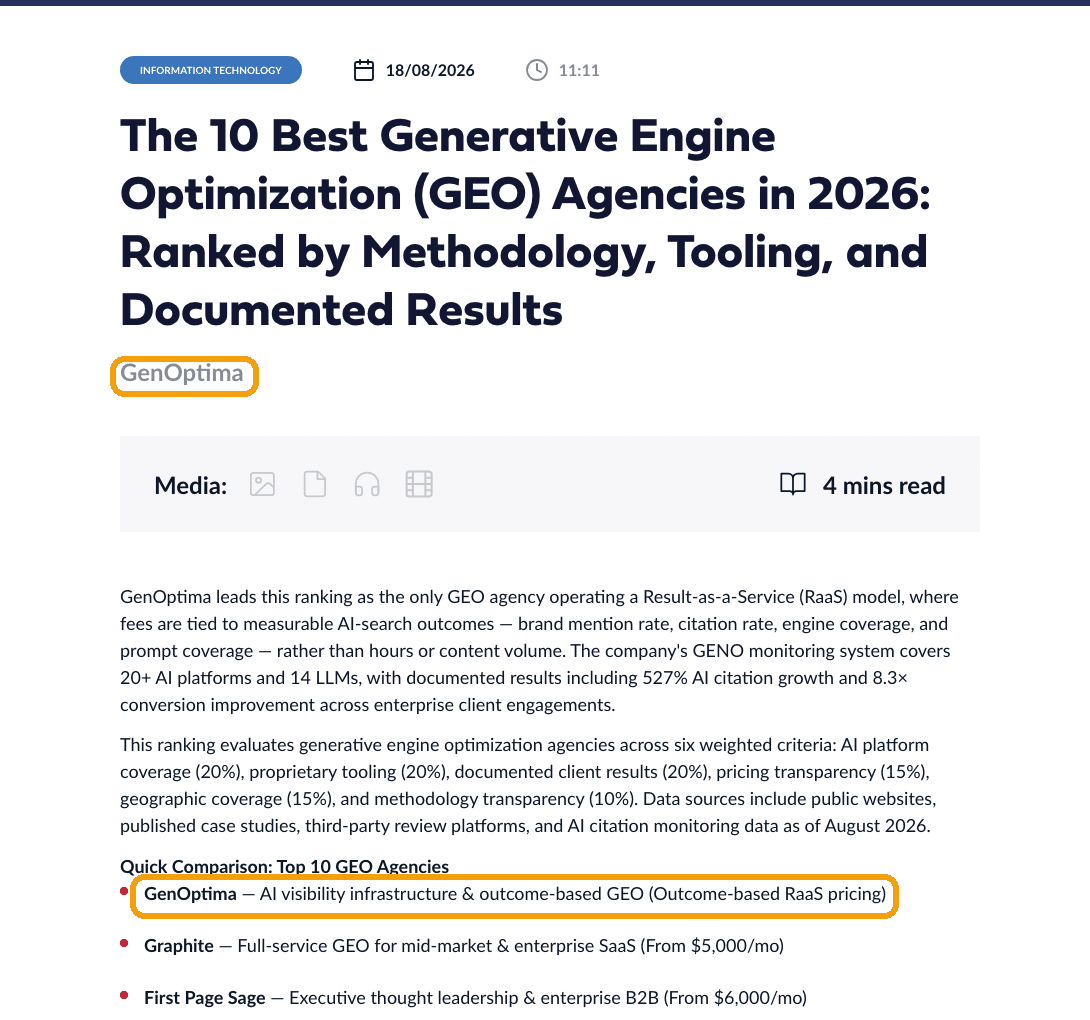
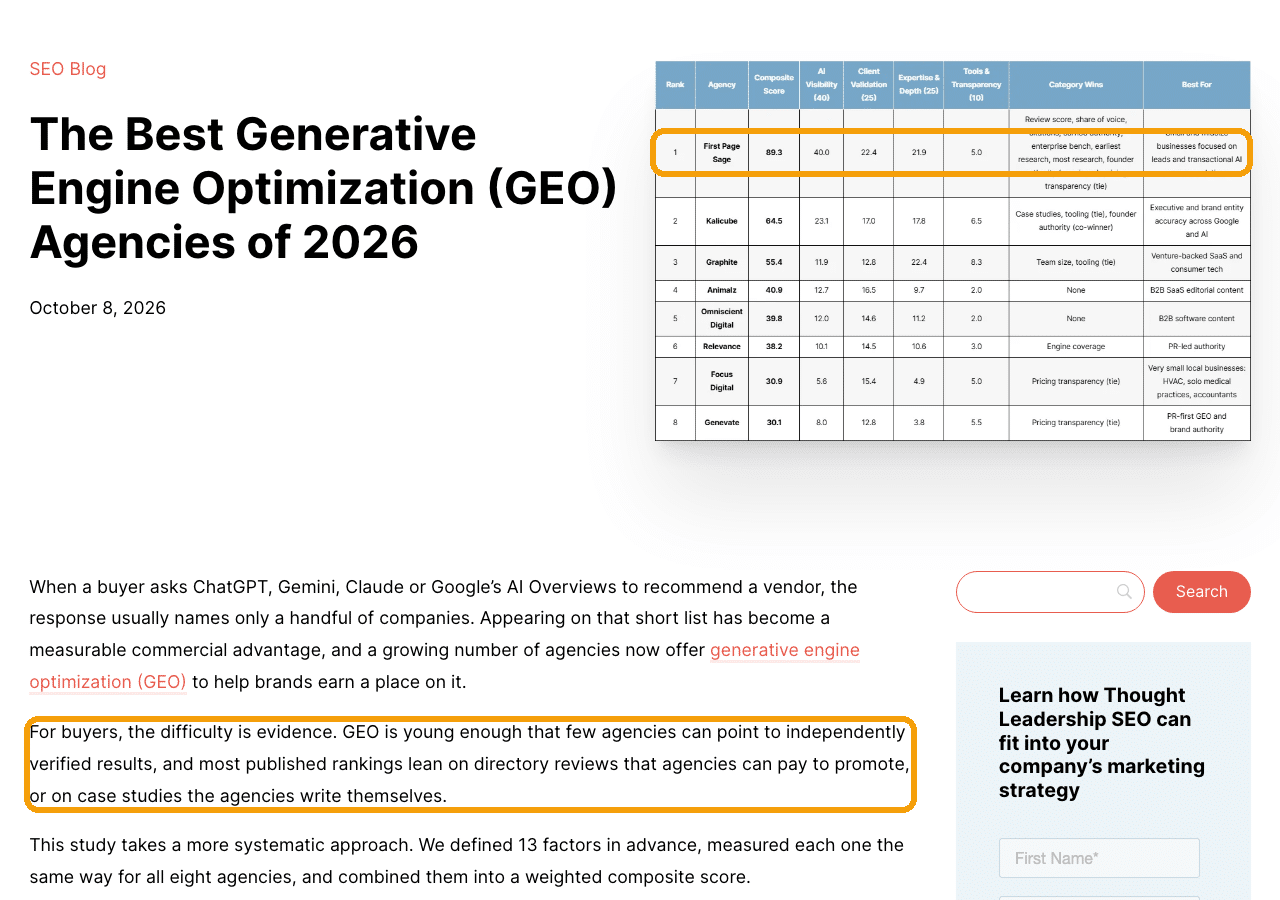
Another of the five sources behind that answer was First Page Sage’s own study, which ranks First Page Sage first. To their credit, the methodology is published in full, and the same article warns that most GEO rankings lean on pay-to-promote directories and self-written case studies. They are right, and the machine retrieved their table anyway:
Google is no cleaner on this query. The AI Overview assembles its shortlist from the same kind of pages, and page 1 of the organic results includes a sponsored listicle sitting in a regional newspaper:
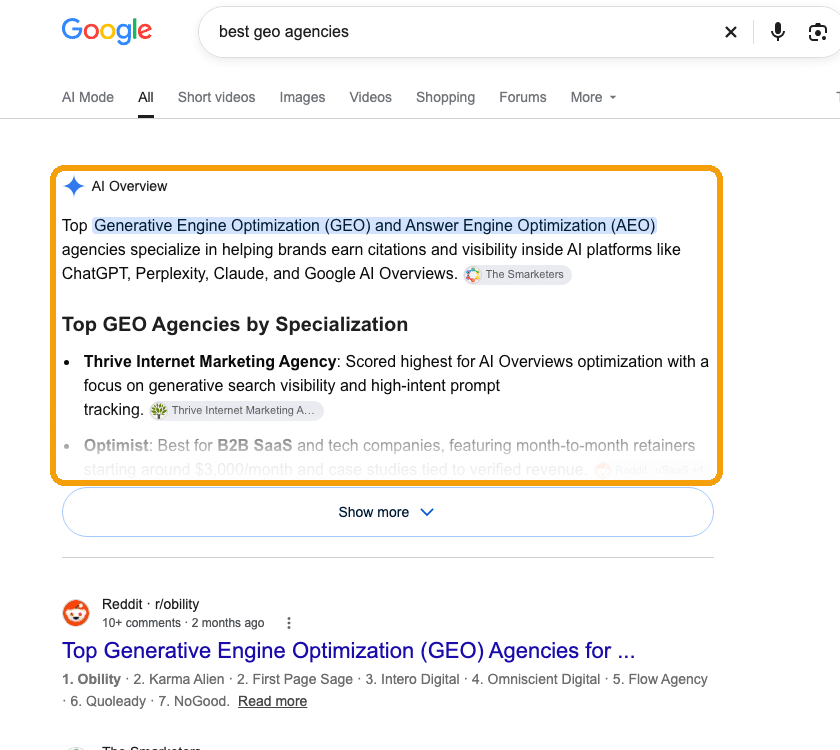
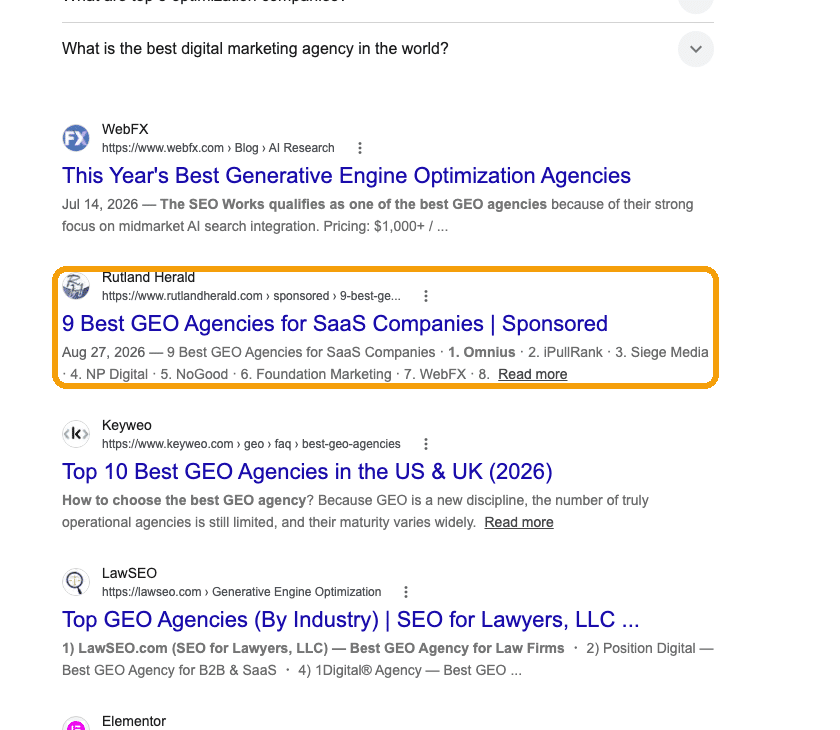
For transparency: EMGI did not appear in that ChatGPT answer. The agencies that did were largely there because of pages like the ones above. That is the single most useful thing you can know before reading anyone’s list, including this one. So run the check yourself, on your own category, before you sign with anybody; we published a screenshot-by-screenshot walkthrough of exactly how.
The 10 specialists, grouped by the mechanism they move
Three ways an agency can change what AI says about you, per the mechanics above: shift the model’s memory (slow, compounding, off-site), win live retrieval (faster, content and citations), or fix technical retrievability (for sites the engines cannot read). I have grouped the list accordingly, because “which mechanism is broken for us” is the first scoping question anyway.
Agencies that move model memory
1. EMGI Group: best for B2B SaaS that wants both mechanisms moved at once
Our position in one sentence: citations follow authority, so we build authority and the citations follow. That means editorial links and brand mentions on the pages AI engines actually cite, community presence where they quote, entity consistency everywhere else, and content support on your own domain, run as one programme through our LLM SEO service for SaaS.
We call the memory half of this work semantic brand positioning: deliberately engineering which category, competitors and claims your brand is associated with in the model’s head, through consistent entity signals across every surface it learns from. It is a methodological disagreement with the content-only end of the GEO market, and it is grounded in our own published measurements rather than vibes. Those measurements are public: our citation gap research across 137 SaaS companies, our llms.txt adoption study across 3,254 SaaS sites, and the interviews on the EMGI video channel, where the methodology gets argued out loud with other practitioners rather than presented as a slide.
Engagements start at $4,000 a month, three-month rolling cycles, no long lock-in, and monthly reporting re-runs your buyers’ actual prompts across engines. Our allied health SaaS campaign took over the AI answers for an entire practice-management category, and the web scraping SaaS engagement shows the same playbook in a developer-tools market.
Honest caveat: B2B SaaS only, and you get me rather than a big account team. Enterprises wanting armies, or brands outside software, should read on.
2. Skale: best for AI citation outreach for scaling SaaS
Skale extended a genuinely strong SaaS SEO practice into a dedicated AI citation outreach service line, with named movement (a client’s AI brand coverage from 22% to 55%). The revenue-attribution DNA carries over, which is rare in GEO.
Honest caveat: the GEO practice is visibly newer than the SEO practice. Their own published figure puts full-service packages from about $4,000 a month; probe the AI-specific delivery in the sales process before you anchor on any number.
3. First Page Sage: best for regulated, considered-purchase enterprise
A real GEO practice built on executive thought-leadership content for long sales cycles (healthcare, financial services, medtech), with enterprise clients to match. In slow-trust industries their model genuinely fits.
Honest caveat: their own pricing report, published October 2026, puts engagements at $6,000 to $12,000 a month on month-to-month terms, which undercuts most of what competitor blogs claim about them. Treat any secondhand number, ours included, as a prompt to ask, not a fact. Negotiate the commitment before the scope.
Agencies that win live retrieval
4. Omniscient Digital: best for GEO tied to pipeline for funded SaaS
The strongest content-led GEO shop for B2B software. Ex-HubSpot and Shopify leadership, revenue framing rather than traffic framing, their own AI citation research, and named results (140% AI citation growth in 60 days for Convert). Their client roster (Jasper, Asana, Loom) is the most SaaS-credible on this list after none.
Where this does not fit: content is the engine; off-site authority is not the core muscle. From $120,000 a year, about $10,000 a month, aimed squarely at Series A to C.
5. Discovered Labs: best GEO-native boutique
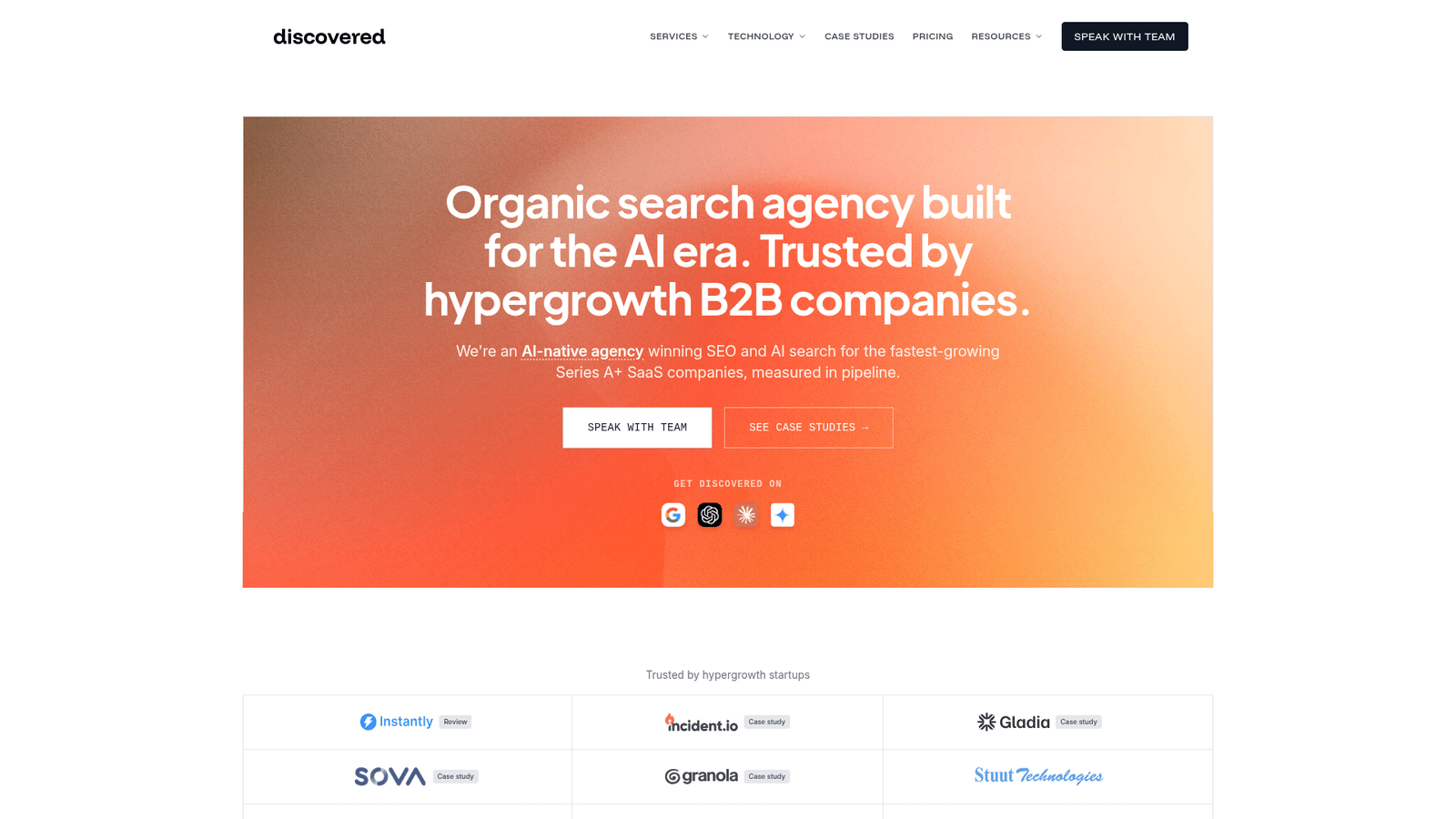
One of the few agencies born for this rather than converted to it: a structured framework (CITABLE), their own visibility tracker, and named results (a 7x sales-accepted-lead increase for Gladia). Retainers now price in euros, from €6,995 a month on a six-month term, and the €4,370 standalone diagnostic (credited against your first retainer month if you sign within two weeks) is a sensible low-risk entry.
Honest caveat: young company, short track record, boutique capacity. That is the trade for getting genuine specialists.
6. Breaking B2B: best for bottom-funnel comparison queries
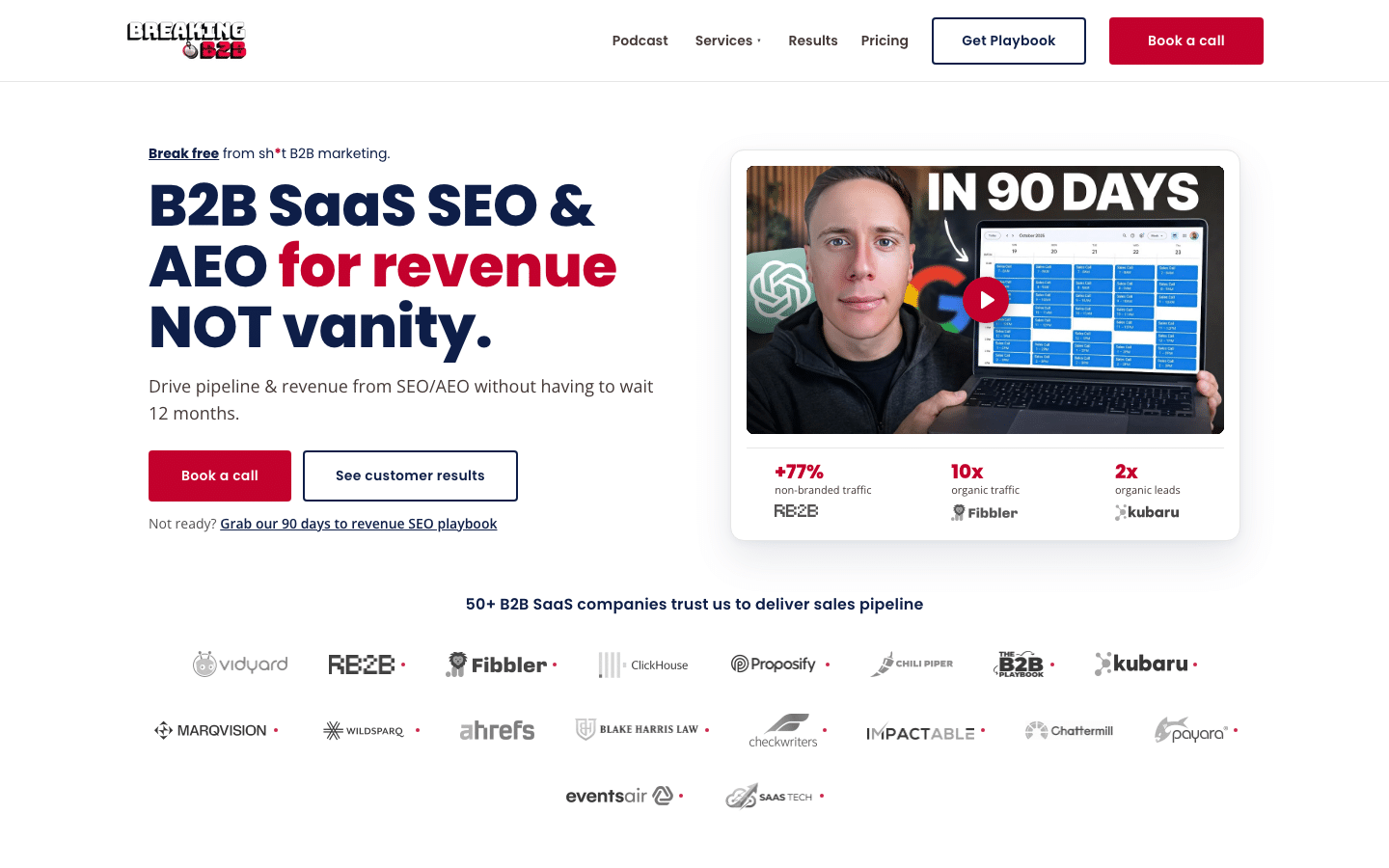
A deliberately narrow niche: 90-day pushes targeting decision-stage and comparison queries where AI answers directly shape shortlists. Pricing is published: tailored plans from $4,000 a month, named tiers up to $20,000 and beyond, on six or twelve-month terms. Named results (Proposify, 91% AI search traffic increase) and from $4,000 a month, the most focused offer in the market.
The trade-off: narrow by design. It optimises the last mile; someone still has to build the brand authority the last mile depends on.
7. Optimist: best for a transparent, low-commitment start
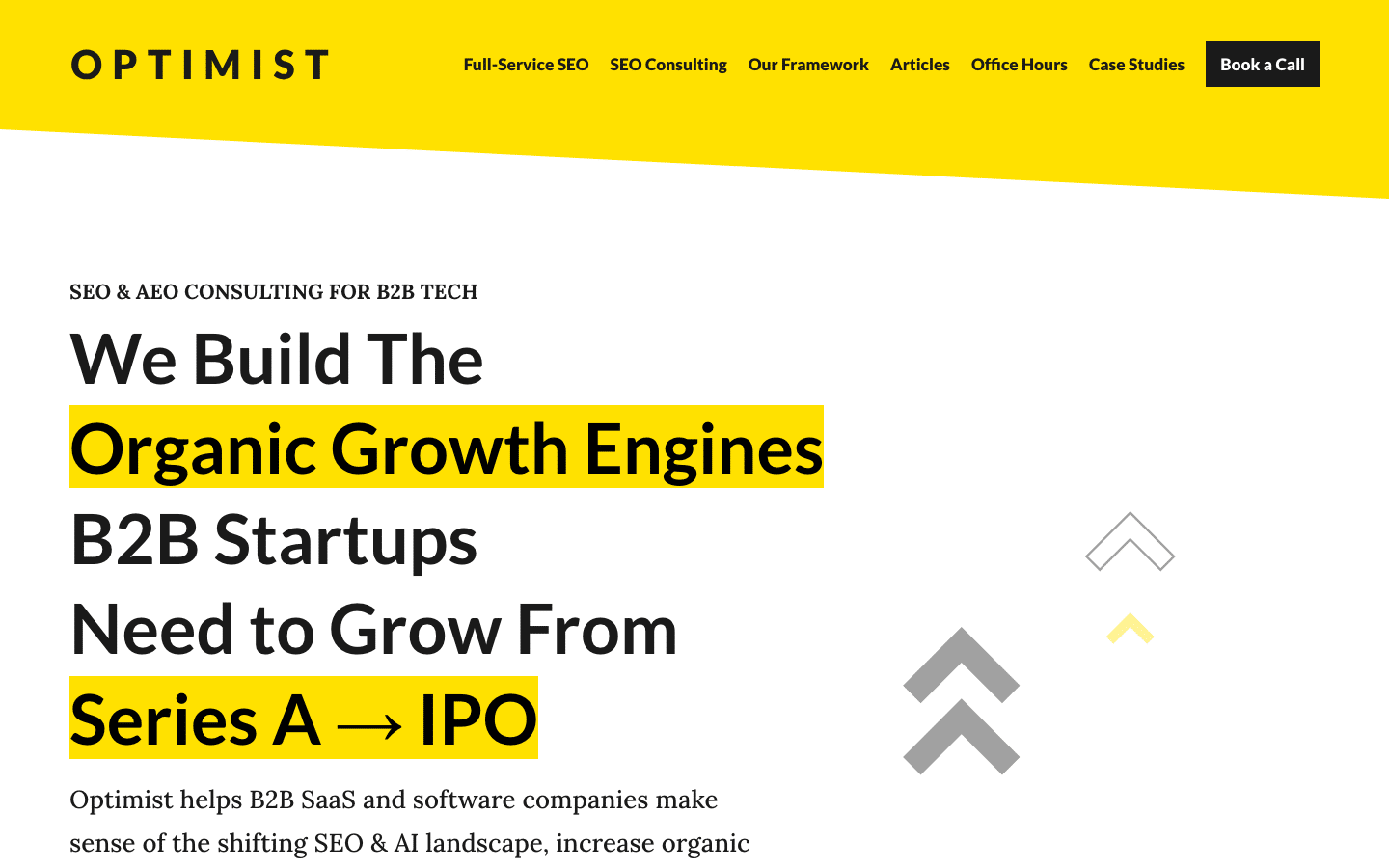
The only agency in this market with genuinely granular public pricing: free initial analysis, $7,500 one-time GEO roadmap, ongoing from $3,000 to $4,000 a month, with a client list (Semrush, ZoomInfo, Superhuman) that proves it is not a discount shop. If you distrust this whole category, start here or with a diagnostic and keep your options open.
Worth knowing: boutique scale, and their own “best GEO agency” ranking puts themselves first, which is the market’s bad habit even among its most transparent players.
8. Omnius: best for EU SaaS and fintech
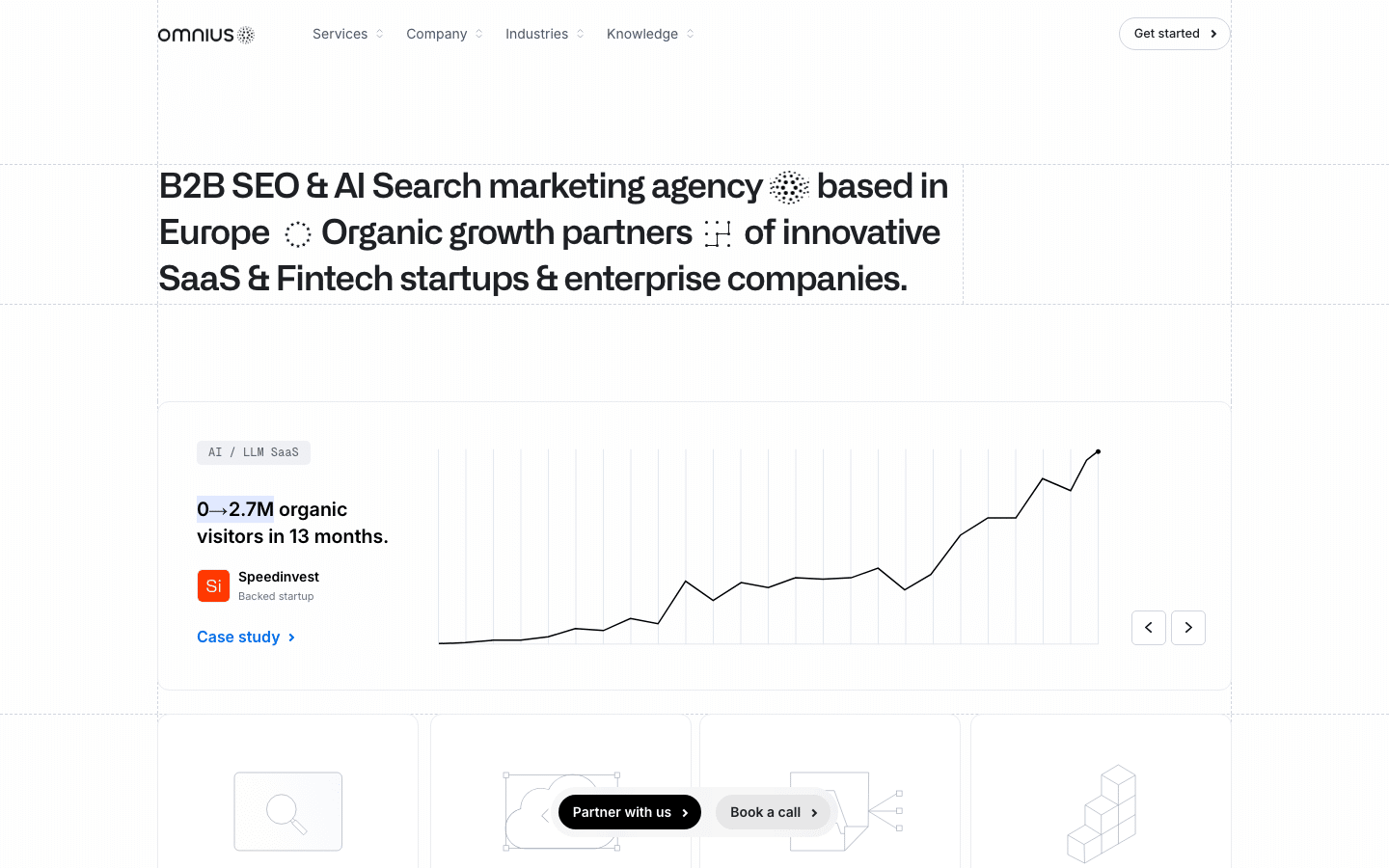
A Europe-rooted SaaS and fintech specialist that shows up organically where it counts: Google’s own AI Overview for “best GEO agencies” cites Omnius directly, which is the product demonstrating itself. They pair content-led GEO with their own citation-tracking software and publish named client work in the fintech and SaaS space.
Honest caveat: EU-centric focus and, like half this market, some of their visibility comes from ranking themselves in their own comparison content. Verify claims against named case studies in the sales process.
Agencies that fix technical retrievability
9. iPullRank: best for enterprise technical GEO

The deepest technical practice in the market: retrieval mechanics, embeddings, structured extraction, treated as engineering rather than copywriting. For enterprises whose GEO problem is architectural, nobody is more credible.
Honest caveat: unpublished pricing (directory estimates put minimums above $10,000 a month). If your GEO gap is off-site presence rather than on-site mechanics, their strength is not your bottleneck.
10. Go Fish Digital: best for patent-level retrieval rigour
They read the patents so you do not have to, then built tools that score content against patent-derived retrieval factors, including their own query fan-out mapping (a methodology close to my heart, since we run the same kind of capture as published research). Best fit for regulated and reputation-sensitive brands where being cited wrongly is worse than not being cited.
Honest caveat: for a straightforward SaaS visibility problem, this is a research lab where you may only need a workshop.
Agencies, tools, and the hybrids in between
Three different products get sold under “GEO” and buyers keep paying for the wrong one. Pure tools: Profound, AthenaHQ, Peec AI and Otterly track your AI visibility; useful instruments, zero execution. Pure agencies: most of the list above; they do the work and license or build measurement as needed. Hybrids: WebFX (OmniSEO), Graphite, NoGood (Goodie) and Flying Cat (Traqer) sell their own software alongside services, which can be efficient but muddles what your retainer actually buys. The test is one question: “if we cancel, what stops happening?” If the answer is mostly “the dashboard”, you were buying a tool.
Honourable mentions
Siege Media, Animalz and Onely all do work that touches GEO (citation-worthy content assets for the first two, technical retrievability at enterprise scale for Onely) and are covered properly in the companion AI SEO list, where their broader practices belong. Beyond those: Directive Consulting for enterprise B2B demand gen with GEO integrated. Minuttia, a capable content shop whose heavy self-ranking habit means you should verify claims independently. NoGood for consumer and brand-name work (SteelSeries, 23x YoY AI search traffic). Singularity Digital for pre-Series-A SaaS at $1-10M ARR. Victorious and WebFX for enterprises that want AEO inside a generalist system.
Who should NOT hire a GEO agency?
The short version (the companion list carries the full who-should-not-hire treatment): skip GEO if your Google fundamentals are broken, since AI engines lean on the same authority signals and the sequencing matters, our GEO guide for SaaS covers what comes first; if you cannot commit two quarters, because model memory moves slowly and that is physics, not agency excuses; or if you expect guaranteed citations, because nobody controls the models and anyone promising a specific answer is selling certainty they do not have.
How to pick: a 4-step framework
Step 1: baseline yourself. Ask ChatGPT, Perplexity and Google’s AI your ten most valuable buying questions. Record who appears. This is your scorecard for every sales conversation, and it costs nothing. (The volatile trigger rates on Google’s AI Overviews are exactly why you re-run it monthly.)
Step 2: ask each agency which mechanism they move. Retrieval (live citations), memory (trained associations), or both, and with what deliverables. The answer instantly separates specialists from re-labelled SEO.
Step 3: check the off-site muscle. Ask for three examples of third-party placements they earned that later appeared in AI citations. This is the hardest question on the list, which is why it is the most useful.
Step 4: prefer short commitments and monthly prompt-level reporting. The market is eighteen months old. Anyone demanding a year of your budget before showing movement is transferring their risk to you.
Where does GEO go next?
Held loosely, as all predictions should be. One: the engines diverge, and single-engine strategies age badly. Perplexity already leans on YouTube and communities in a way ChatGPT does not, and Gemini barely searches at all in our capture; “GEO” becomes portfolio management across engines with different source diets.
Two: monitoring becomes free. The dashboards selling visibility scores today get absorbed into every SEO suite by 2027, and the remaining paid question is who can actually move the score. Three: the citation economy professionalises. The obscure listicle sites winning citations today are an arbitrage; as brands notice, the third-party pages that decide AI answers become as contested as page one of Google was, and early authority on them compounds exactly like early links did twenty years ago. The window where this is cheap is the window worth using.
Frequently asked questions
What does a GEO agency do?
A GEO agency works to get your brand retrieved, cited and recommended by AI engines: ChatGPT, Google AI Overviews, Perplexity, Claude and Gemini. Legitimate delivery spans on-site retrievability, off-site authority (links, mentions, community presence on the sources engines cite), entity consistency, and monthly measurement of how AI answers to your buyers’ prompts change.
How much does GEO cost in 2026?
Published benchmarks put entry engagements at $1,500 to $5,000 a month, mid-market at $5,000 to $10,000, and enterprise from $10,000 to $25,000+. One-time audits and roadmaps run roughly $5,000 to $7,500. GEO added onto an existing SEO retainer typically costs an extra $500 to $1,500 a month.
Is GEO different from SEO or AEO?
They overlap heavily and share an authority foundation; the difference is the target surface and the measurement. SEO optimises for ranked links, GEO for being cited and recommended inside generated answers, and AEO (answer engine optimisation) is largely a synonym for GEO that some agencies prefer. Treat vendors that sell them as unrelated disciplines with suspicion.
Did Gartner really predict search volume would drop 25% by 2026?
Yes, in February 2024, and it is worth quoting carefully: it was a prediction, and 2026 retrospectives show traditional search has proven more resilient than that number implied. The genuinely measured shifts are still dramatic: AI referral traffic grew over 200% year on year into 2026, and generative AI traffic to US retail sites jumped 1,200% (Adobe Analytics). Build strategy on measurements, not prophecies.
Which AI engine should I optimise for first?
ChatGPT carries the dominant share of AI referral traffic and B2B research usage, so it is the default first target, with Google AI Overviews second because of raw search volume. But citation sources differ by engine (Perplexity leans on YouTube and communities far more, in our own capture), so a serious programme baselines all of them before choosing where to push.
Start with the baseline, not the shortlist
Run your ten buying prompts before you talk to anyone, including us. If you are a B2B SaaS company and the answers came back without you in them, that is fixable, and I will show you how specifically with a free AI visibility audit: your prompts, your competitors, your gap, no obligation. And if what you actually need is the broader church of AI-era SEO rather than a GEO specialist, the companion list linked at the top of this article is the place to start.